Two US Service Members Killed in Iranian Strike on Jordan Base
The Jordan strikes left two US service members killed and one missing after an Iranian ballistic missile and drone attack on a military base in Jordan on July 17. [2] Four other US service members were medically evacuated to Jordanian hospitals but have since been discharged, with additional personnel treated for minor injuries and returned to duty. [4] The deaths mark the first American casualties from direct Iranian fire since the opening days of the conflict that began on February 28, bringing the total US military deaths to 16. [1]
Casualties from Iranian Strike on Jordan Base
US Central Command stated that two service members in Jordan were killed in action as CENTCOM and partner forces defended against Iranian ballistic missile and drone attacks on July 17. [2] One service member remains missing in action. [4] Four American service members were medically evacuated to Jordanian hospitals and have since been discharged. [3] Other personnel evaluated for minor injuries have returned to duty. [2] CENTCOM will withhold additional information, including the identities of the fallen warriors, until 24 hours after the next of kin have been notified. [4] US Defense Secretary Pete Hegseth wrote that the soldiers killed in action stiffen resolve. [4] The announcement came as the first US confirmation of casualties resulting from renewed Iranian strikes on US forces. [2]
Context of the US-Iran Escalation
Iran has suspended its participation in a preliminary memorandum of understanding signed with the US a month ago. [1] Supreme Leader Mojtaba Khamenei accused President Trump of violating the deal and stated that Tehran has “unforgettable lessons” in store. [3] Khamenei said America’s attacks proved to everyone how worthless and unreliable the signature of the US President is. [1] Iran’s deputy foreign minister Kazem Gharibabadi announced that the country had entirely suspended its participation in the peace deal after the United States violated the agreement. [3] The collapse of the ceasefire deal followed a struggle between Washington and Iran for control of the Strait of Hormuz. [1] The prolonged fighting has increased pressure on the Trump administration to bring the conflict to an end while avoiding a wider and prolonged war in the Middle East. [3]

Two US service members were killed in an Iranian missile and drone strike on a military base in Jordan. — Source: aljazeera
Iranian Strikes Across Gulf States
Iran launched strikes on US bases and infrastructure in Kuwait, Bahrain, Jordan, and Saudi Arabia in retaliation for a week of US attacks. [1] The secretary-general of the Gulf Cooperation Council, Jasem Mohamed Albudaiwi, accused Iran of committing war crimes with attacks on civilian infrastructure including water desalination plants. [1] Kuwait said Iran had struck a water desalination plant for the second time in two days, and the Gulf state relies on such facilities for 90 per cent of its drinking water. [1] Flights were suspended at Kuwait International Airport because of the missile and drone attack, which also injured several oil-plant workers according to the state-owned Kuwait Petroleum Corporation. [1] Iran fired at a US military base in the city of Al-Kharaj east of Riyadh and the Red Sea port of Yanbu in the first attacks on Saudi Arabia for three months. [1] The IRGC said it had carried out strikes on US combat aircraft at Sheikh Isa Air base in Bahrain and destroyed fighter jets in the US base of Al Azraq in Jordan. [1] Iraq said it intercepted attack drones over Irbil while Jordan reported its air defence systems shot down Iranian missiles. [3] Air raid sirens also sounded repeatedly in Bahrain and in parts of Saudi Arabia. [3]
US Military Operations in Iran
Iranian strikes hit civilian infrastructure including water desalination plants in Kuwait and Saudi Arabia. [1] US strikes were also reported to have damaged a desalination plant in Iran’s southern province of Jask. [1] On Friday night the US military struck roads and bridges in southern Iran as part of an attempt to isolate the ports through which Tehran brings vitally needed supplies into the country. [1] CENTCOM deployed fighter jets and drones to hit surveillance sites, military logistics infrastructure, underground weapons storage and maritime capabilities in the overnight strikes. [1] Iranian state television said that the US had also hit a desalination plant in the southern province of Jask leaving 10,000 people without access to drinking water. [1] Iranian media reported that US airstrikes hit electricity and desalination infrastructure in the southern Hormozgan province. [3] The official IRNA news agency said the Bonji desalination plant was destroyed disrupting water supplies to around 10,000 people while another desalination facility on Qeshm Island was damaged. [3] Iranian media also reported overnight strikes damaged tunnels and bridges on a key highway leading to Bandar Abbas. [3] IRNA said three bridges including one on the route to Bandar Abbas were struck on Saturday. [3]
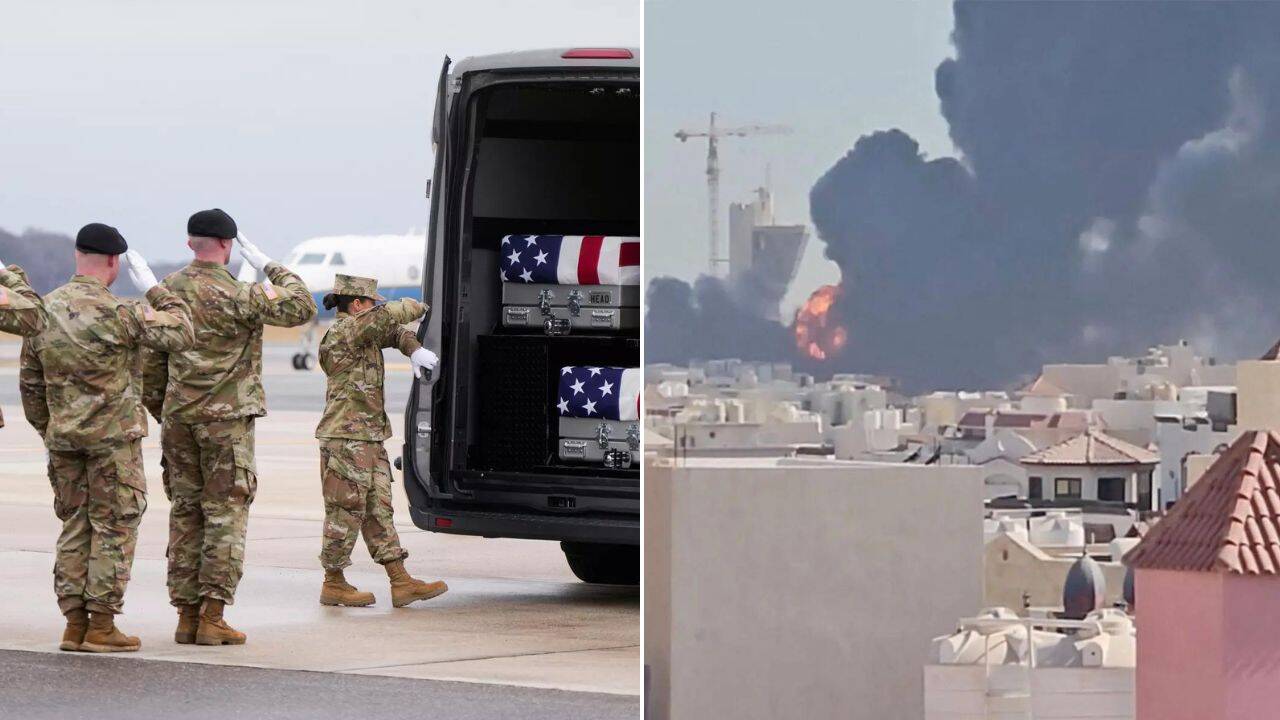
Two US service members were killed and one remains missing after Iranian missile and drone attack on Jordan base. — Source: timesofindia
Official Reactions and Statements
Iranian Supreme Leader Mojtaba Khamenei slammed US attacks in a statement shared on Saturday saying that they proved that US President Donald Trump’s signature was worthless and invalid. [2] The IRGC said that since there is no international institution to prevent the savagery of the US military there is no path before Tehran except the Quranic command to attack in the same manner. [1] The head of the Gulf Cooperation Council slammed recent Iranian attacks on Jordan Kuwait and Bahrain as a war crime and highly dangerous escalation saying that the strikes included the targeting of civilian infrastructure. [2] Legal experts have said such attacks by both sides violate international law. [2] Iranian authorities said at least 50 people have been killed and more than 500 injured in US strikes over the past three weeks including eight people killed in a bridge strike on Friday. [3] US officials also acknowledged that 13 additional American service members including 10 Army soldiers and three Navy sailors had been injured since Monday but did not provide further details. [3]
Regional Impact and Outlook
The conflict has increasingly centred on the Strait of Hormuz where the United States and Iran have exchanged attacks on military and infrastructure targets. [3] The confrontation has disrupted commercial shipping through one of the world’s most critical energy corridors while raising concerns over civilian infrastructure including desalination plants supplying drinking water. [3] The heaviest reported damage from Iranian strikes on Saturday was in Kuwait where authorities said a water desalination plant and an oil facility were hit. [3] Kuwait also reported injuries to firefighters and workers responding to separate fires triggered by the strikes. [3] The country briefly closed its airspace because of missile threats while Kuwait Airways rescheduled most flights. [3] Danny Citrinowicz a former senior Israeli intelligence official said that it was not yet impossible to halt the slide towards all-out war. [1] He said both sides are remarkably managing to escalate but still preserving the rules of the game neither is escalating in a way that would make returning to negotiation too hard. [1]
What to watch next: Observers have watched escalating attacks between Iranian and US forces with growing alarm warning that people across the region would suffer from a return to war while the fighting has also intensified around the Strait of Hormuz after Iran effectively closed the strategic waterway to commercial shipping following the outbreak of the war on February 28.