
Taiwan Hands Over $9.4 Million for Kumamoto Earthquake Reconstruction Amid Earthquakes Today
Taiwan donated more than US$9.4 million in public funds to support recovery from the magnitude 7.1 earthquake that struck Kumamoto Prefecture, Japan, on July 28, which killed 38 people and damaged nearly 43,000 homes amid earthquakes today. [1] Taiwan's Ministry of Foreign Affairs commissioned the International Cooperation and Development Fund to manage the donation account, raising the full amount in one month for reconstruction efforts. [1] The July 28 Kumamoto earthquake prompted swift donations reflecting close Taiwan-Japan ties, with contributions from businesses, civic groups, and overseas Taiwanese communities. [1]
Taiwan Delivers Major Donation to Kumamoto Recovery
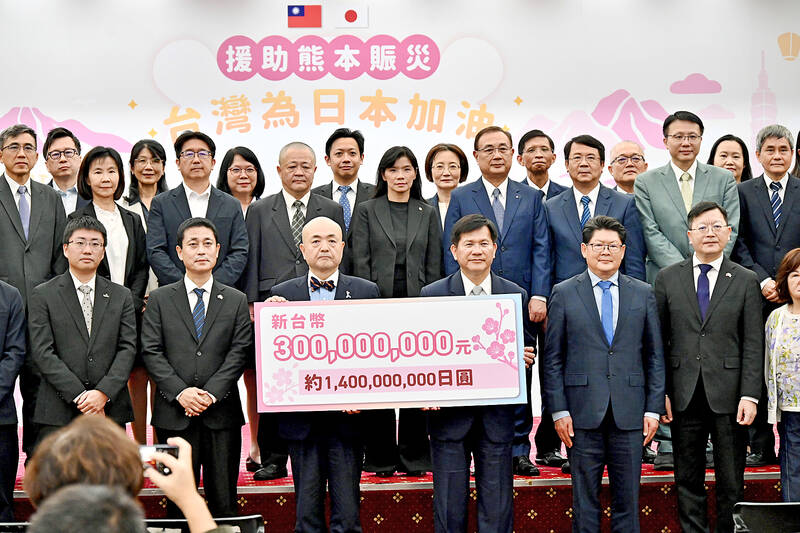
Taiwan yesterday handed Japan more than NT$300 million (US$9.4 million) in public donations to help rebuild communities affected by a magnitude 7.1 earthquake that struck Kumamoto Prefecture in late July. [1] Minister of Foreign Affairs Lin Chia-lung presented the funds to Kazuyuki Katayama, head of the Taipei Office of the Japan-Taiwan Exchange Association, during a ceremony at the Ministry of Foreign Affairs headquarters in Taipei. [1] On Aug. 1, the ministry commissioned the International Cooperation and Development Fund to open and administer a public donation account, marking the first time the ministry had asked the organization to run a public disaster-relief fundraiser. [1] The account raised more than NT$300 million within a month, with the entire amount to be used for recovery and reconstruction, Lin said. [1] “Kumamoto’s safety is a shared concern for Taiwan and Japan,” he said, adding that Taiwan Semiconductor Manufacturing Co (TSMC) and members of its supply chain have established operations there, bringing more Taiwanese to the prefecture to work and live. [1] Lin thanked businesses, civic groups and Taiwanese communities overseas for contributing, saying the response reflected the “family like” bonds between Taiwan and Japan. [1] Katayama thanked Taiwan’s government and people for the donations, saying that the swift and broad response demonstrated the close friendship between Taiwan and Japan. [1] Tomoaki Motojima, who heads a Taiwan-based association representing people from Kumamoto, also expressed gratitude to Taiwanese donors and spoke about the earthquake’s impact and the work needed to rebuild affected communities. [1] Lin said Taiwan and Japan had repeatedly assisted each other following major disasters, including Taiwan’s 1999 Jiji earthquake, Japan’s 2011 Tohoku earthquake and tsunami, the 2016 Kumamoto earthquakes and last year’s Hualien earthquake. [1] “At the moments when we needed each other most, Taiwan and Japan have never been absent,” he said. [1] Lin called for deeper bilateral cooperation on disaster prevention, mitigation, relief and post-disaster reconstruction, adding that both sides face frequent earthquakes and typhoons. [1] Taiwan’s government previously donated NT$5 million for disaster relief, while President William Lai, Vice President Hsiao Bi-khim and Premier Cho Jung-tai each donated NT$200,000 in a personal capacity. [1] TSMC, which operates a plant in Kikuyo, Kumamoto, separately pledged ¥250 million (US$1.6 million) for reconstruction. [1]
Background on the July Kumamoto Earthquake
The July 28 earthquake killed 38 people and damaged nearly 43,000 homes. [1] Minister of Foreign Affairs Lin Chia-lung, front row, third right, Japan-Taiwan Exchange Association Representative Kazuyuki Katayama, front row, third left, Taiwan-Kumamoto Association chairman Tomoaki Motojima, front row, second left, and others attend a donation ceremony for Kumamoto earthquake relief in Taipei yesterday. [1] “Kumamoto’s safety is a shared concern for Taiwan and Japan,” Lin said, adding that Taiwan Semiconductor Manufacturing Co (TSMC) and members of its supply chain have established operations there, bringing more Taiwanese to the prefecture to work and live. [1] Lin thanked businesses, civic groups and Taiwanese communities overseas for contributing, saying the response reflected the “family like” bonds between Taiwan and Japan. [1] Katayama thanked Taiwan’s government and people for the donations, saying that the swift and broad response demonstrated the close friendship between Taiwan and Japan. [1] Tomoaki Motojima, who heads a Taiwan-based association representing people from Kumamoto, also expressed gratitude to Taiwanese donors and spoke about the earthquake’s impact and the work needed to rebuild affected communities. [1]
{IMAGE_2}
History of Mutual Disaster Assistance
Lin said Taiwan and Japan had repeatedly assisted each other following major disasters, including Taiwan’s 1999 Jiji earthquake, Japan’s 2011 Tohoku earthquake and tsunami, the 2016 Kumamoto earthquakes and last year’s Hualien earthquake. [1] “At the moments when we needed each other most, Taiwan and Japan have never been absent,” he said. [1] Lin called for deeper bilateral cooperation on disaster prevention, mitigation, relief and post-disaster reconstruction, adding that both sides face frequent earthquakes and typhoons. [1] Taiwan’s government previously donated NT$5 million for disaster relief, while President William Lai, Vice President Hsiao Bi-khim and Premier Cho Jung-tai each donated NT$200,000 in a personal capacity. [1] TSMC, which operates a plant in Kikuyo, Kumamoto, separately pledged ¥250 million (US$1.6 million) for reconstruction. [1]
Recent Seismic Activity in Indonesia Amid Earthquakes Today
The Meteorology, Climatology, and Geophysical Agency (BMKG) recorded 118 earthquake events in Bandung District and surrounding areas between August 11 and September 17, 2026, as of 8 a.m. local time. [4] BMKG Director of Earthquake and Tsunami Wijayanto said here on Thursday that the 118 earthquakes ranged in magnitude from 1.0 to 3.4, with 13 of them being felt by residents. [4] "A total of 118 earthquake events were recorded, ranging in magnitude from 1.0 to 3.4, while 13 earthquakes were felt in Pangalengan, Talegong, Cisewu, and surrounding areas," Wijayanto said. [4] The felt earthquakes had an intensity of II-III on the Modified Mercalli Intensity (MMI) scale, meaning that the tremors were clearly felt indoors and, in some cases, felt like a passing truck. [4] According to BMKG's analysis, the earthquake epicenters formed a southwest-northeast linear pattern, approximately 5-8 kilometers west of the South Garut Fault's Kendang Segment and north of the Garsela Fault's Kencana Segment. [4] Wijayanto said the earthquakes were shallow and, tectonically, were associated with activity along a local fault in the area. [4] "The distribution of the earthquakes does not lie within the Garsela Fault's Kendang Segment, the Garsela Fault's Kencana Segment, or the Cicalengka Fault, but is located in an area that has not yet been mapped," he said. [4] He said the finding requires further study to identify the earthquake source that triggered the series of seismic activity in Bandung District and surrounding areas. [4] BMKG currently operates 35 seismic sensors across West Java to detect and record earthquake activity, including microearthquakes or small-magnitude earthquakes, with a high level of precision. [4] The agency will continue to monitor the seismic activity and provide updated information to relevant stakeholders and the public. [4] It also urged residents to remain calm and not be influenced by unverified information. [4]
Minor Earthquakes Recorded in the United States
USGS reported a M2.7 earthquake at a depth of 7.8 km located 40 km ESE of Malaga, New Mexico. [2] USGS reported two earthquakes near Nikolski, Alaska (M4.0 at 20.0 km depth and M3.9 at 20.0 km depth). [3] [5] M2.7 Earthquake - 40 km ESE of Malaga, New Mexico. Magnitude 2.7 earthquake at depth of 7.8km. 40 km ESE of Malaga, New Mexico. [2] M4.0 Earthquake - 188 km SW of Nikolski, Alaska. Magnitude 4.0 earthquake at depth of 20.0km. 188 km SW of Nikolski, Alaska. [3] M3.9 Earthquake - 187 km SW of Nikolski, Alaska. Magnitude 3.9 earthquake at depth of 20.0km. 187 km SW of Nikolski, Alaska. [5]
What to watch next: BMKG will continue to monitor the seismic activity and provide updated information to relevant stakeholders and the public while urging residents to remain calm.







