Sudanese Army and RSF Drone Strikes Kill More Than 160 Civilians in Days
A surge in drone strikes by both the Sudanese Armed Forces and Rapid Support Forces has killed more than 160 civilians in recent days as the conflict shifts toward long-range aerial operations targeting supply lines and rear areas.
Escalation of Drone Warfare
Drone attacks in residential areas and markets have killed at least 80 people in al-Dabba, 41 displaced people in Blue Nile province, 17 in Nyala, and three children in Khartoum’s Imtidad Nasser neighbourhood. [1] Residents in the Imtidad Nasser neighbourhood east of Khartoum described hearing the buzz of drones before anti-aircraft fire and explosions struck, killing three children from one family. [1] The use of drones represents a relatively new development in the civil war, pushing operations deep into residential neighbourhoods as both sides seek to exhaust the opponent through long-range preemptive strikes. [1] In one case, a drone struck a transport hub near a market in al-Dabba town in West Kordofan. [1] An army drone attack hit the RSF stronghold of Nyala early on Monday, while a strike by the paramilitary group targeted a gathering of displaced people in Blue Nile province. [1] The United Nations has condemned the strikes, with spokesperson Stephane Dujarric stating that officials are alarmed by the continued deadly drone strikes across the country that are killing civilians, including children, and disrupting central services. [1]
Military Objectives and Battlefield Claims
The SAF has conducted 75 air strikes in Kordofan, West Darfur and South Darfur targeting RSF command centres, fuel depots, supply routes from Libya, Chad and South Sudan, and has downed a drone entering from Ethiopia. [1] Military expert Abu Bakr Abdel Rahim explained that the army’s main motive for escalating drone strikes deep inside the Darfur and Kordofan regions is targeting command and control centres, fuel and ammunition depots, and main supply routes, especially those linked to the borders with Libya, Chad and South Sudan. [1] Geography plays a pivotal role, as the Darfur region is vast and separated from the army’s current concentration areas in Kordofan by desert distances and long, militarily exposed roads. [1] Mohamed Didan, spokesperson for the SAF’s Special Action Forces in Kordofan, stated in a Facebook post that the army launched 75 air strikes targeting fixed and moving targets, along with infantry forces, vehicles, commanders and individuals from the Rapid Support Forces across Kordofan, West Darfur and South Darfur. [1] Didan linked the RSF’s recent drone attacks on Khartoum to their battlefield losses, attributing the escalation to the killing of about 80 mobilised personnel for the forces in strikes that targeted them in the Al-Dabbab area in West Kordofan. [1] The RSF has struck civilian infrastructure including Khartoum airport, fuel stations in Damazin, an electrical transformer in Tendelti causing blackouts, and accuses the army of market massacres. [1] In response, the RSF issued a statement accusing the military of using drones to carry out massacres in the livestock market in Nyala and al-Na’am market in Abyei, and at a truck station in the al-Dabbab area in West Kordofan. [1] A Sudanese government official stated that the army does not target civilians but considers all military and logistical sites and supply lines of the Rapid Support Forces as legitimate targets. [1]
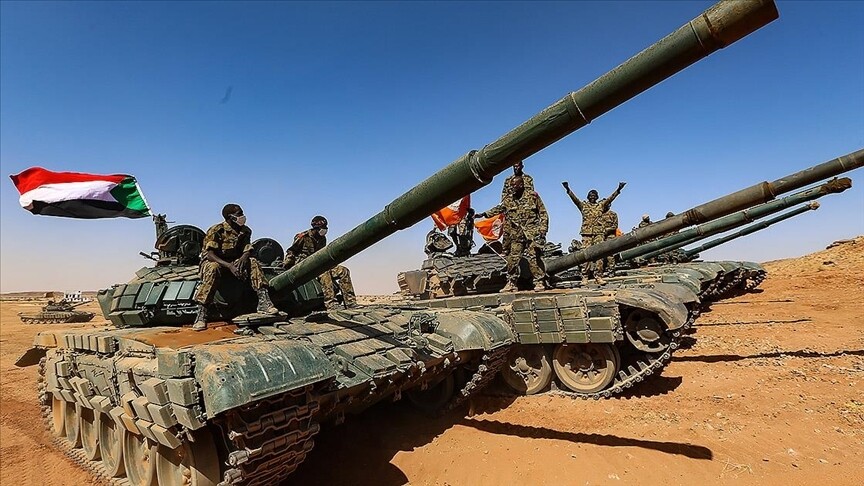
Sudanese army forces retake strategic areas from RSF in Blue Nile state. — Source: anadolu
Territorial Developments in Blue Nile
The Sudanese army has recaptured two strategic areas and a military base in Blue Nile state from the RSF. [2] [3] The army regained control of the Bakori base following clashes with paramilitary forces. [3] Military statements indicate that a drone was detected entering Sudan from Ethiopia, without identifying its operator. [2]
Broader Conflict Context and Displacement
Both sides now deploy multiple drone models sourced from Belarus, Iran, China, Russia, Sudan and Turkiye; the war has displaced 14 million people and killed at least 59,000 since April 2023. [1] The civil war, which began in April 2023, has reached its fourth year. [1] The massacre in el-Fasher in the west of the country last year, described by Amnesty International as ethnic cleansing, propelled the crisis to international headlines after RSF fighters murdered tens of thousands of inhabitants following an 18-month siege. [1] Sudan’s internal balances and past conflict dynamics have contributed to the prolongation of fighting beyond initial expectations. [4] The war’s geographic centre of gravity has shifted toward western Sudan, particularly the Darfur-Kordofan line and border regions. [4] Sudan is increasingly divided into different military and political control areas, with the internationally recognised government returning from Port Sudan to Khartoum in January 2026 while the RSF and its allies formed a parallel administration based in Nyala. [4] That parallel structure has established its own bank and banned the use of new banknotes printed in Khartoum in its regions. [4]
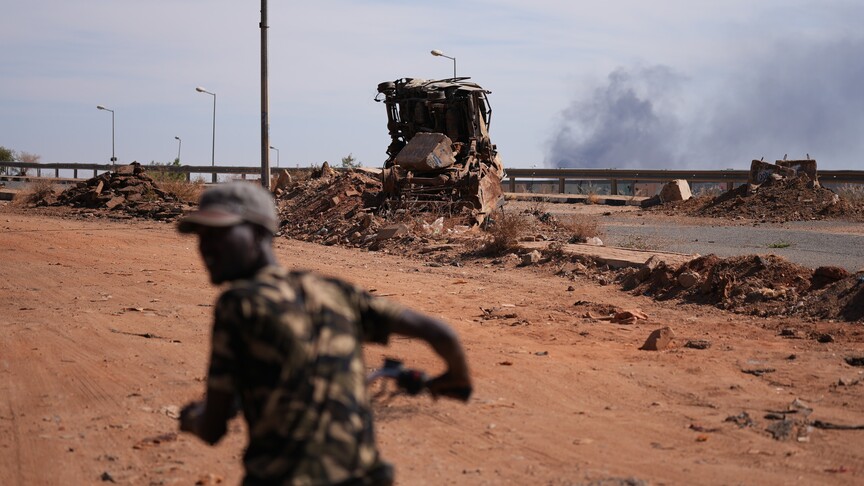
Sudanese army forces recapture strategic military base in Blue Nile region. — Source: anadolu
International Supply of Drones and UN Reaction
An investigative report by the Centre for Information Resilience revealed that 21 different drone models have been used since the war erupted, originating mainly from six countries: Belarus, Iran, China, Russia, Sudan and Turkiye. [1] According to the report, the RSF has deployed 10 different types of drones, while the SAF has used five different models. [1] The United Nations has condemned the strikes that kill civilians and disrupt services. [1]
Internationalisation and Regional Impact
Sudan’s civil war has become far more complex and internationalised than a simple two-sided power struggle. [4] The SAF maintains support relationships at various levels with Egypt, Iran and Saudi Arabia, while the RSF has ties particularly with the United Arab Emirates, though the UAE rejects accusations of providing support. [4] The United States imposed a second round of sanctions on the Khartoum administration on 20 July 2026 after alleging chemical weapons use by the Sudanese army, banning SAF-linked aircraft from using U.S. airspace and opposing international financial institution loans to Sudan. [4] In August 2026 the United States submitted a draft resolution at the United Nations calling for broader sanctions, though a Security Council proposal for a country-wide arms embargo was not adopted due to opposition from Russia and China, while the Darfur arms embargo was extended by two months in October. [4] External actors’ provision of weapons, ammunition, drones, financing and logistics sustains the parties’ fighting capacity. [4] The conflict’s effects extend to neighbouring states, including the Central African Republic. [5]
What to watch next: Continued formation of parallel administrative structures in RSF-controlled areas and the impact of external support on the parties’ ability to sustain operations.