
Strike Ukraine: Russia Launches Missiles and Drones Causing Explosions in Cities
Explosions were heard in multiple Ukrainian cities as Russia launched missiles and drones towards the country.[1] This latest barrage underscores the persistent intensity of aerial assaults in the ongoing conflict, with reports highlighting a significant uptick in such strikes. Over 3,500 air and drone strikes were recorded in March 2026 alone, including a peak of 948 drones launched in a single 24-hour period between 23 and 24 March—the largest such attack since February 2022.[2] These developments have contributed to rising civilian casualties, with 211 killed and 1,206 injured that month.[2] In response, Ukrainian forces have demonstrated defensive capabilities, downing a Russian attack drone on 24 April,[3] while conducting precision counter-operations against Russian targets, including damage to a drone plant in Taganrog and an FSB patrol ship.[5]
Overview of Recent Strikes
The recent Russian missile and drone launches represent a continuation of intensified aerial operations against Ukraine, with explosions reported across multiple cities.[1] These strikes align with a broader pattern of escalation observed in early 2026, as documented in health and conflict monitoring reports.[2] On the ground, the impacts have been immediate and widespread, prompting air raid alerts and defensive activations in urban areas. The kyivindependent's coverage captures the immediacy of the event, noting explosions echoing through cities as incoming threats were detected and partially intercepted.[1]
This overview draws from verified incident reports, emphasizing the scale of the launches. Russia's use of both missiles and drones has tested Ukraine's air defense infrastructure, with the volume of attacks straining response capacities.[2] In March 2026, the total exceeded 3,500 strikes, a marked increase from prior months, according to ACLED data referenced in the Health Cluster Bulletin.[2] Such operations often target infrastructure and civilian-adjacent areas, leading to secondary effects like power disruptions and evacuations, though specific site details remain tied to the explosive sounds reported in cities.[1] The strategic intent appears to overwhelm defenses through saturation tactics, a method refined since the conflict's early phases.
Analyzing the timing, these strikes coincide with seasonal shifts and frontline pressures, maintaining pressure on Ukrainian positions. The repetition in reporting—explosions heard repeatedly across sources—signals a coordinated multi-vector assault, involving launches from multiple directions to complicate interception efforts.[1] This fits into the monthly escalation trend, where drone swarms have become a hallmark, forcing resource allocation across vast airspace.[2]
Escalation in Aerial Attacks
Ukraine experienced a sharp escalation in aerial attacks in March 2026, with over 3,500 air and drone strikes recorded, surpassing the combined totals of January and February.[2] This surge culminated in the record 948 drones launched between 23 and 24 March, marking the largest single 24-hour drone assault since the full-scale invasion began in February 2022.[2] The Health Cluster Bulletin, drawing from ACLED monitoring, highlights this as a pivotal shift, reflecting Russia's adaptation of tactics to maximize disruption.
The data reveals a 49 percent increase in certain metrics as noted by the UN HRMMU, though the bulletin cuts off mid-report; the core figures paint a picture of unrelenting pressure.[2] Civilian casualties spiked accordingly, with 211 fatalities and 1,206 injuries in March, underscoring the humanitarian toll of these operations.[2] Drones, in particular, have proliferated due to their cost-effectiveness and ability to evade radar in swarms, allowing sustained barrages that deplete interceptor stocks.
In the context of strike Ukraine endures, this escalation correlates with static frontline dynamics elsewhere, suggesting aerial campaigns compensate for ground stalemates.[2] The 24-hour drone peak alone would have required extraordinary defensive coordination, likely involving mobile air defense units repositioned to high-threat zones. Such attacks not only cause direct damage but amplify psychological strain on populations, with repeated alerts disrupting daily life and economic activity. The bulletin frames this within health cluster concerns, linking strikes to overwhelmed medical facilities treating blast injuries and shrapnel wounds.[2]
Ukrainian Defensive Measures
Ukraine's Air Force showcased its defensive prowess by downing a Russian attack drone on the morning of 24 April, releasing video footage of the fiery interception.[3] The footage depicts a Shahed drone—commonly used in Russian strikes—engulfed in flames against the dawn sky, confirming a successful engagement amid ongoing threats.[3]
This incident exemplifies routine yet critical defensive actions, where electronic warfare, anti-aircraft missiles, and fighter intercepts neutralize incoming threats. The ukrainskapravda report emphasizes the visual proof provided by the Air Force, bolstering public morale and signaling operational readiness.[3] In the broader strike Ukraine scenario, such downings prevent potential strikes on urban or infrastructure targets, preserving lives and assets.
Defensive measures extend beyond single events; they form a layered system integrating radar detection, ground-based systems like Patriot or NASAMS, and aviation assets. The 24 April downing occurred during morning hours, a common launch window for drones exploiting low light. By publicizing the video, Ukraine's military not only documents efficacy but deters adversaries by revealing interception capabilities.[3] This aligns with patterns where hundreds of drones are launched monthly, yet a significant portion are neutralized before impact.[2]
Ukrainian Counter-Operations
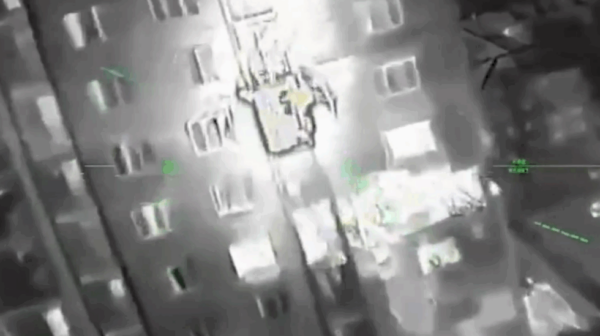
Ukrainian forces executed a high-precision strike on an apartment in occupied Donetsk, deploying a "train" of eight drones to target an alleged housing unit for 12 FSB officers.[4] Described in euobserver's battlefield update on Day 1,520, the operation highlights innovative tactics amid a largely static front.[4] Simultaneously, Ukraine's General Staff confirmed damage to the Atlant Aero drone plant in Taganrog, Russia, and an FSB patrol ship in temporarily occupied Crimea.[5]
These counter-operations demonstrate Ukraine's ability to project force deep into enemy territory using long-range drones and missiles. The Donetsk strike involved sequential drone entries into the apartment, maximizing destructive effect against high-value personnel.[4] In Taganrog, the Atlant Aero facility—key to Russian drone production—sustained confirmed hits, disrupting manufacturing capacity.[5] The FSB patrol ship strike in Crimea further targets occupation enforcers, eroding naval presence in the Black Sea region.[5]
The ukrainskapravda update from the General Staff provides official validation, linking these to broader special operations.[5] While the front remains static, with personnel shortages noted in areas like Kostyantynivka,[4] such strikes maintain offensive momentum. They counter the aerial escalation by hitting production nodes, potentially reducing future drone launches.[2][5]
Impact on the Ground
The escalation in strikes has profoundly affected ground conditions, with civilian casualties in March 2026 reaching 211 killed and 1,206 injured—a sharp rise driven by over 3,500 attacks.[2] These figures, from ACLED via the Health Cluster, reflect intensified targeting of populated areas, straining emergency services.[2]
In occupied Donetsk, the Ukrainian drone strike on FSB officers illustrates reciprocal violence, where precision hits minimize collateral but heighten tensions.[4] Battlefield footage reveals static lines punctuated by such events, with Ukrainian defenders in Kostyantynivka facing personnel shortages amid ongoing pressures.[4] Civilian impacts extend to health crises, as medical bulletins note overwhelmed facilities treating surge injuries.[2]
The ground dynamics reveal a war of attrition: Russian aerial dominance met by Ukrainian counters, sustaining high costs on both sides. Civilian tolls underscore the bulletin’s focus on humanitarian needs, with injuries from shrapnel and blasts dominating caseloads.[2]
What to watch next: Monitor Ukraine's air defenses for responses to potential drone swarms exceeding recent peaks, alongside confirmation of further damage assessments on Russian drone facilities and patrol assets, as frontline staticity persists.[2][4][5]