Strike Palestine: UK Activists Break Into Israeli Weapons Factory
UK pro-Palestine activists, in what has been described as part of ongoing Strike Palestine efforts, broke into an Israeli weapons factory, accessing the site by breaking through the roof and abseiling down before police intervened, resulting in six arrests at the scene.[4] This incident highlights a series of direct actions targeting facilities linked to Israel's military industry, amid broader pro-Palestine activism across Europe and beyond. Parallel developments include legal proceedings against European activists and public endorsements for the groups involved, alongside diplomatic steps toward infrastructure recovery in Palestinian territories.[1][2][3][4]
UK Pro-Palestine Activists Raid Israeli Weapons Factory
The break-in at the Israeli weapons factory by UK pro-Palestine activists represents a high-profile direct action in the Strike Palestine campaign. Activists gained entry by breaking through the roof of the facility, a method that allowed them to descend via abseiling into the premises.[4] Police response was swift, leading to the arrest of six individuals directly at the scene, underscoring the immediate law enforcement involvement in such operations.[4]
This event aligns with tactics employed by groups like Palestine Action, which have targeted sites associated with Israel's defense sector. The factory in question is linked to Elbit Systems, identified as Israel's largest weapons manufacturer, though the specific UK site raid draws from reports of activists physically breaching security perimeters in a dramatic fashion.[2][4] Such actions aim to disrupt operations at facilities perceived as contributing to military supplies, reflecting a pattern of civil disobedience in pro-Palestine advocacy. The arrests highlight the legal risks faced by participants, with on-site detentions ensuring rapid accountability under local laws.[4]
Details from the incident reveal the activists' commitment to high-visibility protests, as breaching the roof and abseiling required planning and execution under pressure. This approach not only draws media attention but also amplifies the message against arms production linked to the region.[4] In the broader context of Strike Palestine initiatives, this raid serves as a focal point, connecting domestic activism in the UK to international solidarity efforts.[4]
Overview of Recent Pro-Palestine Actions
Recent pro-Palestine actions have encompassed raids on facilities connected to Israel's arms industry, with notable incidents in both the UK and Germany. In the UK, activists broke into an Israeli weapons factory, entering through the roof and abseiling inside, which prompted six arrests by police at the location.[4] This operation exemplifies the direct confrontation style adopted by groups challenging military supply chains.
Complementing this, five European activists, referred to as the 'Ulm Five,' conducted a raid on a site linked to Elbit Systems, Israel's largest weapons maker.[2] These individuals are now facing trial in Germany for their involvement, marking a significant legal escalation in response to such activism.[2] The 'Ulm Five' case illustrates how cross-border actions can lead to prosecutions in European jurisdictions, where authorities address breaches at defense-related sites.
These events share common threads: targeting Elbit-linked facilities, which are central to Israel's defense production, and employing invasive tactics to halt operations temporarily.[2][4] The UK raid's rooftop entry and the German site's incursion both prioritize disruption over symbolic protest, leading to immediate arrests and trials.[2][4] Reports indicate these actions are coordinated under banners like Palestine Action, amplifying their impact through synchronized efforts across countries.[2][4]
The sequence of these raids—UK break-in followed by ongoing German proceedings—demonstrates a sustained campaign. Each incident builds on the previous, with arrests serving as both a deterrent and a platform for further publicity.[2][4] Law enforcement's role remains consistent, from on-scene detentions in the UK to formal trials in Germany, reflecting varying national responses to the same activist strategy.[2][4]

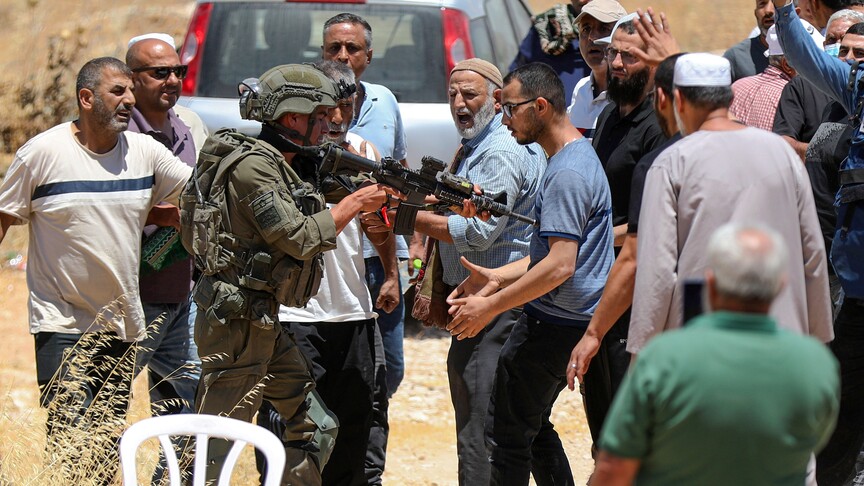
Pro-Palestine activists break into an Israeli weapons factory in the UK. — Source: aljazeera
Public Support for Palestine Action
Public support for Palestine Action has gained momentum through endorsements from prominent figures. A letter backing the group has been signed by 132 public figures, including climate activist Greta Thunberg and author Sally Rooney.[3] This collective statement underscores widespread solidarity with the organization's tactics, particularly its direct actions against arms manufacturers supplying Israel.
The signatories represent diverse fields—activism, literature, and beyond—lending credibility and visibility to Palestine Action's campaign.[3] Greta Thunberg's involvement, known for her global environmental advocacy, bridges movements, suggesting overlaps in themes of justice and resistance.[3] Similarly, Sally Rooney's signature highlights literary voices aligning with pro-Palestine causes, enriching the letter's cultural resonance.[3]
This letter emerges in the context of raids like the UK factory break-in and the 'Ulm Five' trial, positioning Palestine Action as a focal point for international backing.[3] The 132 signatures indicate a robust network of support, potentially influencing public discourse and policy debates on arms exports to Israel.[3] By publicly affirming the group's efforts, these figures frame the actions as legitimate protest against military involvement in the conflict.[3]
The endorsement's timing aligns with heightened activism, providing moral and rhetorical reinforcement amid arrests and trials.[3] It signals that despite legal challenges, Palestine Action retains influential allies, which could sustain momentum for future operations.[3]
Infrastructure Recovery Efforts in Palestine
A key diplomatic development involves infrastructure recovery in Palestinian territories. The Ministry of Public Works and Housing of the State of Palestine signed a Memorandum of Understanding (MoU) with UNOPS to accelerate early recovery and planned reconstruction of essential infrastructure in Gaza and the West Bank.[1] This agreement marks a critical step in addressing damage from ongoing challenges in the occupied Palestinian territory (oPt).
The MoU was formalized by Minister Eng. Ahed Fayek Bseiso on behalf of the Ministry and Karuna, representing UNOPS, emphasizing collaborative scaling of efforts.[1] Focused on Gaza and the West Bank, the pact targets essential infrastructure, vital for civilian life and economic stability.[1] Sources from the Palestinian National Authority and UNOPS highlight the agreement's role in early recovery phases, transitioning to long-term reconstruction.[1]
This initiative responds to infrastructure deficits exacerbated by conflict, aiming for efficient resource allocation and project implementation.[1] By partnering with UNOPS, an expert in operational support, the Ministry gains technical and logistical backing to expedite works.[1] The bilingual (EN/AR) documentation ensures accessibility, reflecting inclusive planning.[1]
In practice, the MoU facilitates attached files and detailed plans for acceleration, positioning it as a foundational tool for rebuilding.[1] It contrasts activist disruptions by focusing on constructive recovery, yet operates within the same regional context.[1]
{IMAGE_3}
Related Incidents in Educational Settings
At UC Berkeley, an event hosted by Law Students for Justice Palestine has drawn sharp criticism. The group capped Palestinian Political Prisoners Day with a video message from a convicted attempted car bomber, prompting backlash labeling the university environment a 'cesspool'.[5]
This event featured the video as a centerpiece, aligning with themes of Palestinian political prisoners and anti-Israel activism.[5] The speaker's background—a conviction for attempted car bombing—intensified reactions, with critics viewing the platforming as endorsement of extremism.[5] UC Berkeley's Law Students for Justice Palestine organized the observance, integrating the video to commemorate the day dedicated to detainees.[5]
The incident underscores tensions in academic spaces, where pro-Palestine groups host controversial figures.[5] Fox News reports highlight the 'cesspool' critique, reflecting broader debates on free speech versus security concerns in university settings.[5] The event's timing on Palestinian Political Prisoners Day ties it to global narratives of incarceration and resistance.[5]
Responses emphasize the provocative nature of featuring such a speaker, fueling discussions on campus activism boundaries.[5] It parallels other pro-Palestine actions by extending advocacy into educational forums, though met with institutional scrutiny.[5]
Current Context and Implications
The convergence of these events paints a multifaceted picture of pro-Palestine engagement. Activist raids, from the UK factory break-in with six arrests to the 'Ulm Five' trial over an Elbit-linked site, illustrate tactical escalation against arms production.[2][4] Public backing via 132 signatories, including Thunberg and Rooney, bolsters these efforts legally and morally.[3]
Counterbalancing this, the MoU between Palestine's Ministry of Public Works and Housing and UNOPS advances reconstruction in Gaza and the West Bank, signed by key officials to scale infrastructure recovery.[1] Educational controversies, like UC Berkeley's event with a convicted bomber's video, extend activism into academia amid criticism.[5]
Collectively, these developments—from direct actions and endorsements to recovery agreements and campus incidents—reflect ongoing dynamics.[1][2][3][4][5] Arrests and trials enforce accountability, while endorsements sustain visibility.[2][3][4] Infrastructure pacts offer stability, contrasting protest fervor.[1] University events highlight ideological divides.[5]
Synthesis shows interconnected spheres: activism challenges supply lines, support amplifies voices, recovery builds resilience, and education sparks debate—all grounded in reported facts.[1][2][3][4][5]
What to watch next
Ongoing trials for the 'Ulm Five' in Germany and potential outcomes from UK arrests could shape future raid strategies, while the MoU's implementation may yield visible reconstruction progress in Gaza and the West Bank.[1][2][4]