
Strike in Lebanon: UN Peacekeeper Dies from Wounds in Attack
A UN peacekeeper from Indonesia has died from wounds sustained in a strike in Lebanon, as reported by the United Nations Interim Force in Lebanon (UNIFIL).[2][3][5] This incident underscores ongoing tensions in the region, where a ceasefire has been repeatedly violated amid cross-border military activities involving Hezbollah and Israeli forces.[1][4] Hezbollah targeted Israeli troops with a drone and shot down an Israeli drone in southern Lebanon, while two people were killed in an Israeli airstrike on the town of Touline despite the truce.[1][4] The attack on the UN peacekeeper occurred on March 29, highlighting the fragile security environment for international forces.[3][5] French President Emmanuel Macron urged the European Union to intensify efforts to restore stability in the Middle East during an EU summit in Cyprus.[3][5]
Death of UN Peacekeeper
The death of the Indonesian UN peacekeeper marks a tragic escalation in the volatile security situation along the Lebanon-Israel border, where UNIFIL personnel have been stationed to monitor ceasefire agreements and maintain stability.[2][3][5] UNIFIL announced that the peacekeeper succumbed to severe wounds sustained during an attack on his base on March 29.[2][3][5] This incident occurred in a context of heightened military exchanges, with the peacekeeping mission operating in southern Lebanon amid frequent reports of drone activity and airstrikes.[1][4]
Details from UNIFIL indicate that the Indonesian soldier suffered critical injuries in the assault, which took place over a week before the official announcement of his passing on Friday.[2][3][5] The mission's statement emphasized the peacekeeper's role in upholding the UN mandate, which includes facilitating disengagement between conflicting parties and preventing further hostilities.[3][5] Such attacks on UN bases are not isolated; they reflect the broader challenges faced by international observers in a zone plagued by truce violations, where even neutral forces become unintended targets.[2]
France24 reporting from Beirut provides additional context, noting that the peacekeeper's death came amid ongoing instability that has drawn international attention.[3][5] UNIFIL has not attributed blame for the specific March 29 attack in its public statements, but the timing aligns with intensified drone operations and strikes reported in the area.[1] The loss of the Indonesian peacekeeper serves as a stark reminder of the human cost borne by troop-contributing nations, with Indonesia providing significant personnel to UNIFIL's ranks.[2] This event has prompted renewed scrutiny of the protection mechanisms for blue-helmet forces in active conflict zones, where rapid response to threats remains a persistent operational hurdle.[3][5]
Hezbollah's Actions
Hezbollah claimed responsibility for targeting Israeli troops with a drone in southern Lebanon, an action that also included the downing of an Israeli drone over the Househ area near Tyre.[1] According to the Lebanese group, the operation involved a surface-to-air missile that successfully intercepted the Israeli unmanned aerial vehicle in the skies above Househ, a location in close proximity to Tyre in southern Lebanon.[1]
These reported military activities by Hezbollah occurred against the backdrop of a ceasefire intended to curb cross-border violence, yet they represent a direct engagement with Israeli forces.[1] The group's statement highlights its use of drone technology to strike troop positions, demonstrating tactical capabilities in the region.[1] Anadolu Agency's coverage details how Hezbollah framed these actions as defensive measures, though they contribute to the cycle of retaliatory incidents that have persisted despite truce agreements.[1]
The downing of the Israeli drone near Tyre underscores the contested airspace in southern Lebanon, where surveillance and strike capabilities from both sides have led to repeated confrontations.[1] Hezbollah's involvement in such operations has been a focal point for regional tensions, with the group's announcements serving to signal its operational reach and readiness.[1] These events align with broader patterns of low-level engagements that test the limits of the ceasefire framework, maintaining a state of heightened alertness along the border.[1]
Israeli Airstrike Incident
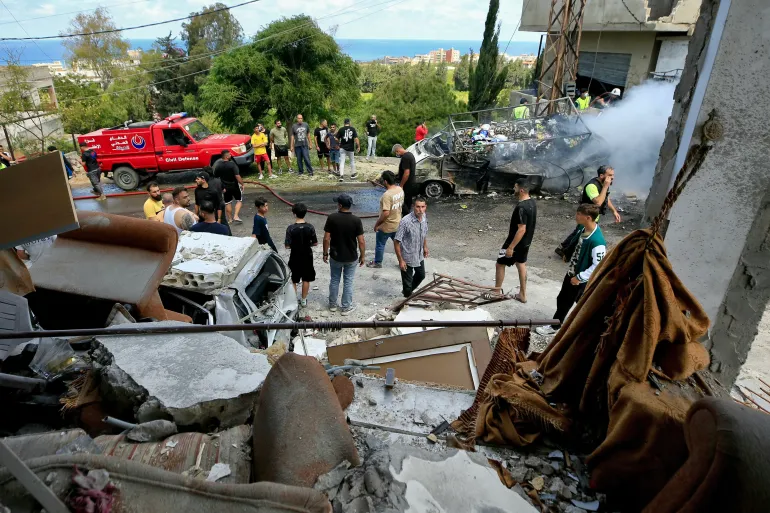
Two people were killed in an Israeli airstrike on the southern Lebanon town of Touline, carried out at dawn despite an ongoing ceasefire.[4] Anadolu Agency reported the strike as part of continuing truce violations, with the attack resulting in fatalities in the targeted area.[4]
The incident in Touline highlights the fragility of the ceasefire, as military actions persist even after agreements aimed at de-escalation.[4] The dawn timing of the airstrike suggests a precision operation, though it led to civilian casualties in the southern town, exacerbating local grievances and drawing attention to enforcement challenges.[4] This event follows a pattern of reported violations, where both sides accuse each other of initiating breaches.[1][4]
Details from the reporting indicate that the strike on Touline was not an isolated occurrence but part of a series of actions that undermine the truce's effectiveness.[4] The deaths of the two individuals underscore the immediate human impact of such operations in densely populated border areas, where distinguishing between combatants and non-combatants remains contentious.[4] International observers, including UNIFIL, continue to document these violations, calling for restraint to prevent wider escalation.[2][3]
International Responses
French President Emmanuel Macron called on the European Union to intensify its efforts to restore stability in the Middle East, making the statement upon arriving at an EU summit in Cyprus.[3][5] This urging came in direct response to the latest developments, including the death of the UN peacekeeper from wounds sustained in the March 29 attack on his base.[3][5]
Macron's remarks, covered by France24 correspondents, emphasize the EU's role in addressing the root causes of instability along the Lebanon-Israel frontier.[3][5] The timing of his comments, coinciding with the announcement of the Indonesian peacekeeper's death, links European diplomatic initiatives to the immediate security threats faced by UN forces.[3][5] France, as a key contributor to regional peacekeeping and a vocal advocate for multilateral solutions, positions this call as part of broader stabilization efforts.[3]
The EU summit's context in Cyprus provides a platform for coordinated responses, with Macron advocating for heightened engagement amid reports of drone strikes, downed aircraft, and lethal airstrikes.[1][4][5] Such international statements reflect growing concern over the sustainability of the ceasefire and the need for diplomatic pressure to protect neutral actors like UNIFIL.[2][3]
Ongoing Developments
Ceasefire violations continue unabated in southern Lebanon, as evidenced by Hezbollah's drone targeting of Israeli troops and the subsequent downing of an Israeli drone near Tyre using a surface-to-air missile.[1] These actions persist alongside the Israeli airstrike on Touline that killed two people at dawn, despite the truce in place.[4]
The pattern of engagements indicates a fragile truce under strain, with both Hezbollah and Israeli operations contributing to an environment of mutual suspicion and rapid countermeasures.[1][4] UNIFIL's reporting on the peacekeeper's death further illustrates how these violations extend risks to international monitors.[2][3] Anadolu Agency's coverage ties these incidents together, portraying a region where dawn strikes and aerial interceptions maintain a cycle of low-intensity conflict.[1][4]
Current status remains tense, with no immediate signs of de-escalation following the March 29 attack and subsequent fatalities.[3][4][5] The involvement of advanced weaponry like drones highlights evolving tactics that challenge traditional peacekeeping protocols.[1]
What to watch next: Monitor UNIFIL updates on further investigations into the March 29 base attack and potential EU responses to Macron's call for intensified stability efforts in the Middle East, amid ongoing reports of drone activities and airstrikes in southern Lebanon.[3][5][1][4]