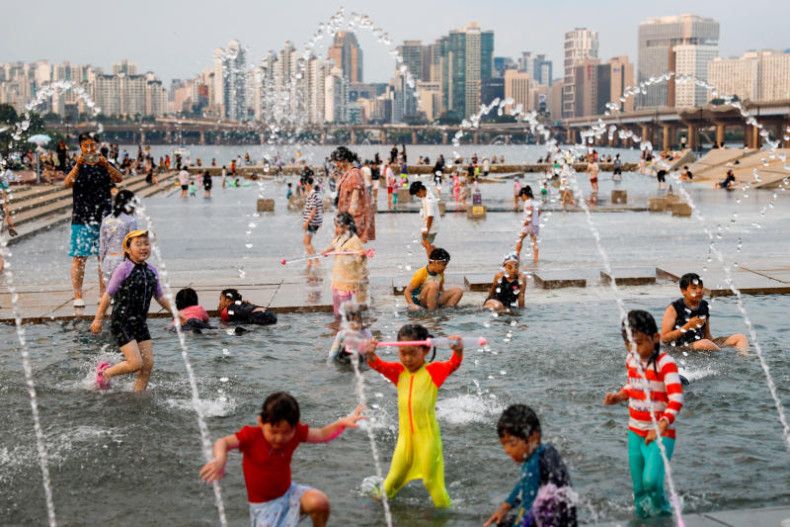
South Korea severe weather: South Korea issues first serious heat wave warning for all of Seoul as temperatures near 38 C
South Korea issued its highest-level serious heat wave warning for all of Seoul for the first time on Tuesday as temperatures are forecast to reach 38 C, while President Lee Jae-myung declared the prolonged heat wave a national disaster with the death toll at 16. [3] [4]
Highest-level heat warning covers all of Seoul for first time
The Korea Meteorological Administration expanded the serious heat wave warning to Seoul’s northeastern and northwestern districts at 11 a.m. Tuesday after southeastern and southwestern areas were already covered the previous day, marking the first time the entire capital is under the highest-level alert introduced on June 1. [1] A serious heat wave warning is issued when the highest perceived temperature reaches 38 C or higher, or the maximum daily temperature reaches 39 C or higher, in an area where the highest perceived temperature is 35 C or higher for two or more consecutive days. [1] The highest-level heat wave warning was issued for Seoul for the first time Tuesday, as continued scorching heat is expected to push the capital's daytime temperature to 38 C. [5] With serious heat wave warnings already issued for Seoul's southeastern and southwestern areas the previous day, all of Seoul came under the warning. [1]
Warnings extend to surrounding provinces and Jeolla region
Serious heat wave warnings were also issued for multiple areas in Gyeonggi Province surrounding Seoul and in the southwestern Jeolla provinces including Jeonju, Jangseong, northern Gokseong, Boseong, Yeosu, Gwangyang, Suncheon, southern Gokseong and eastern Gwangju. [1] In many parts of Gyeonggi Province, which surrounds Seoul, serious heat wave warnings had taken effect as of 11 a.m. Tuesday, including Osan, Hanam, western Yeoju, Goyang, Anseong, southern Paju and Yongin. [1] The highest-level heat wave warning was also issued for many regions in the southwestern Jeolla provinces, including Jeonju, Jangseong and northern Gokseong, and was declared in Boseong, Yeosu and Gwangyang on Saturday and Suncheon, southern Gokseong and eastern Gwangju on Monday. [1]
Record temperatures and national impact from South Korea severe weather
The nation's weather agency said Yangsan, a southeastern inland city, recorded a temperature of 42.5°C on Sunday, the highest temperature measured in 122 years of weather observations. [3] The country saw a new national record for the highest temperature ever recorded in Yangsan on Sunday at 42.5 C. [4] Intense heat has been gripping South Korea for days, although mostly concentrated in southern regions so far, pushing temperatures to record levels in parts of the country and disrupting daily life. [4]
President declares heat wave a national disaster
President Lee Jae-myung told a cabinet meeting that the government must treat the situation as a national disaster, protect vulnerable groups, monitor outdoor and enclosed workplaces, inspect power systems, and overhaul the national crisis system as extreme weather becomes normal. [4] Speaking at a cabinet meeting, Lee called on officials to take necessary measures to protect the daily lives of people and inspect power systems as demand for air conditioning surges. [3] "We need to make efforts for a fundamental overhaul of the national crisis system, since this extreme weather is becoming normal," he said. [3] During a Cabinet meeting Tuesday, Lee said the government should “consider the current situation a national disaster” and mobilize all available resources to safeguard the public. [4] “Protecting people’s lives is the most urgent task,” Lee said, instructing officials to strengthen support for vulnerable groups, including people living in cramped housing and elderly residents living alone. [4] He also called for stricter monitoring of outdoor workplaces and enclosed work environments, urging officials to ensure workers’ right to suspend operations during extreme heat is effectively enforced. [4]
Seoul’s response and rising heat-related illnesses
Seoul reported 18 additional heat-related illness cases on Monday, bringing the cumulative total since May 15 to 185 including two deaths; the national death toll from the heat wave has risen to 16. [1] [3] As the heat wave has intensified, 18 additional heat-related illness cases were reported in Seoul on Monday, government data showed, bringing the city's cumulative total since May 15 to 185, including two deaths. [5] The Seoul metropolitan government said it was closely monitoring the rise in heat-related illnesses and has launched an all-out response, including watering roads and protecting vulnerable groups, like residents living in cramped housing. [1] The city government also designated about 4,000 locations, including community centers, senior citizen centers and welfare centers, as heat shelters. [1] The interior ministry also sent a text message to citizens on the day, urging them to refrain from going out and engaging in outdoor activities, drink plenty of water, rest in cool places and look after the safety of their families. [1]
Sports events canceled due to extreme heat
Two KBO baseball games in Seoul and Gwangju were canceled Tuesday due to the severe heat warnings; three games were already canceled over the weekend in Changwon and Busan. [2] The Korea Baseball Organization announced the game between the NC Dinos and the Doosan Bears in Seoul, and another between the KT Wiz and the Kia Tigers in the southwestern city of Gwangju will not be played as earlier scheduled. [2] The Korea Meteorological Administration issued the highest-level serious heat wave warning for both cities earlier in the day. [2] With the warning in place, the KBO may choose to cancel games by no later than 1 p.m. on a given day. [2] Scorching conditions wiped out three KBO games in the southeastern region over the weekend — two in Changwon and one in Busan. [2]
What to watch next: Officials have warned of rising heat-related illnesses, while authorities have stepped up measures to protect vulnerable groups and workers exposed to extreme conditions.