
South Korea Severe Weather Sees Record 42.5 C Temperature in Yangsan
South Korea severe weather has brought record-breaking heat across multiple regions, with temperatures exceeding 40 C and prompting the first-ever highest-level heat wave emergency warning for the greater Seoul area along with multiple heat-related deaths.
Current Heat Wave Conditions and Records
Temperatures reached 42.5 C in Yangsan on Sunday, the highest since modern weather observations began in 1904. [2] Daegu hit 40.9 C and Goryeong County recorded 41.2 C on Monday. [2] In the southeastern city of Yangsan, where temperatures reached the highest recorded temperature of 42.5 C on Sunday since modern weather observations began in 1904, temperatures peaked at 38 C on Monday. [2] On Monday, Guro, a western district in Seoul, recorded 39 degrees Celsius, while temperatures in Gangnam, southern Seoul, exceeded 37 C. [5] Although lower than Sunday's all-time national high of 42.5 C, recorded in Yangsan, South Gyeongsang Province, temperatures remained extreme in southern regions on Monday. [5] Daegu sizzled with the mercury hitting 40.9 C, while Gwangyang in South Jeolla Province soared past 41 C, and Yangsan, where the record was set a day earlier, reached 39 C. [5] Forecasters said on Monday that extreme heat, previously concentrated in South Korea’s southeast, was spreading into the Seoul metropolitan area and other western regions. [4] South Korea’s weather agency warned temperatures could rise further in western regions this week. [4] The Korea Meteorological Administration said Yangsan recorded 42.5 C on Sunday, the highest temperature measured in 122 years of weather observations. [4] The southeastern city had already broken the national record on the two preceding days. [4]
Expansion of Highest-Level Heat Warnings
Severe heat wave warnings are in effect across southern regions and will extend to southern Seoul, parts of Gyeonggi Province, and additional counties starting Tuesday, marking the first time the highest-level alert applies to the capital region. [2] The Korea Meteorological Administration issued the warning at 4 p.m. for Tuesday, when the daily maximum perceived temperature is expected to exceed 38 degrees Celsius and the daytime high is forecast to surpass 39 C. [3] The warning, the highest level in the KMA’s heat alert system, applies to all Seoul districts south of the Han River, including Gangnam-gu, as well as Osan, Hanam and western Yeoju in Gyeonggi Province. [3] Introduced this year, the Heat Wave Emergency Warning signals exceptionally dangerous conditions in which even healthy people face a sharply increased risk of serious heat-related illness or death, KMA Administrator Lee Mi-seon said. [3] Under the warning, authorities strongly recommend suspending nonessential outdoor work and moving to air-conditioned indoor spaces or cooling shelters. [3] The highest-level warning had previously been issued mainly in southeastern areas, particularly South Gyeongsang Province, after Yangsan recorded a national high of 42.5 C on Sunday. [3] The KMA attributed the westward spread of the heat to easterly winds carrying hot air toward the capital region. [3] As of 4 p.m. Monday, severe heat wave warnings — the highest alert level, calling for an immediate halt to outdoor work — were issued for parts of Seoul and Gyeonggi Province, joining areas in the southern regions that were already under the alert. [5] The warnings will take effect from 11 a.m. Tuesday, according to the Korea Meteorological Administration. [5] It marks the first time that a severe heat wave warning has been issued for the Seoul metropolitan area. [5] Severe heatwave warnings have been issued across parts of southern South Korea, including Busan, Ulsan, South Gyeongsang and parts of Gwangju and South Jeolla Province. [4]
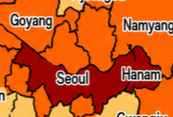
South Korea issues highest-level heat wave warning for Greater Seoul area amid record temperatures. — Source: korea-herald
Health Emergencies and Fatalities
At least three deaths have been reported from heat-related causes, including a man in his 40s in Incheon and two elderly farmers in South Chungcheong Province, with nationwide totals showing 14 possible heat-related deaths and 1,889 illnesses since mid-May. [2] In Incheon, west of Seoul, a man in his 40s died Monday morning with his bodily temperature nearing 40 C after being sent to a hospital the previous day. [2] Also on Sunday, two farmers, in their 60s and 80s, respectively, were found dead in the central province of South Chungcheong. [2] Data from the Korea Disease Control and Prevention Agency from Sunday showed 14 had died and 1,889 people had suffered heat-related illnesses since mid-May. [4] Government figures released Monday showed that 96 patients with heat-related illnesses were reported on Saturday alone, bringing the cumulative total since May 15 to 1,889, including 14 possible heat-related deaths. [5] The death toll is expected to rise, as additional suspected heat-related deaths were reported Sunday in Busan and other areas. [5] In Dangjin, South Chungcheong Province, two elderly farmers were found collapsed after going out to work in the fields in separate incidents Sunday afternoon. [5] The deaths, along with other possible cases, have not yet been officially confirmed as heat-related. [5] Seoul has so far avoided the worst of the heat wave, with 162 heat-related illness cases, including two possible heat-related deaths, reported as of Aug. 1. [5]
Meteorological Causes and Forecast
The Korea Meteorological Administration attributes the heat to overlapping high-pressure systems and strong sunlight, with tropical nights persisting across much of the country, including 12 consecutive nights in Seoul. [2] The KMA attributed the prolonged high temperatures to overlapping high-pressure systems over the peninsula combined with strong, direct sunlight under clear skies. [2] High temperatures are also expected to persist overnight and in the coming days. [3] As heat accumulated during the day continues into the night, we urge residents in the metropolitan area to regularly check the latest weather information and take extra precautions, including staying hydrated and getting sufficient rest, a KMA official said. [3] As of Monday morning, Seoul recorded 12 consecutive tropical nights, while northern Jeju Island extended its streak to 27 nights, the longest currently recorded nationwide. [5] Busan’s overnight temperature fell no lower than 28.5 C, while Yangsan remained at 28 C. [5] Along the east coast in Gangwon Province, overnight lows stood at 26.7 C in Gangneung, 26.6 C in Donghae and 26.5 C in Sokcho. [5] Gangneung, Yangyang and Sokcho have now experienced tropical nights for seven consecutive days. [5] The streak has continued for five days in Donghae, Samcheok and Goseong. [5] A tropical night is recorded when the temperature remains at or above 25 C between 6:01 p.m. and 9 a.m. the following day. [5] North Korean state media also reported temperatures approaching 40 Celsius in parts of the country and a fifth straight tropical night in Pyongyang. [4]

South Korea records 42.5 C high in Yangsan during severe heat wave. — Source: japantimes
Government and Local Response Measures
Government has raised the heatwave response to Level 2, mobilizing resources, expanding cooling shelters, and urging suspension of nonessential outdoor work as electricity demand surges. [4] At 1 p.m. Sunday, the Central Disaster and Safety Countermeasures Headquarters raised the heat response to Level 2, which is activated when more than 108 warning districts are expected to record maximum apparent temperatures above 35 C over the following three days. [5] This is only the second time that the response level has been activated since extreme heat was legally classified as a natural disaster in 2018. [5] Prime Minister Han Seong-sook ordered ministries and local governments to mobilize all available resources to respond to heatwave and drought risks, after the government raised its heatwave response alert to the second-highest level, unlocking funding for relief efforts and more frequent inspections in affected areas. [4] Power authorities have activated emergency measures and are closely monitoring supply and demand as electricity consumption is expected to reach a record high in late August amid surging air-conditioning use. [4] Local governments have scrambled to protect vulnerable residents. [4] Seoul districts have expanded cooling shelters and distributed free water and sun umbrellas, while Yangsan has expanded water-spraying operations and water distribution. [4] Yangsan has rolled out emergency measures, including mobile distribution of iced bottled water, expanded road-spraying operations and public parasols to help residents cope with the extreme temperatures. [5] Seoul Mayor Oh Se-hoon convened a meeting of city officials on Monday morning to review the city's response. [5] Officials in other regions are also stepping up measures, including inspections of cooling shelters and efforts to check on vulnerable groups, including older adults, outdoor workers and others at greater risk from the heat. [5]
Impacts on Daily Life and Vulnerable Areas
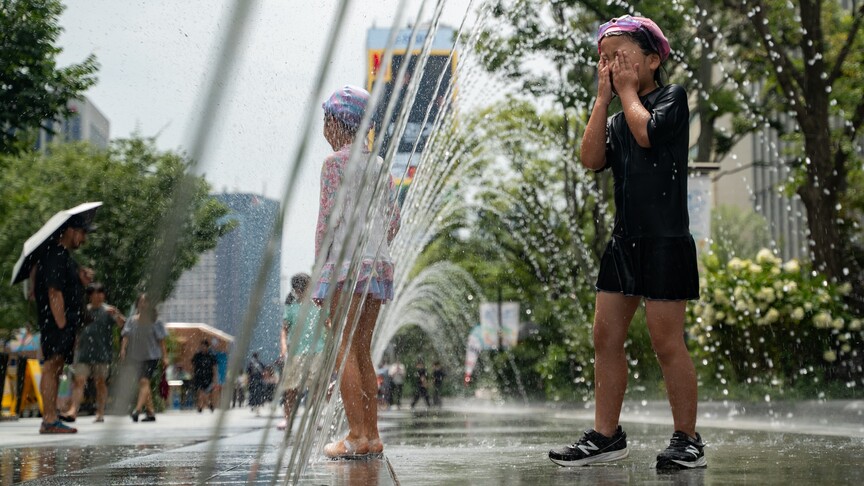
Searing temperatures have disrupted daily life. [4] Over the weekend, the Korea Baseball Organization cancelled games in Busan and Changwon and said further schedule adjustments could be considered if dangerous conditions persist. [4] Local media reported packed beaches, water parks and riverside recreation areas. [4] In Cheongdo, North Gyeongsang Province, the scorching heat has been compounded by a severe drought, with rainfall dropping to just half of last year's level. [5] As of 10 a.m. Monday, the water storage rate at Unmun Dam stood at 26.5 percent, prompting officials to warn of possible water outages as drought conditions worsen. [5] A child cools off in a fountain in Daegu, about 240 kilometers southeast of Seoul, where temperatures surpassed 40 C on Aug. 3, 2026. [2] Pedestrians walk along a mist-spraying zone to cool off on a street in Seoul on Monday as a scorching heat wave continues to grip South Korea. [4] People walk along Yeouidaero in Yeongdeungpo-gu, Seoul, on Monday, amid an ongoing heat wave. [5] A thermal camera image shows central Seoul and the Han River from the observatory of the 63 Building in Yeongdeungpo-gu, Seoul, on Monday. [5]
What to watch next: High temperatures are also expected to persist overnight and in the coming days as the severe heat wave warnings remain in effect.





:strip_icc():format(jpeg)/kly-media-production/medias/9345140/original/019988300_1789021509-1001648010.jpg)