
South Korea severe weather reaches record 42.5°C in Yangsan
South Korea severe weather produced its highest temperature on record when Yangsan hit 42.5°C on August 2, 2026, triggering emergency alerts and official calls to stop all outdoor activities at once. [1] The Korea Meteorological Administration recorded the reading at 1:26 p.m. local time and noted that the city had already exceeded 40°C on each of the four previous days. [1] [3]
Record-Breaking Temperatures
Yangsan exceeded 40°C for a fifth consecutive day while many other cities including Daegu and Busan saw temperatures in the high 30s. [1] The southeastern city of Yangsan reached 42.5°C at 1:26 p.m. local time on Sunday, the highest temperature measured in South Korea since national records began more than a century ago. [4] Neighboring areas such as Busan and Ulsan also approached 40°C, and Changwon climbed to 39.5°C on the same day. [5] These readings formed part of a broader South Korea severe weather pattern that concentrated the most extreme heat in the southeast. [5]
Official Warnings and Public Response
More than 20 localities were under emergency heatwave alerts, a new warning category introduced this year for perceived temperatures of 38°C or actual temperatures of 39°C. [1] The Korea Meteorological Administration urged people to move to cool places such as designated cooling centers, stay hydrated, and warned that indoor spaces without air-conditioning are dangerous. [1] It issued a direct instruction to “immediately stop all outdoor activities” and stated that “indoor spaces without air-conditioning are dangerous.” [4] Residents responded by seeking refuge in air-conditioned shopping malls, cafes, and homes; one office worker in Seoul said, “It is too hot to be outside doing anything” and added that the only option was to remain in air-conditioned places. [1]

South Korea records highest temperature of 42.5°C in Yangsan during severe heatwave. — Source: aljazeera
Health and Safety Impacts
A total of 1,781 people were treated for heat-related illnesses between May 15 and late July with 13 suspected heat-linked deaths; professional baseball canceled a game in Changwon at 39.5°C for safety reasons. [5] The Korea Disease Control and Prevention Agency reported that roughly one-fifth of all heat-related illness cases occurred in Busan, Ulsan, Daegu and the North and South Gyeongsang provinces. [5] The Ministry of the Interior and Safety raised its heat-wave response to Level 2 on Sunday, and the Labor Minister recommended that employers halt outdoor work once perceived temperatures reach 38°C. [5] The Korea Baseball Organization canceled its game in Changwon, stating that the decision prioritized “the safety and health of spectators and players.” [4]
Longer-Term Trends and Climate Context
The average annual number of heatwave days has more than doubled to 19 over the past five years from eight in the 1970s, with scientists attributing increased frequency and intensity to human-induced climate change and the return of El Niño. [1] A heatwave day is defined as one with a maximum temperature of at least 33°C. [3] Scientists have stated that extreme weather events such as heatwaves are becoming more frequent and intense as a result of human-induced climate change, while the return of El Niño this year has added to the warming of Pacific Ocean surface temperatures. [4] Parallel extreme heat affected Europe, where temperatures exceeded 40°C in parts of the south, Japan, where heatstroke alerts covered 30 of 47 prefectures, North Africa, and the western United States. [3]
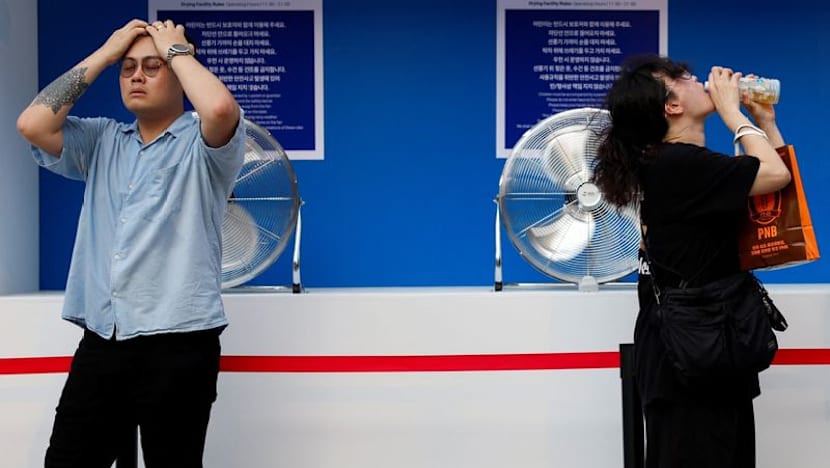
South Korea records its highest-ever temperature of 42.5°C in Yangsan. — Source: channelnewsasia
Forecast and Typhoon Uncertainty
The heatwave is expected to persist with Typhoon Dolphin’s path potentially bringing more humidity or temporary relief through rain and winds. [5] Forecasters expect maximum apparent temperatures to remain around 35°C across most of the country, with easterly winds pushing hotter air inland and Seoul forecast to reach 37°C on Monday. [5] The Korea Disease Control and Prevention Agency projected at least 19 heat-related illness cases in each of six cities and provinces on Monday, with the remaining regions except Jeju Island expected to record between six and 18 cases. [5] Typhoon Dolphin, with a central pressure of 930 hectopascals and maximum sustained winds of 50 meters per second as of Sunday midday, could either draw additional hot and humid air toward the peninsula or deliver clouds, rain and strong winds that temporarily ease conditions. [5]
Public Cooling Activities
People cooled off at beaches, rivers, streams, and pools amid the heatwave as shown in photographs from Seoul, Gangneung, and Cheorwon. [2] Children played in a pool in Seoul and at the Cheonggye stream, while groups enjoyed rafting at the Hantan river valley in Cheorwon, Gangwon province. [2] Additional images captured people at a beach in Gangneung seeking relief from the same temperatures that produced the national record in Yangsan. [1]
What to watch next: Forecasters will track Typhoon Dolphin’s track over the East China Sea to determine whether it increases humidity and prolongs the heatwave or brings rain and winds that offer temporary relief, while health authorities continue to monitor rising heat-related illness numbers. [5]