Palestine Conflict Sees Israeli Bulldozers Uproot Over 2,950 Olive Trees in West Bank Since January
Israeli bulldozers uprooted scores of olive trees in Palestinian villages near Jenin in the occupied West Bank on Wednesday, part of a broader campaign in the Palestine conflict that has destroyed more than 2,950 olive trees across over 300 dunams since the start of the year, weeks before the olive harvest season.
Recent Olive Tree Uprooting Near Jenin
The latest destruction targeted farmland in the villages of Ajjah and Zububa near the separation barrier. [1] Israeli forces have uprooted more than 2,950 olive trees across more than 300 dunams of agricultural land since the start of the year. [1] Zaki Jaradat, head of Zububa Village Council, said the operation formed part of an ongoing campaign of uprooting olive groves across the occupied West Bank. [1] The latest operation targeted farmland in the villages of Ajjah and Zububa, near the separation barrier, weeks before Palestinian farmers were due to begin this year's olive harvest. [1]
Impact on Generational Farmland and Harvest
Among those affected is Fuad Yahya Maqalda, whose family has cultivated olive trees on the land for generations. [1] From the rooftop of his home overlooking the family's land, Maqalda watched Israeli bulldozers move through the olive groves, uprooting trees that had stood for generations. [1] Unable to reach the site, he could only watch as the destruction unfolded below. [1] "We are unable to do anything," he told Middle East Eye. [1] "We cannot understand the intentions behind this uprooting. The occupation uprooted olive trees that have stood on our land since the time of our grandparents." [1] The timing comes weeks before Palestinian farmers were due to begin this year's olive harvest. [1]
Settlement Pressure and Violence in Tel Village in the Palestine Conflict
The village of Tel, southwest of Nablus in the northern occupied West Bank, returned to the forefront of events on 24 July, following a massacre in which four of its residents were killed by Israeli soldiers and settlers. [2] This was followed by the Israeli authorities' announcement of four additional settlement outposts, a move Palestinian residents see as a continuation of a policy to suffocate and isolate the village from its surroundings. [2] More than a quarter of a century ago, settlement pressure on Tel intensified with the outbreak of the Second Intifada, when the "Gilad" outpost was established on large areas of its western land. [2] Since then, the village has lost thousands of dunams, while farmers' access to their land has become conditional on prior coordination with the Israeli army, which is frequently denied or delayed, leading to the neglect of large areas of farmland. [2] The outpost became a permanent base for settler attacks, with settlers assaulting farmers during the olive and fig harvests, preventing them from cultivating their land, and attacking property and livestock. [2] In 2018, the outpost expanded through a new extension known as "Havat Gilad", accompanied by the construction of settlement roads, land clearance, and the uprooting of thousands of trees to make way for vineyards belonging to settlers. [2] Over the years, the outpost expanded towards the archaeological area of Kafrur, moving ever closer to Palestinian homes and becoming a recurring launch point for settler attacks. [2] Settlement expansion has not been confined to the western side of Tel. [2] The head of Tel Village Council, Walid Zidan, said settlers established another outpost several months ago on the eastern side near the "Al-Murabba'a" area separating Tel from the villages of Madama and Burin, leaving the village effectively surrounded from two directions. [2] To the south, Zidan told The New Arab, the military position established by the Israeli occupation in 2001 above Tel Secondary School for Boys and Rouhi Al-Hindi Primary School remains in place today. [2]

Israeli bulldozers uproot olive trees in Palestinian farmland near Jenin in the occupied West Bank. — Source: thenewarab
Tel as Palestine's Fig-Producing Hub Under Threat
Tel is one of the largest Palestinian villages in the governorate in terms of both agricultural land and population, with around 7,000 residents. [2] The village is distinguished by around 8,000 dunams of fertile land out of its total area of approximately 14,000 dunams, where, alongside fig trees, olive trees, almond trees and vineyards flourish. [2] Tel is one of Palestine's largest fig-producing areas, yielding around 15 tonnes of figs at the peak of the harvest season. [2] It is renowned for the diversity and high quality of its varieties, thanks to the moderate climate and fertile soil. [2] Among the best-known varieties produced in the village are white figs, Asali, Hamadi, black figs, Sultani and Zuraiqi, in addition to rare local varieties that farmers have carefully preserved for decades. [2] The fig harvest in Tel begins every July, reaching its peak in August and continuing until mid-September. [2] This year, however, the season faces unprecedented challenges due to settlement expansion consuming the most important fig- and olive-growing lands, in addition to the aftermath of the attack by dozens of settlers, protected by the Israeli army, on 24 July. [2] Festival activities were cancelled, and orchards became sealed-off areas amid the presence of Israeli soldiers and settlers, while large areas of agricultural land were bulldozed, with preliminary estimates indicate around 2,000 dunams were destroyed. [2] According to Palestinian activist and journalist Firas Al-Saifi, the annual Fig Festival serves as a platform for marketing agricultural and handicraft products, supporting farmers, and introducing the public to the importance and varieties of Palestinian figs. [2] Al-Saifi told The New Arab that the aim extends beyond agricultural marketing to reinforcing Tel's identity as one of Palestine's leading fig-producing areas and strengthening the resilience of farmers whose lands are threatened with confiscation by the Israeli authorities. [2]
History of Resistance and Ongoing Military Measures
Like many villages around Nablus, Tel has a long history of Palestinian resistance. [2] Released prisoner Mohammad Ramadan told The New Arab that since the First Intifada in 1987, and later during the Second Intifada (between 2000 and 2005), the village had produced "a large number of martyrs, prisoners and wounded, while many of its residents emerged among the ranks of various resistance factions". [2] Ramadan noted that during the Second Intifada, Tel was one of the villages from which fighters carried out major operations against Israeli forces and settlers. [2] Some of these operations resulted in the deaths and injuries of numerous Israeli soldiers and settlers. [2] He explained that this made the village a constant target of Israeli military raids, arrests and sieges. [2] Like dozens of villages and towns across the occupied West Bank, many homes in Tel have been demolished or raided, while the village has witnessed repeated confrontations with Israeli forces, particularly during large-scale incursions into Nablus governorate. [2] Residents believe this history has placed Tel under permanent Israeli security surveillance, reflected in tighter military measures and intensified settlement activity around the village. [2]
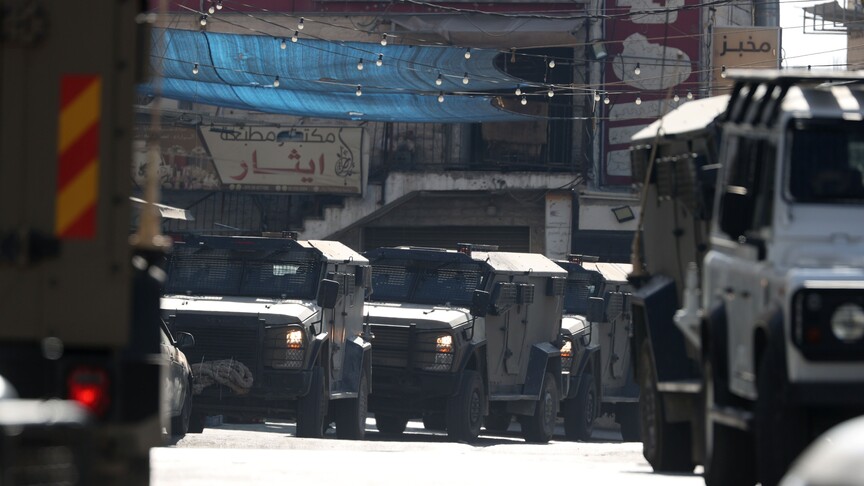
Israeli bulldozers demolish shops and tighten restrictions near Qalandia refugee camp in the West Bank. — Source: anadolu
Demolitions and Restrictions Near Qalandia
Israel's incursions in the Palestinian refugee camp near occupied East Jerusalem continue since early Wednesday. [3] The Israeli army demolished shops and tightened restrictions near Qalandia refugee camp amid ongoing raids. [3] The army's actions form part of measures that have continued since early Wednesday. [3]
What to watch next: The fig harvest in Tel is scheduled to reach its peak in August and continue until mid-September, while settlement expansion around the village and military measures near Qalandia refugee camp remain in place.