
Palestine Conflict Sees 200 West Bank Arrests and Gaza Barriers Advanced by Israeli Forces
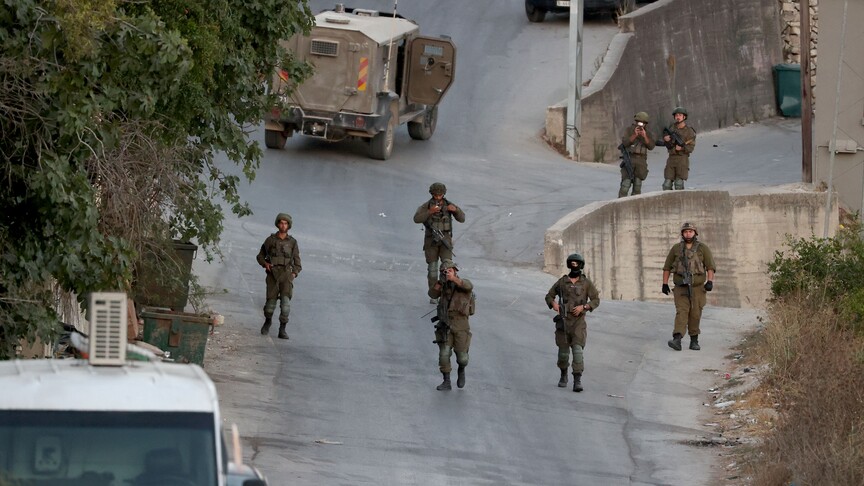
In the ongoing Palestine conflict, Israeli forces have arrested over 200 Palestinians in the West Bank in the past week following an expanded military operation, while in Gaza Israeli forces continue to push barriers deeper into Palestinian territory beyond agreed ceasefire lines, displacing families and expanding control to over 60 percent of the enclave.
West Bank Arrests and Military Operation
The Israeli army announced that over 200 Palestinians were arrested in the West Bank over the past week. [1] These arrests followed the Tell incident that prompted an expanded military operation ordered by Netanyahu and Katz. [1] The operation has involved intensified raids across multiple areas in the occupied territory.
Gaza Boundary Expansion and Displacement

Israeli forces advance sand barriers deeper into Gaza territory displacing Palestinian families. — Source: middleeasteye
Israel is pushing the so-called yellow line deeper into Gaza, displacing Palestinian families and tightening its siege by squeezing more than two million people into an increasingly small section of the devastated enclave. [2] Residents of al-Tuffah in northern Gaza awoke on Monday to find concrete markers moved westwards into the middle of Salah al-Din Road, the territory’s main north-south route. [2] An Israeli flag had also been raised over a three-metre-high sand and earth barrier nearby. [2] Families whose homes Israel destroyed during its genocide on Gaza fled once again on Sunday after the Israeli military warned it would attack a nearby building. [2] The subsequent strike tore apart the tent that had become their only shelter. [2] On 18 July, dozens of families fled Zeitoun after Israel issued an evacuation order. [2] Witnesses reported gunfire from military vehicles and drones, as well as artillery attacks. [2] The United Nations humanitarian agency said about 30 families lost their tents. [2] Satellite images also show Israel razing farmland east of Deir el-Balah after giving families two days to leave. [2] Israeli forces destroyed structures and apparently uprooted an olive grove more than 500 metres beyond the mapped line before installing new concrete markers. [2] In Rafah and Khan Younis, Israel demolished homes and greenhouses to clear routes for new barriers. [2] Satellite imagery indicates that scores of additional buildings were destroyed across Gaza in July alone, including in Jabalia, Beit Lahiya, Zeitoun and Deir el-Balah. [2]
Casualties Since Ceasefire
The death toll from Israel’s genocidal war on Gaza has risen to 73,335, with at least 174,052 Palestinians wounded since 7 October, 2023, medical sources said. [2] Since the ceasefire took effect on 11 October, Israeli attacks have killed 1,209 Palestinians and wounded 3,943, while rescue crews have recovered 803 bodies. [2]
Settlement Activity and Mosque Attacks

Israeli forces advance barriers deeper into Gaza territory displacing Palestinian families. — Source: thenewarab
Israeli settlers set fire to two mosques in the West Bank villages of Qusra and Kur on 26-27 July 2026, with graffiti left at one site. [3] As residents of Qusra village, south of Nablus in the occupied West Bank, were preparing to inaugurate the Al-Rahma Mosque in the southern neighborhood, Israeli settlers infiltrated the village and set fire to the mosque. [3] Another group of Israelis burned down the mosque in the village of Kur, near Tulkarm. [3] In the village of Kur, the imam was shocked at dawn to find flames engulfing the main door and starting to spread to the carpets. [3] Hatem Jiyousi, head of the village council, stated that Israeli settlers infiltrated the eastern side of the village and poured a highly flammable substance before setting fire to the mosque's door. [3] The imam managed to extinguish the flames using water, and the damage did not reach inside. [3] When security camera footage was reviewed, three settlers were seen withdrawing after setting the mosque on fire. [3] Abdul-Azim Wadi, the former mayor of Qusra, noted that this was not the first time Israeli settlers had burned a mosque in the village, as they burned down the Thul-Nurayn Mosque in 2011 in the same manner. [3] This time, the Israeli settlers scrawled racist slogans on the mosque walls after setting it on fire, including one that read "Mosques don't scare us." [3] The Palestinian Ministry of Religious Endowments documented the violation and attack on 13 mosques in the occupied West Bank by the Israeli army and settlers since the beginning of 2026. [3] It also recorded settler attacks on 45 mosques in the occupied West Bank during 2025, under the protection of the Israeli army. [3]
Military Infrastructure and Long-term Control
Under the US-brokered agreement reached with Hamas last October, Israel was supposed to withdraw to the yellow line while temporarily retaining control over 53 percent of Gaza. [2] But Israeli Prime Minister Benjamin Netanyahu has since said that the military controls more than 60 percent of the enclave. [2] In May, he said his “directive” was to increase that figure to 70 percent. [2] Since the agreement, Israel has built more than 42 km of barriers covering about 85 percent of the yellow line. [2] The fortifications, military bases and expanding embankments point towards a prolonged occupation while effectively redrawing the boundary further inside Gaza. [2] Near al-Mawasi, one barrier extends more than 1.5 km beyond the line originally mapped under the agreement. [2] Another in Khan Younis crosses it by more than 500 metres. [2] Israel has also established 14 new military positions since October and expanded several older sites. [2]
Palestinian and International Reactions
The Palestinian Ministry of Religious Endowments strongly condemned these "heinous crimes," asserting that targeting and burning mosques are part of a systematic and planned campaign targeting the Palestinian presence and religious rights, under the protection and with the tacit approval of the Israeli army. [3] The Ministry added that this reprehensible attack is in complete contravention of all international norms and conventions that guarantee freedom of worship and the protection of holy sites, and that the continuation of these violations will only fuel further escalation and tension. [3] The Palestinian Higher Fatwa Council also considered that the Israeli settlers' burning of the mosques in Qusra and Kur as a systematic Israeli policy targeting holy sites and places of worship, warning that the continuation of these violations would fuel tension in the region. [3] Amjad Shehab, an expert on Israeli affairs, noted that the burning of mosques by settlers is primarily linked to their core belief, which he described as the doctrine of Joshua bin Nun as found in biblical sources. [3] He explained that these fundamentalist Jewish groups believe the land should belong to them, and that the presence of mosques or any other religious sites on it represents a religious conflict. [3] Shehab further explained that by burning mosques, they attempt to ignite religious tensions and provoke a religious confrontation with the Palestinians. [3]
What to watch next: The advancing boundary has repeatedly uprooted Palestinians, and Hamas says it will not disarm in Gaza before Israel withdrawal.







