Palestine Conflict Escalates With West Bank Raids and 30 Settler Attacks
Reporting based primarily on aljazeera.com.
The situation in the occupied West Bank is rapidly deteriorating following violence in the village of Tal on 24 July 2026 that killed four Palestinians, one Israeli settler and one Israeli soldier, triggering widespread Israeli military operations, settler attacks and new settlement outposts that have effectively besieged Palestinian communities amid the broader Palestine conflict. [3]
Overview of West Bank Deterioration
The situation in the West Bank is rapidly deteriorating as witnessed in the last few days, compounding the already alarming conditions across the rest of the Occupied Palestinian Territory, with a wider escalation increasingly likely unless immediate steps are taken. [1] This deterioration follows the sequence of events that began in Tal and spread through multiple governorates. [3] The briefing to the Security Council highlighted how the violence has led to armed attacks, raids, demolitions, road closures and arson that have cut off Palestinian cities and villages from each other. [3] Israeli forces have conducted operations that reinforce the sense of siege, while new outposts have appeared overnight in several locations. [3]
Violence and Casualties in Tal
On the morning of July 24, more than 20 Israeli settlers from the illegal Havat Gilad settlement attacked Palestinians’ homes on the eastern edge of Tal, southwest of Nablus in the occupied West Bank. [3] Residents initially drove them back, but the settlers returned shortly afterwards, with Israeli soldiers. [3] Videos appear to show a Palestinian man seizing a settler’s rifle and shooting him dead before soldiers shoot the man dead, with further video revealing Israelis continuing to open fire. [3] Four Palestinians from the Ramadan family were killed in the ensuing violence. [3] A settler and an Israeli soldier also died. [3] In the days since, the retaliation from Israeli forces and settlers alike has been overwhelming, with the occupied West Bank gripped by armed attacks, raids, demolitions, road closures and arson. [3]
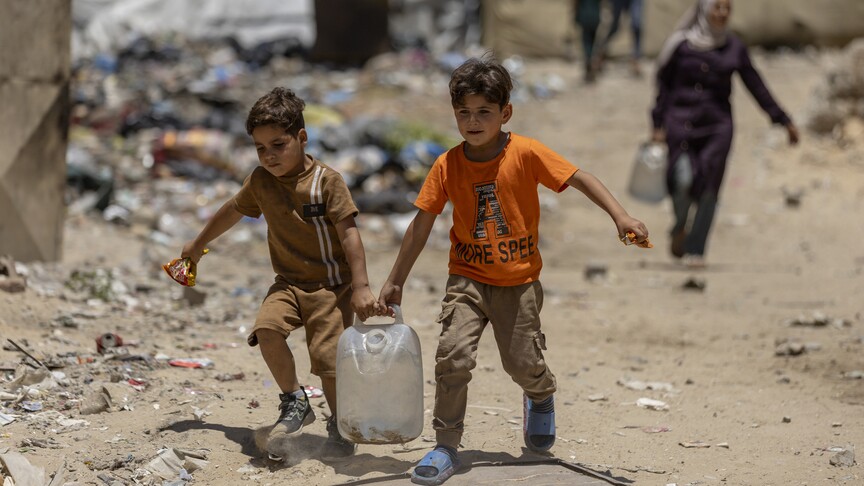
UN delivers water to families in Gaza amid escalating Palestine conflict dangers. — Source: anadolu
Israeli Military and Political Response
Hours after the killings in Tal, Netanyahu ordered a “wide-scale military operation”, including demolishing the alleged Palestinian attacker’s home, revoking work permits in villages he called “terror hotspots”, reinforcing army units and accelerating the “regularisation” of settler farms and outposts. [3] Israeli Minister of Finance Bezalel Smotrich said the response would be an “iron fist”, while National Security Minister Itamar Ben-Gvir said every West Bank village should share the fate of Beit Hanoon in Gaza. [3] By the weekend, Israeli public radio reported that 26 army battalions were deployed across the occupied West Bank. [3] Israeli forces returned to raid Tal nightly over the next several days, arresting roughly 30 to 50 residents and searching some 70 homes. [3] The campaign was also carried out across Jenin, Tubas, Ramallah, Hebron, Bethlehem, Tulkarem and occupied East Jerusalem. [3] In Nablus, about 5km from Tal, Israeli forces stormed the hospital, the Wafa news agency reported, handcuffing doctors and nurses before detaining a wounded patient shot during the Tal attack. [3] Four new Israeli settlement outposts appeared overnight next to Tal and the nearby villages of Awarta, Qusra and Jabal Ubayd. [3] This adds to the Wall and Settlement Resistance Commission’s count of 42 new illegal outposts built across the occupied West Bank in the first half of 2026. [3] Israeli authorities issued new orders this week to uproot olive trees and seize land in Jaba, Ajjah and al-Yamoun in the Jenin governorate, as well as additional land in Tubas. [3]
Settler Attacks and Arson Across Villages
Israel’s Army Radio counted 30 separate settler attacks across the territory over the weekend. [3] In Sarra, southwest of Nablus, settlers burned six Palestinian homes and five vehicles and beat three villagers. [3] When settlers tried to storm the village again on Saturday, Israeli forces followed to protect them and fired tear gas, leading to Palestinians and journalists suffering from tear gas inhalation. [3] In Farata, east of Qalqilya, settlers set fire to a woodworking shop, two homes and farmland, wounding five Palestinians with gunfire, stones and shrapnel, and emptied the water tank of a civil defence truck responding to the blaze. [3] Before dawn on Sunday, settlers set fire to two mosques in so-called “price tag” attacks. [3] One was the al-Rahma Mosque under construction in Qusra, where Hebrew graffiti reading “revenge for Benayahu” was sprayed on the walls. [3] The second was a mosque in Kour village near Tulkarem, which was defaced with racist slogans. [3] A Palestinian infant not yet two months old survived an arson attack on her family’s home in Urif, only because her grandfather pulled her from her crib as more than 150 settlers set the house alight. [3] Early on July 27, a six-month-pregnant woman lost her child in Awarta after being prevented from passing a closed gate by soldiers, who searched the woman while she was suffering extreme bleeding. [3] Israeli forces also sealed roads across the northern West Bank, closing entrances to Sinjil, erecting a checkpoint at Nabi Saleh, and repeatedly shutting gates around Jerusalem, while settlers established rolling roadblocks near Nablus and Ramallah. [3] In Nablus, Ameed Ahmad, the director of the city’s Emergency and Ambulance Center, told Wafa that tightened checkpoint restrictions were delaying ambulance transfers to hospitals, including for kidney dialysis patients. [3]
{IMAGE_3}
Gaza Strikes and Post-Ceasefire Toll
In Gaza, the Ministry of Health’s tally of Palestinians killed since the October 2025 “ceasefire” reached 1,203 on July 27. [3] The week’s dead were killed at locations that have been regularly attacked since the “ceasefire” took effect. [3] A drone strike killed two Palestinians outside Yemen Al-Saeed Hospital in Jabalia. [3] Separate strikes destroyed homes in Zeitoun and the Yarmouk area of Gaza City, and hit a residential block in the Maghazi camp. [3] Brigadier-General Abdul-Nasser al-Maqadma, described by Gaza’s Interior Ministry as the territory’s “governor of northern Gaza” and head of its police force, was killed in a drone strike in Sheikh Radwan. [3] A drone killed Khaled al-Breem in Khan Younis as he went to buy sweets to celebrate his high school exam results with visiting relatives. [3] Two people were killed in a separate strike on the Abu al-Rish family home in Khan Younis on the same day. [3] On July 26, a drone fired three missiles into a four-wheel drive near Deir el-Balah, killing two Hamas security officials. [3] Israel’s “Yellow Line”, which demarcates the area Israel directly controls in Gaza, also continued advancing beyond the lines agreed upon in the October 2025 “ceasefire”. [3] The Israeli army pushed new concrete blocks into the Abu al-Ajeen area east of Deir el-Balah before dawn on July 25, forcing more families to flee. [3] Two days later, the “Yellow Line” was moved again on Salah al-Din Street towards the Sanfour intersection east of Gaza City. [3]
Humanitarian Conditions and UN Concerns
Delivering water to desperate families in Gaza remains dangerous according to the UN. [2] UNICEF wants to repair water pipelines to save lives amid the ongoing violence. [2] The briefing to the Security Council described the situation in the West Bank as rapidly deteriorating and compounding the already alarming conditions across the rest of the Occupied Palestinian Territory. [1] Deaths tied to settler attacks in 2026 had already exceeded all of 2025 before the four Tal killings were added to the count. [3]
What to watch next: The Israeli-controlled “Yellow Line” advancing further into agreed areas in Gaza and the continued deployment of 26 army battalions across the West Bank could compound the already alarming conditions unless immediate steps are taken.