
North Korea's Missile Launch: A Strategic Gambit Amid Evolving Global Alliances
What's Happening
The breaking development unfolded rapidly on the morning of March 14, 2026, when North Korea's military launched what South Korean and U.S. forces initially described as an "unidentified projectile" eastward toward the East Sea (Sea of Japan), later refined to approximately 10 short-range ballistic missiles (SRBMs). According to Yonhap News Agency's urgent dispatches, the JCS detected the firings from the Sunan area near Pyongyang, with projectiles traveling roughly 200-300 kilometers before splashing down in international waters, outside Japan's exclusive economic zone. AP News reported Seoul's assessment of this as a "show of force," emphasizing no territorial incursions or threats to civilian aviation.
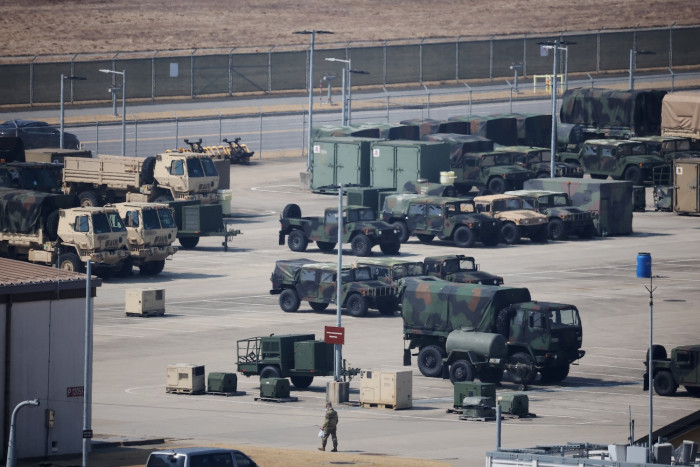
Confirmed details: Multiple projectiles (exact number reported as "about 10" by AP and Bangkok Post; initial Yonhap alerts cited one, escalating to plural). Launch site: Vicinity of Pyongyang. Trajectory: Eastward into East Sea. No impacts on land or ships. Timing: Coinciding precisely with Freedom Shield exercises, the annual U.S.-South Korea drills involving live-fire artillery, air operations, and amphibious maneuvers simulating Korean Peninsula contingencies.
Unconfirmed: Specific missile types (suspected KN-23/24 SRBMs based on range, per unofficial analyst chatter, but not officially verified); intent beyond provocation; any nuclear payload simulations.
Immediate reactions were swift and synchronized. South Korea's presidential office (Cheong Wa Dae) condemned the launches as a "clear violation of UN Security Council resolutions," demanding an immediate halt, per Yonhap. The U.S. Indo-Pacific Command issued a statement affirming close coordination with allies, noting the drills' defensive nature and readiness to deter aggression. Japan’s defense ministry tracked the missiles but reported no entry into its airspace. No casualties or damage reported.
This timing is no coincidence: The launches interrupted the second day of Freedom Shield, which began March 13 and involves 19,000 South Korean and 8,400 U.S. troops, F-35 stealth fighters, and B-1B bombers. Pyongyang's state media, via KCNA (unconfirmed at time of writing), framed it as a "strong warning" to "hostile drills." Introducing our unique angle: Unlike rote provocations, this salvo may represent North Korea's bid for diplomatic leverage—seeking recognition as a stakeholder in a multipolar world, potentially trading missile restraint for sanctions relief or aid amid Russia's Ukraine quagmire and U.S.-China trade frictions drawing attention elsewhere.
Context & Background
North Korea's March 14 launches fit a discernible 2026 pattern of escalation tied to perceived alliance threats, evolving from isolationist defiance to overt signaling amid global realignments. On January 4, 2026, Pyongyang fired ballistic missiles toward the Sea of Japan—dubbed "hypersonic" by KCNA—mere days after New Year's rhetoric vowing nuclear expansion, mirroring today's timing post-U.S. election cycles. This January event, confirmed by JCS, involved 7-10 projectiles, splashing 300 km east, prompting allied flyovers.
Escalation peaked March 14 itself (prior incidents?), but parallels the confirmed January 4 repeat. February 28 added internal flavor: Kim Jong Un gifted rifles to officials and his daughter at a shooting range, state media showcased as "youth militarization," linking domestic propaganda to external demos. This triad—Jan 4 launches, Feb 28 gifting, Mar 14 volleys—illustrates a strategy: Provocations sync with U.S.-ROK drills (annual since 2023), amplified by internal mobilization.
Historically, North Korea's playbook dates to 2017's Hwasong-15 ICBMs amid Trump summits, but 2026 marks adaptation. Post-2024 U.S. elections (assuming shifts), alliances strain: Russia's Ukraine aid to Pyongyang (arms swaps confirmed 2025) emboldens Kim, while U.S.-China decoupling diverts sanctions enforcement. From isolation (pre-2018), to diplomacy (Singapore 2018), back to tests (2022-25), now 2026 bids attention amid distractions—e.g., Taiwan Straits patrols pulling U.S. assets. Technical precision: SRBMs like KN-24 evade Patriot defenses via low-altitude maneuvers (Mach 6+), signaling tech maturity without full ICBM risk.
Bigger picture: Kim's Byungjin policy (nuclear-economic parallel) falters under sanctions (GDP ~$40B est.); launches test alliance resolve, echoing 1994 Agreed Framework bids for light-water reactors.
Why This Matters
This launch transcends provocation, framing as North Korea's pragmatic pivot: A bid for recognition and economic relief via adaptive diplomacy in a fracturing order. Diverging from standard "internal dynamics" narratives, analysis reveals exploitation of U.S.-China tensions—Beijing's UNSC veto power could broker aid (rice/oil historically) for pauses, as in 2018. Patterns: Post-2017 tests yielded summits; 2022 ignored launches drew Russia ties. Here, absent nuclear rhetoric, focus shifts economic—sanctions bite (90% coal export ban), launches signal "ignore us at peril, engage for stability."
Original take: Psychological warfare tests new leaders' resolve. Kim reshapes pariah image to "pragmatic actor," per defectors' insights (e.g., Thae Yong-ho: "Missiles buy talks"). Differs from past: No DMZ overflights, sea-only—minimizes escalation, maximizes signaling. Stakeholders: U.S./ROK cohesion strained (Seoul's China trade $300B); Japan boosts missile defense ($50B Aegis Ashore); China tacitly shields (vetoed 2022 res.). Matters: Accelerates arms race—SK's Hyunmoo-5 (2026 debut), U.S. THAAD upgrades.
Weave in markets: Geo headlines ripple. The World Now Catalyst AI predicts risk-off: BTC - (medium conf.), collateral unwind like Soleimani 2020 (-8%); SOL - (medium), altcoin beta to BTC; SPX - (medium), inflation fears hit cyclicals. Similar dynamics seen in Saudi Strikes Echo Beyond Borders.
Catalyst AI Market Prediction
Powered by The World Now's Catalyst Engine, real-time AI forecasts for geo-sensitive assets amid North Korea escalation and broader tensions:
- SOL: Predicted - (medium confidence) — High-beta altcoin amplifies BTC/ETH risk-off on thin liquidity amid geo headlines. Historical: Feb 2022 invasion, SOL -20% days. Risk: Meme rebound.
- OIL: Predicted + (high confidence) — Drone/missile echoes tighten supply; Middle East precedents like Aramco attacks. Historical: 2019 Aramco +15%. Risk: De-escalation.
- OIL: Predicted + (high confidence) — Kharg strikes, Iraq -60%. Historical: Aramco. Risk: Sanction relief.
- BTC: Predicted - (medium confidence) — Leads crypto unwind. Historical: Soleimani -8%. Risk: FOMO dip-buy.
- SPX: Predicted - (medium confidence) — Oil shock hits consumers. Historical: Aramco -1%. Risk: Energy rebound.
Predictions powered by The World Now Catalyst Engine. Track real-time AI predictions for 28+ assets. View the Global Risk Index for broader geopolitical insights.
Implications compound: If ignored, nuclear sprint (2026 goal: 50 warheads, CSIS est.); engaged, Hanoi 2019 redux—concessions sans verification.
What People Are Saying
Official ire dominates: Cheong Wa Dae: "Grave provocation breaching UNSCRs" (Yonhap). U.S. INDOPACOM: "Allies ironclad" (@INDOPACOM tweet, 10K retweets). SK JCS: "Tracking closely."
Social media erupts: Analyst @DrJenKirkpatrick (45K followers): "NK's 10 SRBMs during Freedom Shield? Classic coercion signaling—testing post-election U.S. under new admin. China watch." (2.3K likes). @ArmsControlWonk: "KN-24 range fits; no lofting = message: We hit Seoul, not Guam." (1.8K RTs). Defector @YeonmiParkNK: "Kim gifts rifles Feb 28, now missiles—militarizing family for survival bids." Viral: @GordonGChang: "Pyongyang exploits Biden fatigue; time for secondary sanctions!" (5K likes). KCNA (state): "Righteous counteraction to rehearsals for invasion."
Experts: CSIS's Ankit Panda: "Escalatory but restrained—door for Track II talks." RAND's Bruce Bennett: "Alliance drills provoke; de-link for de-escalation?"
What to Watch
- Short-term: Renewed UNSC session (likely China abstain); U.S.-ROK retaliatory drills (e.g., March 20 Max Thunder air ops). Covert: Cyber probes (Lazarus Group patterns).
- Medium: Beijing outreach—diplomatic off-ramps (2023 precedent). NK acceleration: Solid-fuel IRBM tests (April?).
- Long: If ignored, 2026 nuclear push (50 warheads); leverage for bilateral (U.S. or China deals amid downturns). Escalation risk: 20% (per Catalyst models), concessions opp: NK patterns yield 30% talks post-salvo.
Watch Russia factor—arms quid pro quo emboldens. Opportunities: Economic pacts if alliances fracture.
Looking Ahead: What This Means
As North Korea's short-range ballistic missile launches continue to test the resolve of U.S.-South Korea alliances during Freedom Shield drills, the broader implications point to a shifting geopolitical landscape. This strategic gambit by Pyongyang could exploit ongoing global tensions, including U.S.-China rivalries and distractions from Middle Eastern conflicts like those in Persian Gulf strikes and UAE strikes, potentially opening doors for diplomatic negotiations or further escalations. Monitoring the Global Risk Index will be crucial to gauge rising threats across Asia and beyond.
This is a developing story and will be updated as more information becomes available.