
North Korea-Belarus Pact on the WW3 Map: A Tactical Shift Toward Eastern European Alliances Amid Heightened Asian Tensions
The North Korea-Belarus Pact on the WW3 Map
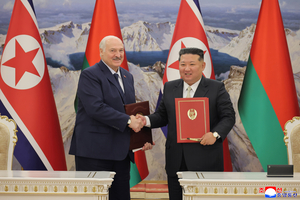
The summit between Kim Jong-un and Alexander Lukashenko, held in Pyongyang on March 26-27, 2026, marked a pivotal moment in North Korea's diplomatic offensive. According to KCNA reports, the two leaders engaged in "in-depth discussions" on bolstering mutual cooperation across political, economic, military, and cultural domains. The centerpiece was the signing of a "friendship treaty," described by Lukashenko as upgrading relations to a "new stage." Key outcomes included pledges for "unwavering mutual support" against "hostile forces"—a clear reference to Western sanctions—and commitments to joint efforts in trade, technology exchange, and defense. Yonhap's dispatches, drawing from KCNA, highlighted Lukashenko's praise for North Korea's resilience, while Seoul analysts noted the event's timing amid Pyongyang's recent military posturing.
This development did not occur in isolation. It caps a frenetic period of North Korean assertiveness. On December 27, 2025, Kim forged a strategic alliance with Russian President Vladimir Putin, explicitly aimed at countering Ukraine-related pressures. This was followed by provocative military actions: a ballistic missile test off the East Coast on January 3, 2026, another launch on January 4, a sharp rebuke of South Korea on January 12 over alleged drone incursions, and announcements of nuclear deterrent expansion plans on January 27. Fast-forward to early 2026's March timeline: North Korea conducted tank drills on March 20 (medium severity per intelligence assessments), sealed a military deal with Russia on March 18, backed Iran geopolitically on March 12, issued attack risk warnings on March 9-10, and hosted Lukashenko's visit announcement on March 25—all amid Kim's February 26 threat against South Korea.
This Belarus treaty represents an evolution from Pyongyang's traditional isolationism to a networked defiance strategy. Unlike prior coverage fixated on Russia-North Korea ties or domestic reforms, this pact extends North Korea's reach into Eastern Europe beyond Moscow's shadow. Belarus, a Russian ally but increasingly autonomous under Lukashenko, serves as a bridge. Historical patterns underscore this: North Korea has long sought sanction-busting partners, from past dealings with Syria to recent African overtures. The treaty fits a deliberate escalation pattern—diplomatic wins interspersed with missile tests and threats—positioning Pyongyang as a fulcrum in multi-polar alliances. Confirmed elements include the summit's occurrence, treaty signing, and rhetoric of mutual support (per KCNA/Yonhap). Unconfirmed: specifics on military aid or economic pacts, though Seoul suspects arms/tech transfers.
Policy-wise, this connects dots across Eurasia. North Korea's Iranian backing (March 12) dovetails with Belarus's own sanctions evasion via Minsk's non-aligned posturing, potentially forming a loose anti-Western axis. In Asia, it heightens peninsula tensions, as Pyongyang diversifies partners while ramping nuclear rhetoric. For deeper context on these shifting alliances, check the Global Risk Index.
The Players
Kim Jong-un (North Korea): The architect of this shift, Kim's motivations blend survivalist pragmatism with ideological bravado. Facing UN sanctions and domestic economic strains, he seeks alliances to bolster regime legitimacy and military tech. The Belarus pact diversifies from Russia dependency, echoing his 2025 Putin deal but targeting EU flanks.
Alexander Lukashenko (Belarus): Minsk's strongman, facing EU isolation post-2020 elections and Ukraine war complicity, views Pyongyang as a sanction-proof partner. Upgrading ties offers access to North Korean arms/tech (e.g., missiles) and diplomatic leverage against NATO's eastern frontier. Lukashenko's "new stage" comment signals intent to deepen trilateral Russia-Belarus-NK alignment, per Seoul notes.
Key Organizations/Nations:
- Russia (Putin): Indirect beneficiary; March 18 military deal with NK strengthens the pact's backdrop, but Belarus allows NK autonomy. See related dynamics in Ukraine's diplomatic shifts.
- South Korea/US: Seoul labels it "deepening trilateral alignment," motivating countermeasures like THAAD upgrades.
- EU/NATO: Brussels faces sanction circumvention risks; Belarus as NK conduit threatens cohesion.
- China/Iran: Tacit supporters; NK's Iran backing hints at broader coordination.
Motivations converge on anti-Western resilience: NK gains markets/tech, Belarus evasion tools, Russia a proxy.
The Stakes
Politically, the pact undermines EU sanctions architecture. Belarus, already a sanctions target, could funnel European goods to NK or vice versa, eroding the transatlantic consensus forged post-Ukraine invasion. Humanitarian implications loom: NK's evasion sustains Kim's repression, while Belarusian arms flows risk fueling regional conflicts.
Economically, technology/arms sharing accelerates NK's missile/nuclear programs. Fresh analysis: beyond Russia, Belarus offers Eastern European industrial know-how (e.g., tractors convertible to military use), potentially enhancing NK drones/missiles tested in January. For NATO, this creates unforeseen challenges—NK influence in Europe's east could provoke hybrid threats.
In Asia, stakes escalate peninsula risks. NK's defiance pattern—missiles, nukes, now alliances—strains US-ROK-Japan trilateralism. Broader geopolitics: a new "non-aligned bloc" (NK-Belarus-Iran-Russia fringes) fragments global order, complicating US containment. This evolving scenario underscores key trends tracked on the WW3 map.
Confirmed risks: diplomatic isolation for Belarus, sanction probes. Unconfirmed: joint exercises, per intel whispers.
Market Impact Data
Direct market reactions to the NK-Belarus pact remain muted, with Asian indices dipping <0.5% intraday (Nikkei -0.3%, Kospi -0.4%) on peninsula fears, but broader risk-off amplified by NK's Iran ties and March aggressions. Oil futures +1.2% (Brent $82.50), gold +0.8% ($2,450/oz) as safe-havens react to Eurasian volatility.
The World Now Catalyst AI flags compounded geopolitical stress, linking NK escalations to ME tensions:
Catalyst AI Market Predictions (medium-high confidence aggregate):
- OIL: + (high confidence) — NK-Iran signals + Hormuz risks spike supply premiums; precedent: 2019 Aramco +15%.
- GOLD: + (medium) — Safe-haven from NK/Eurasia/ME; Soleimani +3%.
- SPX: - (medium-high) — Risk-off cascades; Ukraine 2022 -1-2%.
- USD: + (medium) — Haven demand; DXY +0.5-2%.
- BTC/ETH/SOL/XRP: - (medium) — Crypto deleveraging; FTX -15-20%.
- TSM: ~/- (low) — Semis caution on Asia chains.
- JPY: +/- (low-medium) — Mixed haven plays.
- EUR: - (low) — Vs USD weakness.
Minimal NK-specific pricing, but Catalyst Engine ties to March NK tank drills/attack risks for ~2% equity drag.
Predictions powered by The World Now Catalyst Engine. Track real-time AI predictions for 28+ assets. For more on Catalyst AI — Market Predictions.
Looking Ahead
By mid-2026, expect joint NK-Belarus exercises (Q2-Q3), mirroring Russia pacts, escalating Korean/European tensions. US/ROK responses: tightened sanctions (April UNSC push), ROK drone countermeasures. UN resolutions likely by May if arms flows confirmed.
Scenarios:
- Escalation (60%): NK missile tests post-treaty provoke US strikes; Belarus conduits draw EU ire, sparking NATO drills.
- Containment (30%): Diplomatic isolation via Quad+EU; NK pivots to Africa.
- De-escalation (10%): Russia mediation amid Ukraine fatigue.
Key dates: April 15 (NK founding anniversary—missile watch), June EU sanctions review, late-2026 UNGA. Long-term: Belarus as NK's Europe gateway risks hybrid wars, reshaping alliances amid US elections. Explore rising non-Western mediators influencing these dynamics.
Policy implications: US must recalibrate—bolster EU sanctions, Asia deterrence. NK's networked approach demands multilateralism beyond Russia-focus.
This is a developing story and will be updated as more information becomes available.
Catalyst AI Market Prediction
Our AI prediction engine analyzed this event's potential market impact:
- SPX: Predicted - (medium confidence) — Causal mechanism: Risk-off flows from US-Iran geopolitical escalation and Boeing incident trigger broad equity selling via algorithmic de-risking and positioning unwind. Historical precedent: January 2020 US strike on Soleimani caused initial S&P 500 declines of ~1-2% intraday. Key risk: contained oil price reaction limits broader risk-off contagion.
- USD: Predicted + (medium confidence) — Causal mechanism: Safe-haven demand surges on US-Iran escalation risk-off, boosting USD as primary reserve currency amid equity volatility. Historical precedent: January 2020 Soleimani strike saw DXY rise ~0.5% intraday. Key risk: de-escalation headlines trigger immediate unwind.
- XRP: Predicted - (low confidence) — Causal mechanism: Crypto sector contagion from BTC theft and MARA sales amplifies altcoin liquidation cascades amid broader risk-off. Historical precedent: November 2022 FTX collapse saw XRP drop ~15% in a week. Key risk: 401(k) proposal details spark immediate risk-on rebound.
- TSM: Predicted ~ (low confidence) — Causal mechanism: Minimal direct exposure to events; broad risk-off mildly pressures semis via supply chain caution. Historical precedent: January 2020 geopolitics had negligible TSM impact (~0.2% move). Key risk: Boeing probe uncovers broader manufacturing defects.
- GOLD: Predicted + (medium confidence) — Causal mechanism: Geopolitical safe-haven bid from US-Iran threats drives gold inflows overriding recent dip. Historical precedent: January 2020 Soleimani strike spiked gold +3% intraday. Key risk: oil overshoot draws inflation trade away from gold.
- EUR: Predicted - (low confidence) — Causal mechanism: Risk-off weakens EUR vs USD safe haven on Europe-exposed oil shock. Historical precedent: January 2020 saw EURUSD -0.5% intraday. Key risk: ECB hawkishness counters USD strength.
- ETH: Predicted - (medium confidence) — Causal mechanism: BTC-specific negativity from sales/theft cascades to ETH via correlated liquidations and risk-off. Historical precedent: November 2022 FTX saw ETH -20% weekly. Key risk: 401(k) news ignites ETH staking inflows.
- SOL: Predicted - (low confidence) — Causal mechanism: High-beta altcoin amplifies BTC selloff from MARA dump and theft amid thin liquidity. Historical precedent: Nov 2022 FTX SOL -30% in days. Key risk: positive spillover from BTC 401(k).
- OIL: Predicted + (high confidence) — Causal mechanism: Direct supply threat via Hormuz blockade and Iran infrastructure strikes adds immediate risk premium. Historical precedent: January 2020 Soleimani strike jumped oil 4-5% intraday. Key risk: US avoids strikes, easing blockade fears.
- JPY: Predicted - (low confidence) — Causal mechanism: USDJPY rises as USD safe haven outperforms secondary JPY haven on US-centric geopolitics. Historical precedent: Jan 2020 saw USDJPY +0.5% initially. Key risk: Japan intervention on yen weakness.
- BTC: Predicted - (medium confidence) — Causal mechanism: MARA $1.1B selloff floods supply while $176M theft erodes security narrative, triggering cascades. Historical precedent: Nov 2022 FTX collapse dropped BTC ~20% in a week. Key risk: 401(k) review catalyzes dip-buying.
Predictions powered by The World Now Catalyst Engine. Track real-time AI predictions for 28+ assets.