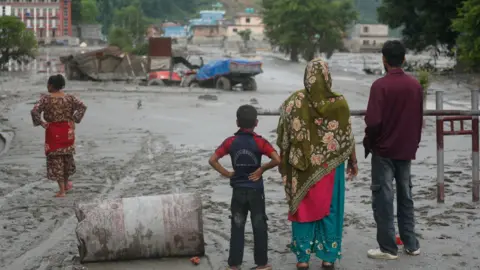
Nepal Floods Leave 165 Dead and More Than 1,300 Missing Across Border With Tibet
Flash floods triggered by a glacial collapse on the Nepal-Tibet border have killed at least 165 people with more than 1,300 others missing across Nepal and China's Tibet region, including hundreds of foreign tourists. [1] [2]
Death Toll and Missing Persons
Nepal police have recovered 162 bodies with the toll expected to rise significantly. [1] In Nepal, 826 people including nearly 500 foreigners remain missing while 558 people including 260 foreigners are missing in Tibet. [2] Nepalese police and tourism officials confirmed that nearly 500 foreigners were among the 826 people missing in Nepal, with the confirmed death toll expected to rise significantly past 165. [2] Police spokesperson Abi Narayan Kafle said the toll will go up as search efforts resume and more bodies are recovered. [2] Among the missing tourists from more than two dozen countries, 177 are from India, 63 from the United States, 34 from Australia, 33 from the United Kingdom, and 25 from Canada. [2] In Tibet’s Gyirong county, Chinese state media reported 558 people missing, including 260 foreign nationals. [2] Authorities on both sides fear the total number of casualties will be far higher than the nearly 170 bodies so far recovered. [4]
Cause of the Catastrophic Flood
A glacial collapse generated seismic activity that caused a catastrophic debris flow down the Lhende River, leading to a wall of water and mud surging more than 160 km along the Bhote Koshi and Trishuli rivers. [1] [2] The US Geological Survey said it was a glacial collapse that caused seismic activity and the catastrophic downstream impacts in Nepal and Tibet. [1] Early reports suggested an earthquake may have caused the lower section of a glacier to collapse, but the US Geological Survey noted that the seismic event, initially recorded as a magnitude 4.4 earthquake, was actually the seismic energy generated by the sudden collapse of glacial rock and ice, followed by a huge debris flow. [2] Preliminary satellite imagery analysis indicated that a landslide of ice and rock triggered a debris-laden surge down the Lhende River approximately 20 km northeast of the Rasuwagadhi border crossing. [2] Before-and-after satellite imagery showed lush green mountainside now buried under brown debris and sediment. [4] Experts confirmed that a substantial portion of the glacier snout collapsed at about 5,200 metres and crashed onto the valley floor about 1,200 metres below. [4] Earth scientist Dan Shugar noted that the imagery showed a large amount of snow had melted in the 24 hours prior to the disaster. [4] A still-dammed lake in Gyirong, Tibet, poses further risks. [2]
Impact on Communities and Pilgrims
The disaster struck areas popular with trekkers and Hindu pilgrims heading to Mount Kailash, with 77 Hindu pilgrims from Sadhguru's Isha Foundation among those affected at the border. [2] Video footage showed rapid torrents of water and debris sweeping away dozens of people at a border crossing in Gyirong, while downstream in Nepal homes, roads, and power infrastructure were destroyed. [2] In the affected valleys, thick mud swathed homes, trees, and vehicles, while aerial footage showed collapsed houses, submerged cars, and a metallic bridge washed away by the torrents. [2] The flash floods sent a powerful surge of water, sediment and boulders through the Bhote Koshi and Trishuli river systems, with water levels on the river at the Galchhi area downstream rising by as much as nine metres within 30 minutes. [4] Several hydropower projects are located in the worst-affected areas in the mountainous district of Rasuwa, which has a population of about 50,000. [4] Healthcare worker Tula Bahadur BK in Rasuwa said settlements next to the river have been completely swept away. [2]
Ongoing Search and Rescue Efforts
Rescue teams using helicopters have retrieved 125 survivors and are dropping emergency supplies. [2] More than 5,000 army and police rescue personnel joined the rescue effort that retrieved 125 people, including 20 foreigners. [2] Army spokesperson Raja Ram Basnet said helicopters were dropping tents, food, and medicine provided by neighbouring India into the hardest-hit districts. [2] Rescuers in Nepal have deployed helicopters to search for survivors and drop emergency supplies to thousands of people cut off in a rugged mountainous area. [2] Chinese authorities warned that a still-dammed lake in Gyirong upstream from the flood-affected border crossing poses further risks and could severely complicate rescue efforts. [2]
Families Searching for Loved Ones
Families of the missing are desperately searching hospitals and police stations in Kathmandu. [1] Anxious relatives crowded the corridors of a Kathmandu hospital on Thursday as they searched for missing family after the Nepal floods. [1] Subash Khatani was scanning lists and speaking to officials in the hope of finding news of his elder brother Ram Sharan Rasaili, one of the hundreds unaccounted for after the disaster in Rasuwa. [1] Chitra Bahadur Nepali was looking for his nephew Yubraj Sewak, a driver who had been travelling towards the worst-affected Rasuwa district before contact was lost. [1] Nepali said his nephew was in contact until about 8:00 am the previous day and that another member of the family is also missing. [1] As rescue teams scoured for survivors, families moved between hospitals and police helpdesks, desperately hoping for word on those missing. [1] The Bir hospital said it would treat all victims for free and was fully prepared to handle the surge in patients. [1]
International Response and Aid
The US State Department announced it was dispatching a disaster response adviser and providing $500,000 in emergency aid. [2] Canadian Prime Minister Mark Carney described the flooding as devastating, adding that Canadian officials were monitoring the situation closely. [2] United Nations Secretary-General Antonio Guterres confirmed that UN teams were delivering emergency supplies and support staff to affected communities in Nepal. [2] Australian Prime Minister Anthony Albanese noted that gathering clear information from the remote area remained challenging due to limited local infrastructure and resources. [2] Nepal’s Prime Minister Balendra Shah left by road for Bidur in one of the worst-affected districts of Nuwakot to assess the flood situation. [2]
What to watch next: Chinese authorities have warned that a still-dammed lake in Gyirong poses further risks that could severely complicate ongoing rescue efforts in the area.