
Most dangerous countries see oil prices near $107 after Houthi airport and tanker attacks
Escalating conflicts across the Middle East, DR Congo and Ethiopia are driving oil prices toward $107 a barrel in some of the most dangerous countries while former DR Congo President Joseph Kabila forms a new alliance with M23 rebels and Ethiopian forces advance into a key Tigray town.
Oil Prices Surge on Middle East Attacks
Brent crude oil prices rose to nearly $107 per barrel on Monday as fresh attacks on Saudi Arabia and oil tankers near the Strait of Hormuz heightened concerns about global oil supplies, outweighing expectations of additional Russian diesel exports. [2] Brent crude gained $2.09, or two per cent, to $107 per barrel on Monday morning, while the United States benchmark, West Texas Intermediate, rose by $1.93, or 2.1 per cent, to $93.78 per barrel. [2] The increase followed a weekend of attacks in the Middle East, including a Houthi strike on Riyadh’s international airport on Saturday that killed 13 people and wounded more than 300. [2] Further attacks were reported on Sunday, while two oil tankers were struck near Oman and in the Strait of Hormuz. [2] The tanker attacks have raised concerns about the recovery of oil exports from the Gulf, which reached 81 per cent of pre-war levels in September. [2] Crude oil and condensate shipments recovered to 91 per cent, while refined petroleum product exports remained at 60 per cent. [2]
Houthi Strikes on Saudi Targets
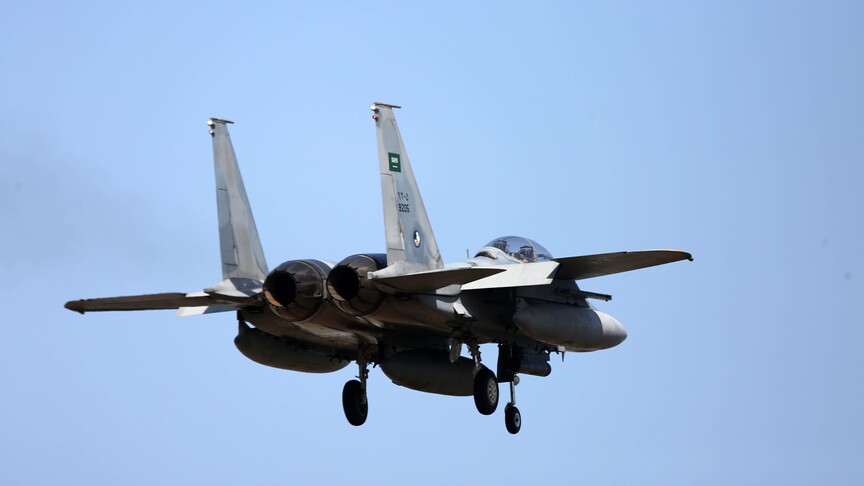
Saudi Arabia prepared for various scenarios amid Houthi attacks. [4] Information Minister Salman Al-Dosari says life continues normally as attacks disrupt airport operations. [4] The Houthi strike on Riyadh’s international airport on Saturday killed 13 people and wounded more than 300. [2] Saudi Arabia is preparing for various scenarios amid the Houthi attacks while insisting daily life continues normally despite airport disruptions. [2]
Kabila Forms Alliance with M23 in DR Congo
Former DR Congo president Joseph Kabila will lead a new political-military movement with the Rwanda-backed M23 armed group which controls swathes of the country's violence-wracked east. [3] The Kabila-M23 tie-up was presented at a joint press conference at Kabila's residence in Goma, the major city in eastern Congo that the armed group has controlled since January 2025. [3] Kabila was condemned to death in absentia a year ago for "complicity" with the Rwanda-backed M23 armed group. [3] The 55-year-old Kabila, who ruled from 2001 to 2019, is accused by Congolese authorities of being one of the initiators of the Congo River Alliance (AFC), the now dissolved political wing of the M23. [3] Eastern DRC has been plagued by violence for over 30 years with several attempts at mediation having failed so far. [3] A deal signed in December by Kinshasa and Kigali, under the auspices of Washington, has had no tangible effect on the ground. [3] Meanwhile, in July 2025, Kinshasa and the M23 committed, as part of a Qatari-mediated process, to a ceasefire that is not being respected. [3]
Ethiopian Forces Advance in Tigray
Ethiopian government forces entered the key Tigray town of Adwa near the Eritrea border after rebels withdrew. [5] Ethiopian forces tighten their grip on Tigray, advancing into the key town of Adwa after rebels withdrew. [5]
OPEC Revises Down Oil Demand Outlook
The Organisation of the Petroleum Exporting Countries sharply reduced its expectations for global oil demand growth in 2026. [2] OPEC Secretary-General, Haitham Al Ghais, said on Monday that the group expected global oil demand to grow by 400,000 barrels per day this year, down from its initial forecast of 1.4 million barrels per day at the beginning of the year. [2] The latest projection represents a reduction of one million barrels per day from the group’s original outlook, although it is slightly higher than the 380,000 barrels per day forecast issued in September. [2] OPEC expects much of the oil demand deferred during this year’s disruptions to return in 2027. [2] The International Energy Agency, however, projected a sharper contraction, forecasting that global oil consumption would decline by 2.5 million barrels per day in 2026 before rebounding by 2.6 million barrels per day in 2027. [2]
Broader Conflict Impact on Energy Markets
The latest price increase came despite expectations of additional Russian diesel supplies and an agreement announced by United States President Donald Trump for Russia and Ukraine to stop attacking each other’s energy infrastructure. [2] Trump said on Friday that Russia would immediately supply more than 300,000 metric tonnes of diesel, equivalent to about 2.25 million barrels, to the United States and global markets, with further supplies expected. [2] Russia has also partially lifted restrictions on diesel exports, allowing an additional 500,000 tonnes, or approximately 3.7 million barrels, to enter the international market. [2] However, Ukrainian President Volodymyr Zelensky accused Russia of violating the energy infrastructure ceasefire agreement on Monday. [2] In the United States, oil companies, including Shell, Chevron and BP, were preparing to restore offshore production in the Gulf of Mexico after Hurricane Isaias disrupted operations over the weekend. [2] Escalating conflicts across the Middle East, DR Congo and Ethiopia continue to affect energy markets in some of the most dangerous countries.
What to watch next: OPEC expects much of the oil demand deferred during this year’s disruptions to return in 2027 while the International Energy Agency projected a sharper contraction before rebounding in 2027.





/file/attachments/2999/13950161_903283.jpg)