Japan Earthquake Injures 37 and Disrupts Tokyo Trains
A magnitude 5.9 Japan earthquake struck eastern Japan early Sunday, injuring at least 37 people in the Tokyo region and surrounding prefectures, with a second magnitude 6.0 quake hitting Hokkaido hours later.
Initial 5.9 Quake Strikes Eastern Japan
The 5.9 quake struck around 2 a.m. local time with its epicenter in southern Ibaraki Prefecture at a depth of about 68-70 km, reaching a maximum Japanese seismic intensity of 5-lower in parts of Ibaraki, Saitama, Chiba, and Tokyo. [1] The Japan Meteorological Agency reported the focus located about 68 kilometers deep, and the movement reached a maximum intensity of 5-lower on the Japanese seismic scale in various points of Ibaraki, Saitama, Chiba and Tokyo. [1] The United States Geological Survey measured the magnitude at 5.8. [2] Residents in Tokyo described it as the strongest tremor they had felt in recent years, and the shaking was perceived across a wide area including northeastern and central Japan. [2] The Japan Meteorological Agency defined an intensity of 5-lower as one where most people feel fear and need to hold onto something stable, with some objects possibly falling from shelves. [2]
Injuries and Human Impact
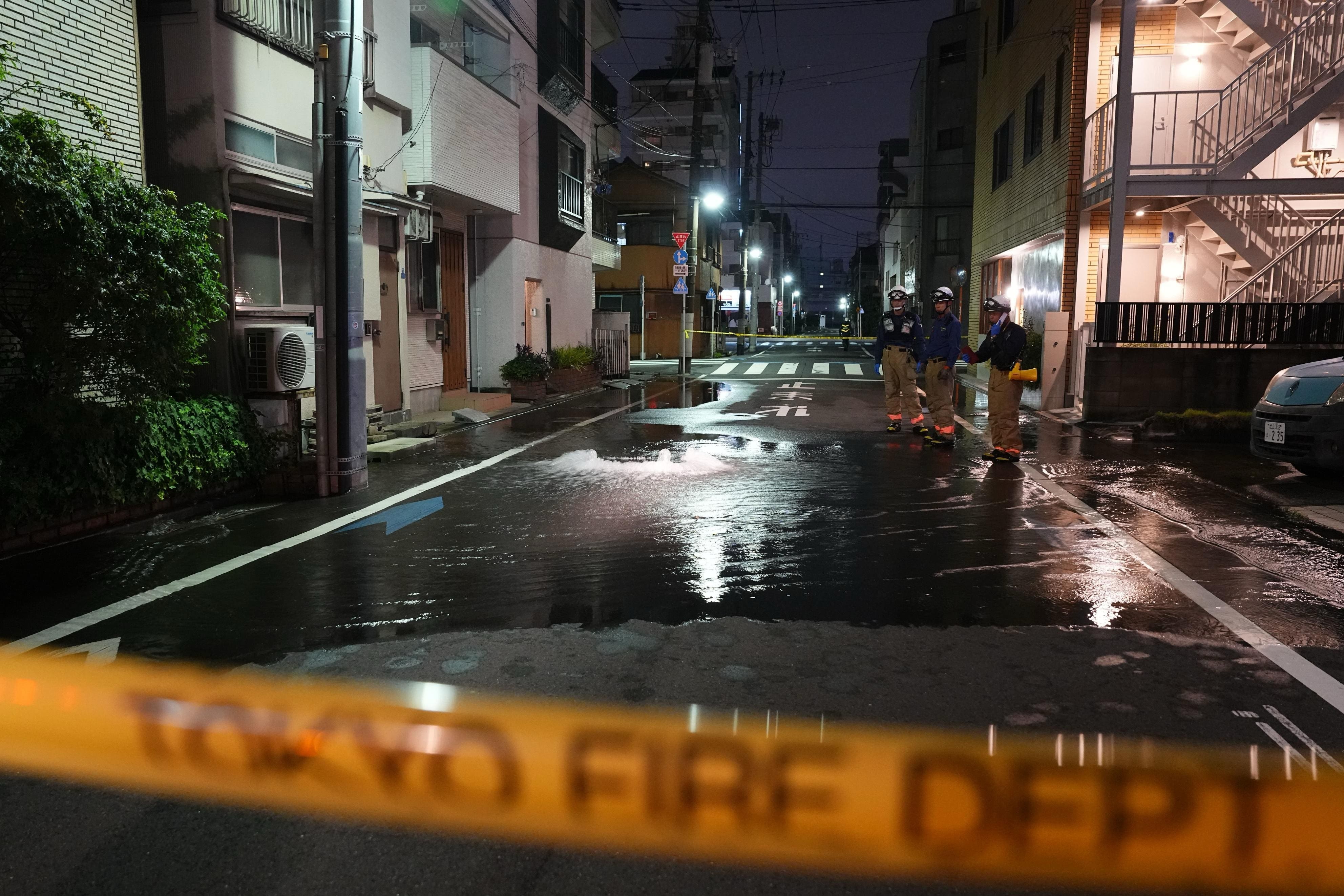
Firefighters work in a flooded street after a magnitude 5.9 earthquake struck eastern Japan. — Source: gdelt At least 37 people were injured, mostly with minor injuries from falling or striking furniture while getting out of bed in panic; one elderly woman in Yokohama suffered a serious hip injury. [1] The official count of injured reported during the morning reached 37, including a woman about 80 years old who suffered a serious hip injury after falling from bed in Yokohama. [1] At least 37 people were injured after the magnitude 5.9 quake hit the Ibaraki area northeast of Tokyo during the early hours of Sunday. [2] The Fuji News network, citing the Fire and Disaster Management Agency, reported that up to 10 a.m. local time at least 37 people had been injured in Tokyo, Ibaraki Prefecture and Kanagawa Prefecture among other zones. [2] Most of the injured suffered when they fell or struck against furniture or doors after being surprised by the quake while sleeping and getting out of bed in panic. [2] Most of the injured were hurt when they fell down or hit themselves against furniture or doors as they were caught off guard by the first quake in the morning. [3]
Infrastructure Damage and Transport Disruptions
The quake caused temporary delays and suspensions in some rail services including express trains to Narita Airport, broken water pipes leading to street flooding in Tokyo's Koto district, and prompted inspections of buildings and infrastructure. [1] The tremor activated seismic alerts on cell phones and generated scenes of concern in different points of the capital. [1] There were also delays and temporary suspensions in some rail services, including express trains connecting Tokyo with Narita Airport. [1] Shinkansen bullet trains continued operating normally. [1] The quake interrupted some rail services serving Tokyo and Narita Airport in the Kanto region temporarily, although operations were gradually restored. [2] Several water pipes burst in Tokyo and other zones, causing temporary flooding on some highways. [2] The quake caused delays to express trains serving Tokyo and Narita Airport and other local trains serving northeastern regions, but Shinkansen bullet trains were running normally. [3] The start of some train services was delayed, while some trains ran at reduced speeds according to JR East and other operators. [3] Some express services operated by Tobu Railway remained halted. [3]
Official Response and Nuclear Safety
No tsunami warning was issued, and no anomalies were detected at nuclear facilities including Tokai No. 2 and Fukushima. [1] After the earthquake the Japan Meteorological Agency ruled out the possibility of a tsunami. [1] The Nuclear Regulation Authority reported that no anomalies were detected at the Tokai No. 2 plant located in Ibaraki, while no problems were reported at the nuclear facilities in Fukushima. [1] Despite the intensity of the phenomenon, no tsunami threat was issued. [2] The government set up a task force to assess the extent of possible damage. [3]
Aftershock Warnings and Follow-up 6.0 Quake
Prime Minister Sanae Takaichi activated emergency mechanisms and a government task force to assess damage; the Japan Meteorological Agency warned of possible aftershocks of similar intensity for about a week. [1] The Japan Meteorological Agency warned that during approximately one week aftershocks of similar intensity could occur, especially in the coming days. [1] The agency urged the population to remain alert to the possibility of a moderate aftershock during the next week, especially in the next two or three days. [2] Hours later, a magnitude 6.0 earthquake struck off the coast of Urakawa in Hokkaido at a depth of about 40-43 km with seismic intensity 4, but no tsunami warning or immediate injury reports were issued. [3] A second earthquake of magnitude 6.0 struck parts of Japan's Hokkaido prefecture on Sunday evening, just hours after tremors of magnitude 5.9. [3] According to the Japan Meteorological Agency, the second earthquake had a depth of 40 kilometers, with its epicenter off the coast of Urakawa in Hokkaido. [3] The quake hit at 10:45 p.m. local time. [3] No tsunami warning was issued because the tremors' seismic intensity was 4 on a scale of 7. [3] A magnitude 6.0 earthquake occurred at a depth of 42.9 km. [4]
Japan's Seismic Context
Japan is located in one of the most seismically active zones on the planet and has strict earthquake prevention and response protocols. [1] The previous month another quake of magnitude 7.1 affected the Kumamoto area in Kyushu, the southernmost island of Japan, causing 38 deaths and leaving 364 others injured. [2]
What to watch next: The Japan Meteorological Agency warned that during approximately one week aftershocks of similar intensity could occur, especially in the coming days, while the government task force continues to assess damage.