

Iran War Resumes as US Enforces New Blockade on Iranian Ports
The Iran war that began in February 2026 has resumed after a fragile June Memorandum of Understanding, with the US seeking to enforce a new blockade against Iranian ports and causing renewed disruption to shipping through the Strait of Hormuz. [1] Multiple attempts at partial de-escalation through negotiations have occurred since the conflict started, yet the recent Memorandum of Understanding signed by the US in June in Versailles has fallen under strain in the past week. [1] When a memorandum of understanding intended to bring the Iran war to a formal close within sixty days was announced on June 14, the world breathed relief as the Strait of Hormuz seemed to be slowly reopening. [2] Barely a month into the ceasefire, fresh hostilities broke out between the US and Iran. [2]
Resumption of Hostilities After June Ceasefire
The recent Memorandum of Understanding signed by the US in June in Versailles has fallen under strain in the past week, with the US seeking to enforce a new blockade against Iranian ports. [1] Donald Trump has made some of the most aggressive public threats about military action of any modern US president and has walked back many of them. [3] On March 21 Trump stated on his Truth Social platform that if Iran does not fully open the Strait of Hormuz within 48 hours the United States would hit and obliterate their various power plants starting with the biggest one first. [3] Two days later Trump extended the deadline for five days citing very good and productive conversations with Iran and then paused the period of energy plant destruction by 10 days to April 6. [3] On April 5 Trump unleashed a profanity-laden post stating open the Strait or you will be living in Hell. [3] On April 7 Trump announced a whole civilisation will die tonight never to be brought back again. [3] Hours later he said he agreed to suspend the bombing and attack of Iran for a period of two weeks accepting a truce proposal from war mediators. [3] On June 11 Trump posted that the United States will be hitting Iran very hard tonight and at some point in the not too distant future will be taking Kharg Island and other oil infrastructure locations. [3] Five hours later Trump said he cancelled the scheduled strikes and bombings against Iran that evening citing progress in negotiations. [3] An interim deal to end the fighting was signed in June but within a month the conflict re-intensified with Iran hitting US facilities across the Middle East and US forces striking Iranian coastal defenses while expanding targets to include bridges and infrastructure. [3] On July 31 Trump told a meeting of his cabinet that they will be hitting them very hard and at some point they are going to say we just cannot take it anymore. [3] On August 1 Trump said they have just been asked by Iran and other Middle Eastern countries to hold off any attack claiming the perimeters of a deal has been agreed to. [3]
Disruption to Global Energy and Food Supplies
The most immediate impact of the US-Iran war has been increased global fuel prices as commercial oil tankers face security risks and spiralling insurance costs transiting through the Straits of Hormuz. [1] Adam Hanieh highlighted in April the looming impact on the price and supply of food as one-third of the world's fertilisers were shipped through Hormuz prior to the war. [1] Since its resumption last month the war is no longer contained to two countries and has pulled in other countries from the region as well as armed militias. [2] The conflict has already spilt over to the Red Sea where Yemen’s Iran-backed Houthis are targeting Saudi-flagged ships and to the Caspian Sea where Ukraine hit vessels carrying Iranian-linked military cargo. [2] Riyadh has also stitched together a Multinational Maritime Defence Alliance a 14-nation coalition announced on July 30 led by Saudi Arabia alongside Turkey Pakistan and Egypt to safeguard critical regional waterways. [2] The International Monetary Fund has cut its global growth forecast pointing to geopolitical uncertainty tighter financial conditions and inflation risk. [2] The World Bank puts growth below pre-pandemic norms and the Organisation for Economic Cooperation and Development flags the same softness in both advanced and emerging economies. [2] The International Energy Agency has warned that oil-market volatility tied to the war is complicating energy security and investment planning worldwide. [2] A fifth or more of all seaborne oil passes through the Strait of Hormuz alone with Bab el-Mandeb carrying a further slice of global shipping. [2] Higher energy costs feed into fertiliser and food production too and the World Bank has repeatedly pointed out that commodity spikes land hardest on developing economies. [2]
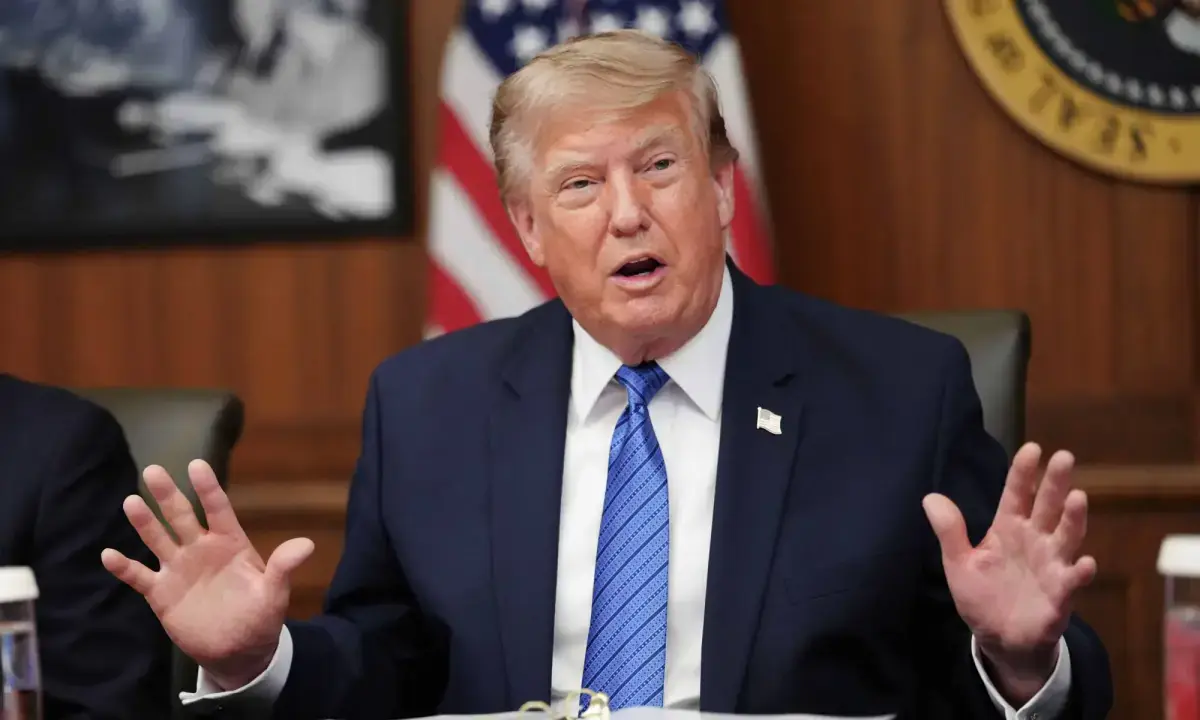
Donald Trump speaks during renewed US-Iran hostilities over the Strait of Hormuz blockade. — Source: dawn
Effects on Sudan's Civil War Economy
Since 2023 Sudan has been in the midst of a civil war and the world's worst humanitarian crisis. [1] Bread and fuel prices have an evocative significance in Sudan because attempts to dismantle bread and fuel subsidies in 2018-19 led to mass protests culminating in the 2019 revolution that brought down the military president Umar al-Bashir. [1] Since the start of the current war in 2023 access to food has been weaponised with widespread food insecurity leading to death and displacement as much as active conflict. [1] Access to fuel is important to sustain economic activity during Sudan's crisis through mechanised irrigation pumps used in commercial farming and for transport moving consumer imports and agricultural exports across the country. [1] Fuel also sustains military activity most notably the movement of troops as well as the air power deployed by the Sudanese Armed Forces. [1] Complex logistical operations are required to transport fuel across Sudan's large distances across conflict zones and sometimes these operations are carried out through risky informal operations with convoys of truck drivers paying cash-in-hand to cross deserts dirt tracks and land borders. [1] All of this makes the cost of fuel prohibitively high in a country where incomes have collapsed due to the war and the effect of further price rises due to the war in Iran has already exacerbated this hardship. [1]
Regional Power Shifts Between Saudi Arabia and UAE
It is well established that the UAE has been providing extensive support to the Rapid Support Forces while the Sudanese Armed Forces has received sustained support from Egypt and more measured support from Saudi Arabia. [1] Immediately before the start of the US-Iran war Saudi Arabia and the UAE were engaged in a major diplomatic confrontation with reverberations in countries around the Arabian Peninsula and its periphery. [1] A military advance by the Southern Transitional Council in Yemen backed by the UAE in December 2025 led to the STC capturing large parts of the southern Yemeni coastline and territory bordering Saudi Arabia. [1] This led to a dramatic riposte by Saudi Arabia against both the STC and the UAE bombing some of the latter's naval facilities in Yemen. [1] This new regional fracture soon spread to other theatres such as Somalia in January 2026 when the federal government in Mogadishu with support from Saudi Arabia ended multiple investment agreements with the UAE governing access to ports and compelled the UAE to withdraw its military presence from Bosaso in Puntland. [1] The US-Iran war has further weakened the UAE's position relative to its Saudi neighbour because all major Emirati ports except for the small eastern emirate of Fujairah are inside the Gulf with their maritime access to the world compromised by the disruption of shipping in the Straits of Hormuz. [1] Conversely Saudi Arabia has a long coastline on the Red Sea with major port facilities in Jeddah and Yanbu so its ability to receive imports and to deploy part of its navy is consequently little compromised. [1] During the Iran-Iraq War Saudi Arabia constructed an East-West oil pipeline linking the country's eastern oil-producing regions to its port facilities on the Red Sea and this pipeline has become crucial since February and the start of the US-Iran war. [1] Although this pipeline cannot replicate the volumes of exports that pass through the Gulf in peacetime conditions Saudi Arabia's economy is more resilient to the shock of the current war than is the UAE and Riyadh is considering expanding this critical pipeline infrastructure. [1]
{IMAGE_3}
Iran's curtailed Role in Sudan
Since 2023 Iran has gradually increased diplomatic contact and cooperation with the Sudanese Armed Forces to provide technical support and security training. [1] This is a pragmatic relationship as both countries have been subject to long-term Western sanctions and cooperation is accordingly a means of building capacity and resilience outside of Western trade and financial networks. [1] Relations since 2023 have revived a close relationship that had existed in the 1990s when Sudan was first subjected to US sanctions. [1] The prize for Iran in Sudan is a Red Sea base. [1] Iran through the so-called Axis of Resistance has extensive experience of providing technical assistance and security training to weak regimes and non-state actors in Iraq Syria Yemen Lebanon and Palestine allowing these partners to acquire a military capability and resilience beyond what their financial resources would suggest. [1] The war with the US is likely to have severely curtailed Iran's ability to provide meaningful support to actors in Sudan. [1] However in the case of a protracted war Iran could find that it is in a position to export its expertise in military drone technology as well as effective and protracted military operations conducted with limited financial resources. [1]
Broader International and Economic Repercussions
Pakistan and other mediators have kept pushing both sides to return to the MoU a 14-point framework under which Washington and Tehran agreed to halt hostilities and reopen Hormuz to shipping while working through the harder questions of sanctions Iran’s nuclear programme and regional security over a 60-day window yet they have not been able to stop the war as yet. [2] The map of this war keeps getting bigger with more actors being added. [2] Global institutions have already stopped treating the Iran war as a regional story. [2] The International Monetary Fund has cut its global growth forecast pointing to geopolitical uncertainty tighter financial conditions and inflation risk while the World Bank puts growth below pre-pandemic norms and the Organisation for Economic Cooperation and Development flags the same softness in both advanced and emerging economies. [2] Finance Minister Muhammad Aurangzeb blamed the Middle East conflict for disrupting a trajectory that had otherwise been on track despite the 2025 floods and tariff uncertainty at the start of the fiscal year. [2] The State Bank held its policy rate at 10.5pc through the early months of the conflict then raised it by a full percentage point to 11.5pc in April as oil-driven inflation pushed past the central bank’s target range. [2] Inflation has since eased down to 11.1pc in June from 11.7pc in May. [2] The State Bank has now held the rate steady for two consecutive meetings most recently on July 27. [2] A current account deficit of just $139 million last fiscal year and reserves sitting around $20bn buy Pakistan more room than it had in 2022-23. [2]
What to watch next is whether mediators can revive the 14-point framework that aimed to halt hostilities and reopen Hormuz within a 60-day window while addressing sanctions Iran’s nuclear programme and regional security.







