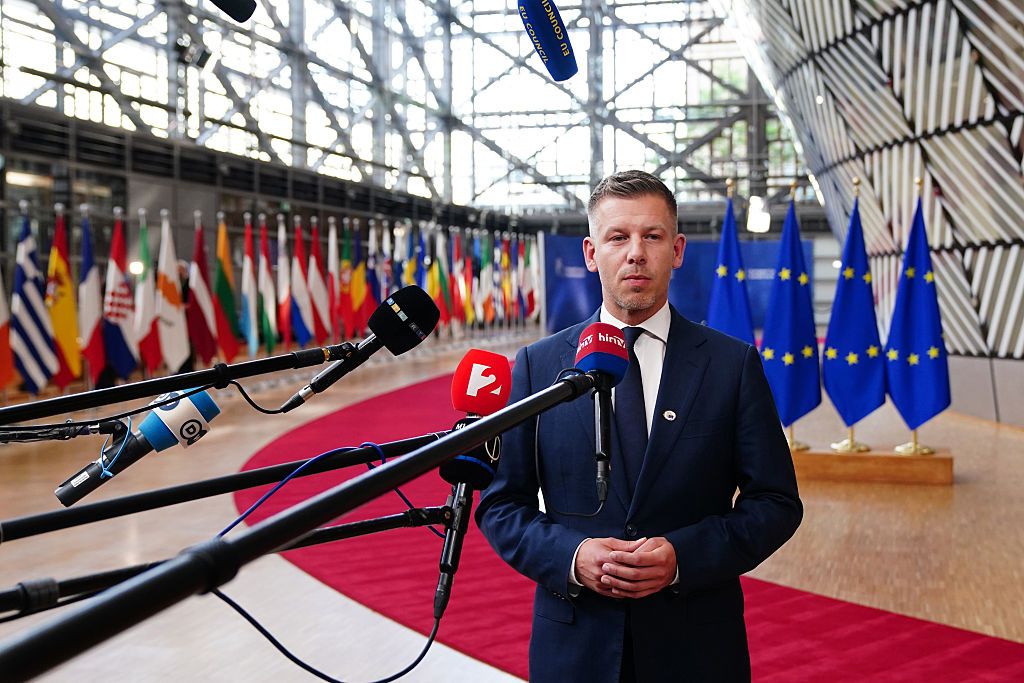

Hungarian Leader Forces EU to Drop Ukraine Accession Acceleration Pledge
EU Waters Down Ukraine Accession Language
The conclusions of the meeting of EU leaders on June 18 have been watered down, at the insistence of Hungarian Prime Minister Peter Magyar, to reduce the urgency of advancing Ukraine's EU accession process. [1] Three days prior, the EU opened the first of six so-called enlargement clusters for Ukraine and Moldova, to-do lists that they must complete to become the union's member states. [1] It was expected that the remaining five clusters would open in July at the latest. [1] The draft conclusions for the EU leaders' summit, seen by the Kyiv Independent, read that the European Council "looks forward to the opening of the other clusters as soon as possible, in line with the merits-based approach." [1] The final conclusions agreed on the evening of June 18 have deleted the wording "as soon as possible." [1] This adjustment means the text no longer signals an accelerated timeline for the remaining clusters. [1] The change leaves the pace of Ukraine's accession more dependent on the standard merits-based process without an explicit push for speed. [1]
Magyar Claims Credit for the Revision
Magyar tweeted, "At my initiative, a clause referring to accelerating accession was removed from the text at the very last moment. It wasn't easy," after leaders finished meeting late on June 18. [1] He presented it as an example of how he can represent Hungary better at the European level than his predecessor, Viktor Orban. [1] "That's how it can be done, if someone comes not just to flip tables and sow fear, but strives to find a compromise," Magyar said. [1] Magyar had previously suggested that he sees Ukraine joining the EU only in 10-15 years, a timeline much further into the future than most dates being floated by Ukraine and its European allies. [1] Though not as serious a disruption for Ukraine as Viktor Orban's liberal use of the veto, these changes still come as a blow to President Volodymyr Zelensky, who insisted on Ukraine getting a fast-track EU membership during the G7 summit held the same week. [1]
Diplomats Confirm Hungarian Pressure
Two EU diplomats confirmed separately to the Kyiv Independent that Magyar had pushed for this change, which, while small, potentially carries big implications. [1] One of them said that their prime minister had informed them that Budapest wanted to emphasize that Ukraine would have to adopt all the rules, and that Kyiv would not be able to cut corners. [1] The other added that they were not surprised as Hungary's objection had "been hanging over things for a while." [1] The diplomats noted that the revision aligns with Budapest's long-standing position that full rule adoption must occur without shortcuts. [1]
Zelensky's Response and Expectations
Zelensky left the June 18 meeting of EU leaders early, after which he told journalists that "partners are great, they are our friends, we will open all the clusters, I am sure of this. We deserve it, and we will not give up." [1] He expressed confidence that the process would continue despite the altered language in the conclusions. [1] The early departure followed discussions that included European Council President Antonio Costa and Poland's Prime Minister Donald Tusk. [1]
Broader Global Diplomatic Developments
The United States hailed an initial meeting between the Venezuelan government and opposition representatives. [2] An Israeli envoy reaffirmed commitment to the US-backed Israel-Lebanon ceasefire deal, stating that if Hezbollah does not violate the agreement, it will be kept. [3] A former Israeli Navy commander warned that diplomatic agreements may lead to Israel-Iran escalation. [4] Maj. Gen. (res.) Eliezer Marom stated in an interview that Israel must prepare for repeated rounds of fighting with Iran, noting that the Middle East has entered a new phase in which diplomatic agreements do not necessarily create stability and may even lead to escalation. [4] He added that if an agreement is signed, Israel needs to understand that and prepare for it. [4] Marom also addressed diplomatic moves surrounding Lebanon, saying Israel should move diplomatically and do so quickly. [4]
What to watch next: Further meetings on the Venezuela government-opposition track and any follow-up steps on the Israel-Lebanon ceasefire will indicate whether the initial contacts produce sustained progress.