Gaza War Leaves Thousands Missing as Families Search Rubble and Prisons
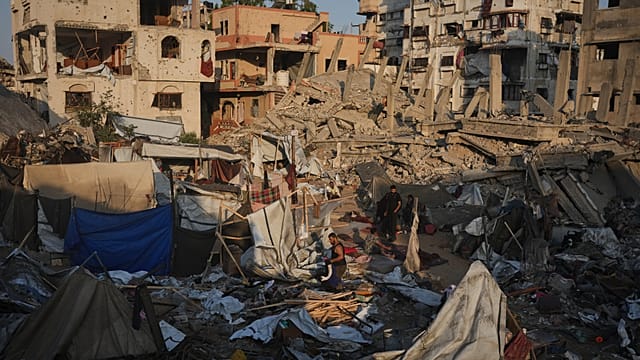
Families in Gaza continue searching for thousands of missing relatives lost during the Gaza war, many presumed buried under rubble, while a ceasefire between Israel and Hamas remains in place despite ongoing strikes that have killed more than 1,200 people since October.
Ongoing Search for the Missing
Mothers in Gaza hold photos of sons who vanished in the Gaza war and ask released prisoners if they saw or heard their names, remaining in limbo between conflicting accounts. Fadwa al-Ghalban holds a cellphone showing a photo of her son, Mosaab, at her tent in Muwasi, along Gaza's southern coast. [1] Gaza Holding photographs of their sons who vanished during the war, mothers in Gaza wait for answers. [1] Thousands of people are still missing across the territory, with many lost beneath the rubble of destroyed buildings. [1] Families’ last hope is often that their relative has been detained by Israeli authorities. [1] "Every now and then, whenever a prisoner was released, we would ask, 'Did you see my son? Did you hear his name?'," says Reem Amin Youssef Fayad, whose son is missing. [1] "Some said they had heard his name but had not seen him. Others said they had seen him. Between those who said they saw him and those who only heard his name, we remain in limbo." [1] Jumanah Manaa's son Amro Manaa is also missing. [1] "When I see someone come out safely and their family welcome and embrace them, tears flow from my eyes. I sit and cry and say, 'God, may the day come when he returns and we experience the same joy they are experiencing.’” [1] The personal anguish of families like Fadwa al-Ghalban, Reem Amin Youssef Fayad and Jumanah Manaa centers on waiting for news of vanished relatives and questioning released prisoners. [1] This search prolongs the agony as families navigate between hope and uncertainty in the aftermath of the Gaza war. [1]
Mothers in Gaza hold photos of sons missing since the war as they seek answers from released prisoners. — Source: africanews
Challenges in Body Recovery and Identification
Recovering bodies under rubble is hampered by Israeli restrictions on heavy equipment, risks from unexploded ordnance, and the lack of DNA testing at facilities like Al-Shifa Hospital, making identification difficult. [1] Ziyad Ashour is head of the Medical Evidence Section in the Forensic Medicine Department at Al-Shifa Hospital. [1] "This year, our situation has begun to stabilise, and we have started making significant efforts to trace unidentified people. However, in the Gaza Strip, unfortunately, we do not have DNA testing, which is the main method used around the world for identification. Clothing is not enough, and personal belongings found with the bodies are not enough, because we receive many bodies as cadaver.” [1] As time passes, it also becomes increasingly difficult to identify the victims. [1] The obstacles to retrieving and identifying bodies from rubble include equipment restrictions, unexploded ordnance, and the absence of DNA testing at Al-Shifa Hospital. [1] These barriers leave many families without closure during the ongoing Gaza war recovery efforts. [1]
Ceasefire Status and Recent Violence
Despite the ceasefire, Gaza authorities reported four deaths including two children from Israeli strikes on Thursday, with more than 1,200 killed in Gaza since the truce took effect in October. [1] And the killing doesn’t end despite a ceasefire still in place between Israel and the Palestinian militant group Hamas. [1] On Thursday, Gaza authorities said four people died in Israel strikes on the territory, including two children. [1] Since the ceasefire took effect in October, more than 1,200 people have been killed in Gaza. [1] The continuation of the Israel-Hamas ceasefire alongside fresh Israeli strikes that killed four people including two children on Thursday, and the total of more than 1,200 killed since October, underscores persistent violence. [1] Hamas is reportedly holding talks with international mediators in Cairo aimed at consolidating the truce. [1] This status highlights the fragile nature of the truce amid the broader Gaza war. [1]
Hamas Disarmament Deal and Mediation
Hamas is holding talks with international mediators in Cairo to consolidate the truce, and has confirmed a deal to disarm as part of a US-brokered plan. [1] Hamas confirmed Friday that it will disarm in a potential breakthrough for ending the war in Gaza, but major obstacles remain. [5] Trump says Israel 'very happy' with Gaza disarmament agreement. [3] Replay: US President Donald Trump addresses Cabinet meeting following the announcement that Hamas had agreed to disarm in Gaza as part of a US-brokered plan. [4] Hamas confirmation of a deal to disarm under a US-brokered plan, ongoing talks in Cairo with mediators, and statements from Trump that Israel is very happy with the Gaza disarmament agreement form the core of current mediation efforts. [3] [4] [5] These developments occur even as the Gaza war leaves thousands missing. [1]
{IMAGE_3}
Broader Impact Since October 2023
The broader Gaza conflict since October 2023 has killed more than 73,000 Palestinians and exposed the nature of the Zionist project as a settler-colonial enterprise. [2] The genocide in Gaza since October 2023, which has killed more than 73,000 Palestinians, has marked a historic turning point in the Palestinian struggle and in the nature of the conflict with the Zionist project. [2] What unfolded went far beyond another war or another episode of Israeli violence; it exposed to the world the true nature of the Zionist project as a settler-colonial enterprise built upon ethnic cleansing, apartheid and the systematic erasure of the indigenous Palestinian people. [2] Since its emergence in the late 19th century, the Zionist movement has sought to establish a settler-colonial state in Palestine through the mobilisation of western imperialist powers and an enduring alliance with dominant forces in the international system. [2] This context on the overall death toll exceeding 73,000 Palestinians and the conflict's exposure of the settler-colonial dimensions of the Zionist project provides essential background to the ongoing searches and violence. [2]
What to watch next includes Hamas talks with international mediators in Cairo aimed at consolidating the truce alongside the confirmed disarmament deal under the US-brokered plan.