
G7 Opposes Coercion Across Taiwan Strait and China Seas at France Summit
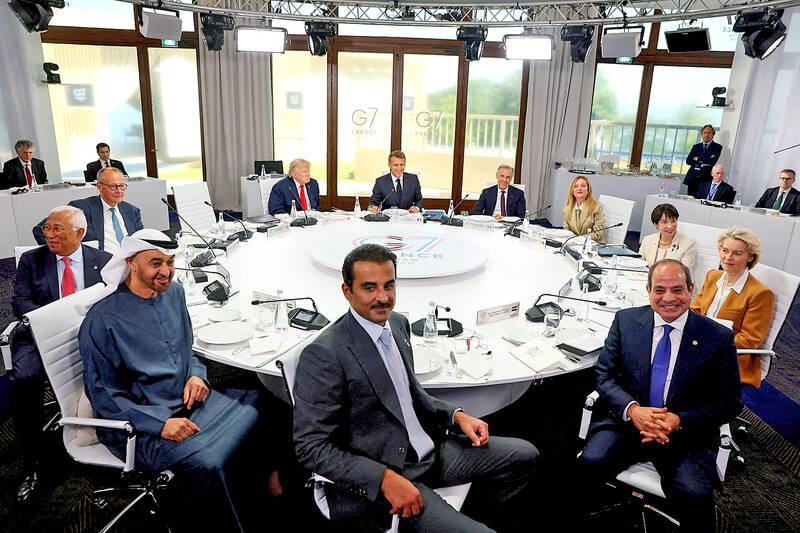
G7 leaders voiced opposition to unilateral attempts to change the status quo by force or coercion in the East and South China Seas and across the Taiwan Strait while pledging continued military support for Ukraine and welcoming a US-Iran agreement during their summit in France.
G7 Statement on Indo-Pacific and Taiwan Strait
G7 leaders affirmed their opposition to any attempts to unilaterally change the status quo in the East China Sea, South China Sea and Taiwan Strait. [1] The statement released on the second day of the summit in France stressed the importance of a free and open Indo-Pacific based on the rule of law. [1] Leaders expressed opposition in particular to changes pursued by force or coercion across those areas, without directly naming China in the text. [1] The emphasis on regional stability aligned with broader calls to maintain rules-based order in the Indo-Pacific region.
Support for Ukraine and Middle East Developments
Leaders reaffirmed their unwavering support for Ukraine in defending its freedom, sovereignty and territorial integrity. [1] They committed to providing Ukraine with air defense capacities, additional systems and interceptors, and long-range capabilities. [1] The G7 also pledged support for keeping the Strait of Hormuz open, noting that the UK and France are preparing measures to ensure the safety of navigation there. [1] These preparations were described as playing an important role in normalizing conditions in the strait. [1] The statement welcomed the US-Iran agreement and stressed that Iran must never obtain a nuclear weapon. [1]
Canada's Palestinian Aid Announcement
Canadian Foreign Minister Anita Anand announced an additional $100 million in funding to support humanitarian assistance for civilians in Gaza and the West Bank. [2] The assistance, delivered through the UN, Red Cross, Red Crescent and other NGOs, brings Canada’s total contribution to $500 million for the Palestinian territories. [2] The funds are intended to help provide emergency medical assistance, food and nutrition, water, sanitation, shelter, protection services and stabilization initiatives. [2] Anand also noted the launch of the International Peace Fund for Israel and Palestine with the UK and Australia, including a Canadian commitment of $1.8 million to support civil society organizations working on grassroots peace efforts. [2]
US Command Name Restoration
The Pentagon restored the name of US Indo-Pacific Command to US Pacific Command, reversing a 2018 decision. [4] The change does not alter the command’s area of responsibility, which stretches from the western part of India to America’s Pacific coastline, nor its fundamental mission. [4] Officials said the restoration honors the command’s deep historical roots and fosters a sense of pride among personnel. [4] The US Pacific Command was originally established after World War II and operated under that name for over 70 years before the previous renaming. [4]
Allied Naval and Defense Cooperation
Greece is expected to contribute one frigate and one support vessel for mine-clearing and patrols in the Strait of Hormuz. [3] Lithuania and the United States signed a letter of intent to deepen cooperation on drone and counter-drone systems during a ceremony in Paris. [5] These steps complement ongoing allied efforts to support navigation security and technological partnerships in key regions.
Call for North Korea Denuclearization
The G7 called for the complete denuclearization of North Korea in accordance with UN Security Council resolutions. [1] This position was included in the leaders’ statement alongside other geopolitical priorities discussed at the summit.
What to watch next: Further details on UK and France preparations for Strait of Hormuz navigation safety, implementation of Canada’s additional humanitarian funding, and progress on the Lithuania-US drone cooperation agreement.