
France Wildfires Force Nearly 200,000 to Evacuate in Gironde and Landes
France wildfires have forced the evacuation of nearly 200,000 people in the Gironde and Landes regions, with additional evacuations near Bordeaux and more than 220,000 people displaced across France and Spain combined. [5]
Mass Evacuations in Southwest France
French authorities have ordered the evacuation of almost 60,000 people near Bordeaux, taking the total number of people told to flee wildfires in France and Spain to more than 220,000. [5] Around 200,000 people have been evacuated in south-west France in the Gironde and Landes regions. [5] In the early hours of Saturday, four towns near Bordeaux were evacuated as a precaution. [5] The towns were Saint-Médard-en-Jalles, Saint-Jean d'Illac, Martignas-sur-Jalles, and Saint-Aubin de Médoc, which together have a population of 58,400 residents. [5] Officials evacuated the entire Cap Ferret peninsula on the south-west coast, with hundreds escaping by boat after flames swept through the popular tourist destination. [5] The area has a year-round population of just under 8,000 people, but numbers can increase 10 fold during the summer holiday season. [5] Further south, another wildfire near Biscarrosse in the Landes region forced more than 23,000 people to evacuate homes, campsites, a nursing home and a summer camp. [5] France and Spain have evacuated more than 160,000 people as unprecedented forest fires ravaged areas near Madrid and Bordeaux. [1] Nearly 270,000 people are evacuated in France and Spain, with nearly 200,000 evacuated in France alone. [3]
Conditions at Evacuation Shelters in Bordeaux
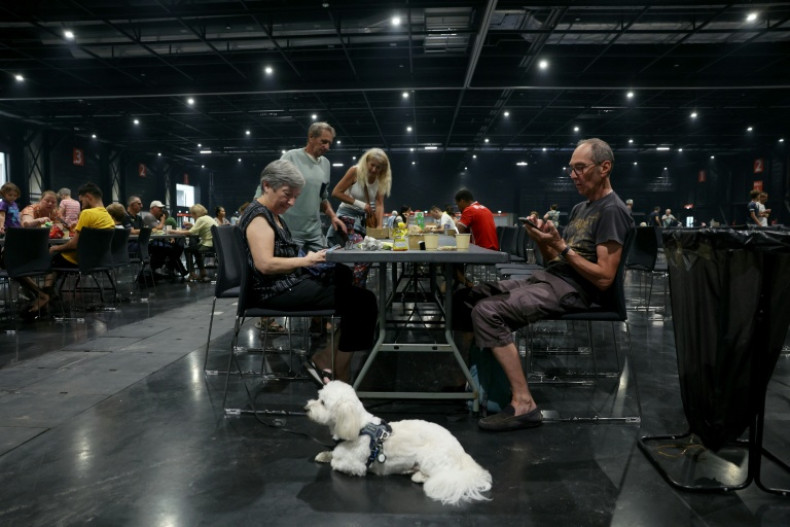
Amid rows of camp beds and stacks of food supplies at a makeshift shelter in Bordeaux, thousands of tourists and locals try to regain their composure after fleeing wildfires sweeping through southwest France. [1] Most of the evacuees, coming from the Arcachon Bay area and towns near Bordeaux that are now threatened by the fire, arrived during the night. [1] Masks are distributed upon request. [1] Smoke still hangs in the air, although it is easier to breathe than the previous evening, when the acrid smell of fire spread across Bordeaux. [1] Some evacuees have brought their cats and dogs with them, and bags of pet food and cat litter have been made available. [1] Several buses have been chartered to transport elderly people. [1] A first-aid station has been set up, with a doctor on site to provide support. [1] Locals in Bordeaux have come forward to help. [1]

Wildfires prompt evacuation of nearly 200,000 people in France's Gironde and Landes regions. — Source: france24
Scale and Behavior of the Gironde Wildfire
The Gironde blaze, described by local prefect Sophie Brocas as an "XXL fire", has burned through more than 19,000 hectares of forest and destroyed about 80 homes. [5] Fire and rescue chief Marc Vermeulen said conditions were more severe than during the devastating fires that hit the region in 2022, with drought enabling the blaze to continue spreading through the night. [5] "We have never seen a convective fire of this magnitude," France's Interior Minister Laurent Nuñez told French broadcaster TF1, adding that around 50 firefighters had been injured. [5] He said the blaze was "self-sustaining" and changing direction, with the fire moving east towards Bordeaux on Friday evening. [5] Landes prefect Gilles Clavreul said the fire would not be extinguished by the end of Friday, with winds reaching 50km/h and temperatures of 36-37C. [5] Philippe de Gonneville, the mayor of one of the worst-affected areas, Lège-Cap Ferret, said the region had faced extreme weather conditions for the last month and a half with no rain and above-average temperatures. [5]
Government and International Response
French President Emmanuel Macron has mobilised the military to assist the response. [5] President Macron described the wildfire situation in the country as very tense, particularly in Gironde. [5] The government will hold an emergency meeting on Saturday morning. [5] In the meantime, Macron said France had activated the European Union's civil protection mechanism and will receive reinforcements, including two Black Hawk helicopters from the Czech Republic and Slovakia. [5] The European Union has deployed aircraft and helicopters to support firefighting efforts in Spain and France. [5]
Extreme Weather and Climate Context
The European Union has deployed aircraft and helicopters to support firefighting efforts in Spain and France, as much of southern Europe grapples with repeated heatwaves and prolonged drought. [5] Europe is the fastest-warming continent, heating at more than twice the global average since the 1980s, according to the EU's Copernicus Climate Change Service. [5] Hotter, drier conditions are leaving vegetation with less moisture, creating fuel that enables wildfires to ignite and spread more quickly. [5] Wildfires have burned more land in Europe already this year than the annual average for the past two decades, according to the European Forest Fire Information System. [5] The European Environment Agency has said climate change has increased forest fire risk across Europe, with the greatest danger expected in southern Europe. [5] The average forest fire season has become 20 percent longer between 1979 to 2013, according to the UN's climate panel. [3]
Eyewitness Accounts from Residents and Tourists
Nuala Kelly, a 75-year-old Irish tourist, said she had never seen anything like this. [1] “Never, never, never, never, never, and I’ve travelled all over the world and been in all sorts of situations,” she told AFP at Bordeaux’s vast exhibition centre now housing thousands of people displaced by the wildfires. [1] “It’s an experience, you know, I would be happy to do without it, but everybody’s been very kind here, very good, so we have to be thankful.” [1] Olivier Stewart, 38, had to leave Merignac with his wife and young children after receiving an emergency notification. [1] “The children are the most stressed. They think the fire is going to burn down the house, but we’re coping,” he said. [1] Frederic Tavitian, a 70-year-old retiree, who lives about 50 kilometres away, said it took him about four hours to get to the shelter because of the traffic jams. [1] “At 3pm, we were told, ‘You have to evacuate.’ We saw columns of smoke, like a volcano about to erupt. So we left,” said Tavitian, sitting on his camp bed with a guitar in hand. [1] He was worn out from not being able to sleep due to the constant noise. [1] “It’s really tough. That’s the way it is. We just have to live with it,” he said. [1] David Duval, 55, said he could accommodate a family. [1] “I have a spare room available,” he said. [1] “It breaks my heart when I see all these people in distress. We have to think about what each of us can do,” said the engineer, who lives nearby. [1] French-Norwegian Emilie Dorgeville said she is trying to relax and enjoy the fine weather while there is total chaos. [3] “It is total catastrophe around us,” she said. [3] “We are still in a safe area by the sea. Now the fire has started to spread eastwards, and we do not know if they are going to close the roads.” [3] “I feel sorry for those who live here and do not know if they have a house tomorrow.” [3] Norwegian-French Natalie Thourmieux lives in Bordeaux with her family. [3] “It has been very scary, because the fire went very fast with the wind.” [3] “We could not breathe and we had to close all the windows. There was also a lot of ash everywhere.” [3] Silje Winther Dahl lives in a small town south of Charente Maritime. [3] “It smelled like sour campfire, right. It stings a little in the nose, the eyes and everything. The sun was just a red knob in the sky that you could look straight at. Almost a bit like a solar eclipse.” [3]
What to watch next: The Gironde blaze is moving east towards Bordeaux, with authorities reorganising the response to fight it from the ground and prevent further advance, while Spain monitors whether the Burgohondo fire merges with the Madrid blaze. [5]