
Doomsday Clock Tensions Rise With Iran's Warning to South Korea Over Hormuz
Tensions over the Strait of Hormuz have intensified the doomsday clock as Iran prepares to declare a new restricted zone in the Gulf while issuing direct warnings to South Korea and maintaining that the ball has long been in the US court.
Iran's New Restricted Zone and Shipping Corridor Plans
Iran said it will announce a new restricted zone in the Gulf in the coming days, along with maps of a new shipping corridor through the Strait of Hormuz. [4] The new restricted zone will begin from where the US blockade of Iran begins and extend into areas of the Gulf, according to Mohsen Rezaei, the secretary of Iran’s Supreme National Security Council. [4] Any ship entering the new zone would be added to a sanctions list. [4] Maps detailing passage routes for the Strait of Hormuz would also be approved soon. [4] The maps of a new international corridor which lies in Iranian and Omani waters and in which Iran will have management have been agreed and should be signed in the coming days. [4] Iran says talks with Oman on a temporary safe route through the strait have made very good progress and reached the final stage. [1] Iran says the ball has long been in the US court over the Strait of Hormuz. [1] We will only commit to the Strait of Hormuz being open when they the Americans stop the sabotage, threats and attacks on Iran, Rezaei added. [4]
Doomsday Clock Warning to South Korea on Hormuz Involvement

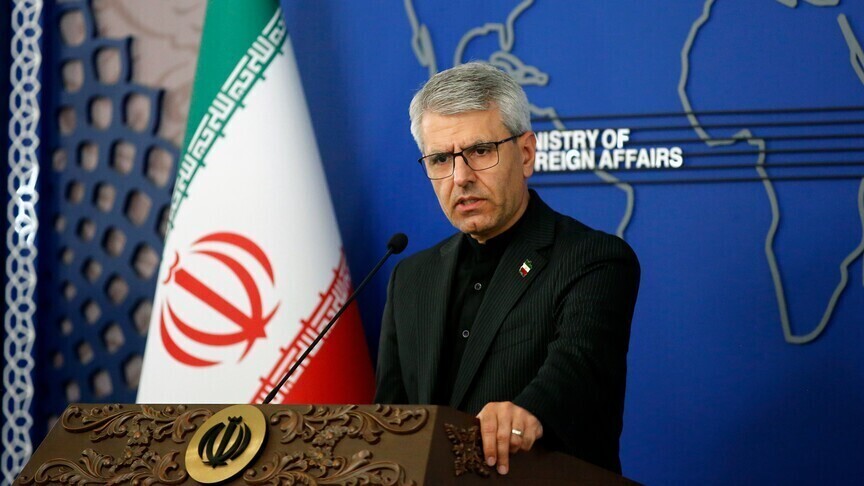
Iran official warns South Korea against involvement in Strait of Hormuz tensions. — Source: japantimes
Iran’s foreign ministry warned South Korea against military deployment or involvement in US operations in the Strait of Hormuz, saying such a move would have serious consequences. [3] On Friday, Seoul said it was considering contributions to US security efforts in the strategic Strait of Hormuz, which Tehran has largely controlled since the outbreak of war against the United States on Feb. 28. [3] South Korea said it would consider the move provided that its own military readiness was not compromised, but added that no decision had been made. [3] Iran’s foreign ministry spokesperson Esmaeil Baqaei warned South Korea against succumbing to what he called US pressure and intimidation. [3] Any military deployment or participation in operations by other countries in the Persian Gulf or the Strait of Hormuz can only be regarded as direct support for the party responsible for that aggression and will have serious consequences, he said in a post on X. [3] Iran and the United States have continued to trade fire in and around the Strait of Hormuz, even after an April ceasefire brought the initial intense bombardment campaign to an end. [3] Negotiations between the two foes have stalled as they vied for control over Hormuz, which normally carries around a fifth of the world’s oil and liquefied natural gas exports. [3] Since the war erupted, traffic through the vital waterway has been virtually paralyzed, disrupting global energy markets. [3] Iran has required vessels to seek permission to transit, a move opposed by Washington and several regional countries, insisting that there will be no return to the pre-war system of unrestricted navigation. [3]
Ongoing Military Stalemate and Recent Strikes
Six months after US-Israeli strikes on Iran sparked the war, the conflict appears to be at a stalemate. [4] A preliminary ceasefire accord reached in June has unravelled, and little progress has been made in diplomatic efforts to get the peace process back on track. [4] After a pause in military action for much of August, tit-for-tat strikes have resumed. [4] US forces struck three Iranian oil tankers on Saturday, US Central Command said, including one off Kharg Island, Iran’s key oil export hub, following attacks by Iran’s Islamic Revolutionary Guard Corps on US warships in the region. [4] Tehran has shown it retains the capability to attack US interests in neighbouring countries and to shut down oil flows through the Strait of Hormuz, through which about a fifth of global oil supplies flowed prior to the conflict. [4] An average of 10 commodity ships transited the Strait per day in the past 10 days, the lowest since May, according to shipping data on Monday. [4] That helped oil prices extend last week’s big gains, with Brent crude up 0.8% above $97 a barrel. [4]
IAEA Blind to Iran's Nuclear Program
The International Atomic Energy Agency is completely blind regarding Iran's nuclear program and has been since at least June 2025, the agency's Director-General Rafael Grossi told its Board of Governors on Monday. [5] As stated in the report the Agency has neither received information from Iran regarding the status of its declared nuclear material or facilities nor had access to any of those facilities to conduct in-field verification activities, Grossi said. [5] Therefore, the Agency was unable to discharge its safeguards responsibilities under the NPT Safeguards Agreement at declared nuclear facilities in Iran. [5] Consequently, we were not able to verify their status for safeguards purposes and the associated nuclear material, and as a result I am also unable to report in relation to the implementation by Iran of relevant provisions of the UN Security Council resolutions or the Board’s resolutions of November last year and June this year, he continued. [5] It is more than a year since the Agency lost continuity of knowledge in relation to the previously declared inventories of LEU and HEU enriched up to 60% U-235 at the declared nuclear facilities affected by the military attacks of June 2025, he noted. [5] The Agency’s lack of information about these facilities and associated nuclear material and our inability to conduct verification activities at these facilities is a matter of serious proliferation concern, Grossi said. [5] The situation needs to be rectified with the utmost urgency. [5] He called on Iran to engage with the Agency constructively in order to make possible the full and effective implementation of Agency safeguards in Iran and to fulfill its responsibilities under the NPT Safeguards Agreement. [5] A return to diplomacy and negotiations aimed at finding a solution to issues related to Iran’s nuclear program is imperative, and the Agency stands ready to support such efforts, Grossi added. [5] The situation regarding Iran’s nuclear program has implications for the global non-proliferation regime, he warned. [5]
Economic Pressure and Iranian Response
Iran has said it will step up efforts to tackle problems created by US sanctions that are crippling its economy. [4] However, the US campaign to throttle Iran’s economy by blockading its oil exports and stopping sanctions evasion is growing increasingly difficult to withstand, three senior Iranian sources have said. [4] Iran’s Parliament Speaker Mohammad Baqer Qalibaf said on Sunday that the US should understand that the rules of the game have changed before it is too late. [4] From now on, any attack against Iran’s interests and security will receive a faster, heavier and more painful response, he said in a speech published on his Telegram channel. [4] Qalibaf said that alongside the military front, Iran’s main battle was now over production and people’s livelihoods. [4] He cited sharp currency fluctuations, inflation, unemployment and market management as major challenges, adding Iranians could tolerate hardship but not mismanagement or inaction and expected the government to act quickly. [4] Iran’s Economy Minister Ali Madanizadeh said Tehran planned to respond to US economic pressure with reforms and rejected the notion that sanctions would cause it to change course, according to state media on Sunday. [4] They speak of economic pressure and isolation, of breaking off financial ties and they think that by pressuring the economy of a country they can change the decisions of its people, Madanizadeh said. [4] I have to clarify one point: The responsibility of reforming Iran’s economy is with its government and people, not with the US Treasury. [4] Iran is the third-largest producer in the Organization of the Petroleum Exporting Countries and exported 90% of its crude via its Kharg Island export hub before the war. [4] Flows have been disrupted since a US blockade of Iranian oil exports began in mid-April. [4] US Central Command said on X that as of Sunday it had redirected 92 commercial vessels, disabled three and boarded two to ensure strict compliance with its blockade. [4] On August 31, US President Donald Trump issued a one-line social media post accompanied by an AI-generated video depicting Kharg Island being blown to smithereens. [4] Iranian authorities have vowed a strong response if Kharg is attacked. [4] In an interview aired on state TV on Sunday, Iran’s Oil Minister Mohsen Paknejad said the island had been hit around 550 times in previous months but continued to operate. [4]
US-Iran Standoff Over Strait Control
Negotiations between the two foes have stalled as they vied for control over Hormuz. [3] Iran has required vessels to seek permission to transit, a move opposed by Washington and several regional countries. [3] Iran insists that there will be no return to the pre-war system of unrestricted navigation. [3] US Energy Secretary Chris Wright said oil was getting through the waterway. [4] Our transits through the Strait are averaging over 9 million barrels a day now, and with the access pipelines that go around the strait, we’re probably two-thirds or more of pre-conflict flows, he told CNN. [4] So Iranians are still causing trouble, but the United States Navy is winning that battle, Wright said. [4] Iran’s blockade of the Strait of Hormuz has pushed up fuel prices, weighing on Trump’s popularity as his Republican Party heads into elections in November when control of Congress is at stake. [4]
What to watch next: Iran and the United States continue to trade fire in and around the Strait of Hormuz even after the April ceasefire, with stalled negotiations over control of the waterway that normally carries around a fifth of the world’s oil and liquefied natural gas exports.