
Climate Change Destabilised Nepal Glacial Flood That Killed Over 1,400 Amid Natural Disasters
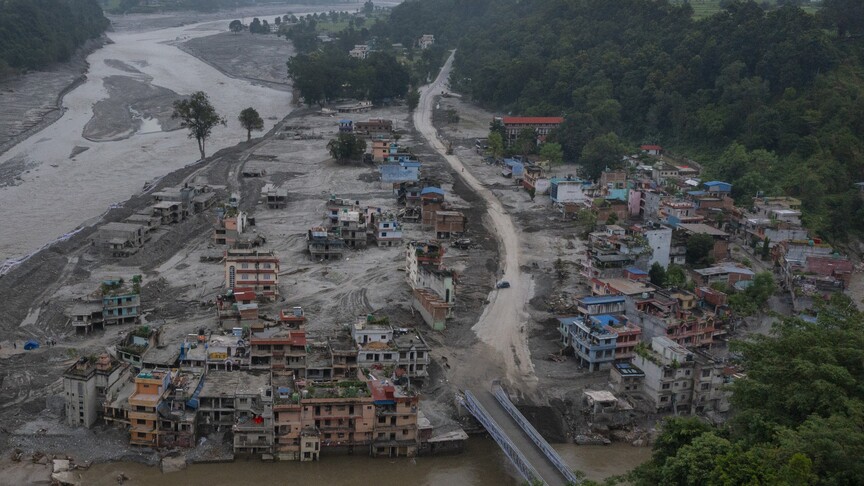
A glacial mountain collapse on the Nepal-China border on August 26 triggered catastrophic floods and landslides that killed at least 1,446 people and left more than 6,600 missing in the context of natural disasters, with researchers attributing a significant role to climate change through warming temperatures, glacier thinning, permafrost degradation and increased meltwater.
Disaster Overview and Human Toll
The disaster destroyed roads, bridges and hydropower dams, isolating communities and creating extreme access challenges for aid delivery, with journeys that once took two hours now taking all day. [2] Nepal revised its missing persons toll upward to 6,150 as of mid-September, with 1,403 bodies recovered in Nepal and additional deaths and missing persons reported in Tibet. [5] The combined toll from the deadly glacial mountain collapse on the Nepal-China border from both nations now stands at 1,446 people dead and at least 6,669 missing. [5] Across the border in China, the toll is 43 dead and 519 missing, according to state media. [5] Several hundred foreigners, including tourists and pilgrims, are among the missing. [5] The sheer scale of the flood was unlike anything witnesses had seen before, with the Nepali government pointing the finger at the dire impact of rising global temperatures on the Himalayan mountains. [2]
Climate Change Link Confirmed by Study
A World Weather Attribution study found climate change acted as a destabilizing factor on pre-existing geological weaknesses, with July-August temperatures 1.5C warmer due to human influence, glaciers thinning by half a metre per year, and possible preconditioning from the 2015 earthquake. [3] The study by research group World Weather Attribution says climate change was a likely contributing factor in the avalanche of rock and ice that unleashed devastating floods on the Nepal-Tibet border last month. [3] There was "absolutely no doubt that human-induced climate change played a role here in the preconditioning of the disaster", said Dr Friederike Otto, an Imperial College London climatologist who co-authored the study. [3] The study said the disaster was the result of a "compound event" caused by rising temperatures, thinning glaciers, thawing permafrost and pre-existing geological weaknesses. [3] According to the study, July and August temperatures in the area were around 1.5C warmer "due to human influence on the climate". [3] Meanwhile, glaciers in the region had also been thinning by about half a metre a year, which could weaken existing fractures and increase instability. [3] Heavy snowfall last October and November also added to a large amount of meltwater early this year. [3] Climate change, while not the only cause of the disaster, was a "destabilising factor acting on a pre-existing geological predisposition", the study said. [3] According to the World Weather Attribution study, a magnitude 7.8 earthquake that struck Nepal in 2015 and triggered a rock-ice avalanche could have also weakened the underlying rock mass. [3] Climate change destabilizing factor in deadly Nepal-China flood disaster, say researchers. [1] Incident may have been preconditioned by 2015 earthquake, while warming, permafrost degradation, glacier thinning and retreat, increased rainfall, unusually warm conditions likely contributed, says World Weather Attribution. [1]
Rescue workers search for survivors amid Nepal glacial flood debris that killed over 1,400 people. — Source: channelnewsasia
Humanitarian Response and Access Challenges in Natural Disasters
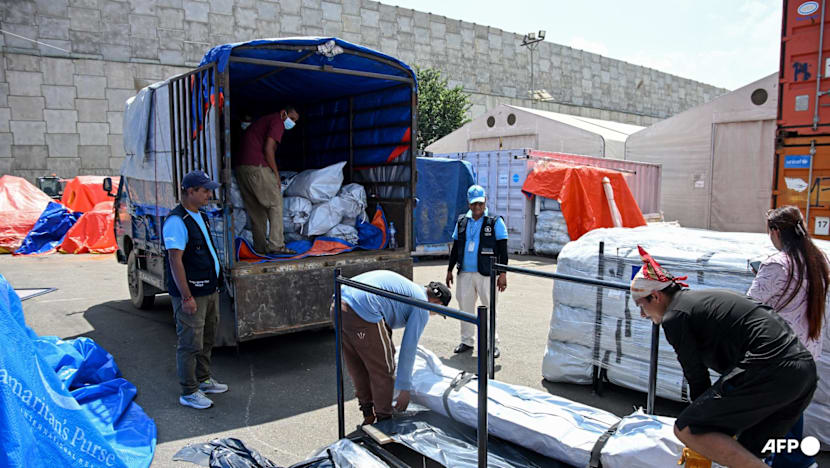
WFP described the aid operation as among its top three most challenging disasters, deploying cargo drones for the first time in Nepal to deliver food in five to 10 minutes where helicopters or ground transport were impossible. [2] Aid operations after Nepal's devastating floods rank among the World Food Programme's most challenging, its country chief said on Thursday (Sep 17), as cargo drones and helicopters delivered food to isolated communities. [2] The catastrophic Aug 26 flood was triggered by a Himalayan glacial mountain collapse on the China-Nepal border that scientists have linked to climate change. [2] Riaz Lodhi, head of the UN's World Food Programme (WFP) in Nepal, told AFP that it was among the "top three most challenging disasters" the agency had faced. [2] "We have seen disasters, we have seen earthquakes, we have seen disasters caused by floods, we have seen war situations, conflicts," Lodhi said. [2] "We have had access challenges in many of these situations", he added, but said the challenges in Nepal were extreme. [2] "This is a very unique access challenge where, in some places, the only way to reach people is by helicopters," he said. [2] "It's a very, very expensive operation." [2] The destruction meant journeys that once took two hours can now have become day-long ordeals. [2] Many communities near the epicentre of the disaster remain cut off, with the UN working alongside Nepal's government to get emergency supplies into devastated areas. [2] For the first time in Nepal, WFP deployed cargo drones to deliver food to isolated communities. [2] "When the first drone went up in the air with the food attached to it, I knew that it was a game-changer ... It's an innovation in delivering food assistance," Lodhi said. [2] During a deadly 2015 earthquake in Nepal, WFP relied on mules, yaks and porters carrying food on their back, sometimes taking two to three days to reach those in need. [2] "Now, the same food, by deploying these cargo drones, we were able to deliver within five to 10 minutes," Lodhi said. [2] The drones can carry between 30kg and 100kg, depending on operating conditions. [2] "People in need, they didn't have to wait for days," he added. [2] "The food was reaching there immediately." [2] Lodhi said that WFP has used drones before, but not at this scale. [2] "What we are learning in Nepal with the use of these cargo drones will change the way WFP reaches people in need," he said. [2] WFP expects to provide food assistance for four to six months, but Lodhi said that would not mean the end of humanitarian needs. [2] "They have lost their food stocks, they have lost their homes, they have lost their crops. So the needs are huge," he said. [2]
Reconstruction Costs and Pursuit of Climate Funds
Nepal plans to seek around $20 million from the UN Fund for Responding to Loss and Damage using the attribution study as primary evidence, while estimating total reconstruction costs at $4.78 billion. [3] Nepal hopes to claim around $20m from the UN Fund for Responding to Loss and Damage, which helps countries affected by climate change. [3] The UN Fund for Responding to Loss and Damage, which came into operation last year, requires countries to submit evidence proving that the losses they faced were caused by climate change. [3] The World Weather Attribution report is now the strongest evidence for their claim that climate change was a significant factor in the collapse of rock and ice at Langtang Lirung, authorities say. [3] The report "will be the main basis of our claim as it has detailed what role climate has played in this disaster," said Maheshwar Dhakal, spokesperson for Nepal's Ministry of Agriculture, Forest and Environment. [3] In his first foreign trip as Nepali Prime Minister, Balendra Shah is set to appear at United Nations General Assembly in New York next week to talk about the recent disaster and climate justice. [3] Nepal estimates the reconstruction bill will amount to US$4.78 billion. [2] Nepal estimates the reconstruction bill after the deadly floods will amount to US$4.78 billion. [5] Prime Minister Balendra Shah will take his first foreign trip as Nepal's leader to address the UN General Assembly on the urgent issue next week. [2]
What to watch next: A barrier lake at the collapse site remains, according to both governments, and a second flood is still possible.