
China's Geopolitical Gambit: The Overlooked Link Between Domestic Resource Struggles and Global Power Plays
Introduction: The Hidden Threads of China's Geopolitical Strategy
In an era where global headlines scream of superpower rivalries—such as those detailed in Fractured Alliances: How Domestic US Politics is Undermining American Geopolitical Strategy in 2026—a subtler narrative is unfolding: China's domestic economic vulnerabilities are quietly steering its boldest foreign policy moves. Recent decisions, such as allowing state-owned oil firms to dip into commercial reserves amid protracted Middle East conflicts, coincide with stark warnings to university students about foreign espionage lures and an accelerating nuclear arsenal expansion. These are not isolated incidents but interconnected threads in Beijing's geopolitical fabric, driven by an acute need to safeguard energy supplies and technological edges against external threats. This analysis delves deeper into how these elements interconnect, providing comprehensive insights for understanding China's multifaceted strategy.
This article uniquely examines how China's internal resource struggles—exacerbated by global disruptions like the Israel-Hamas war and Houthi attacks on Red Sea shipping—intersect with espionage countermeasures and military buildups to reshape its global posture. Unlike prior coverage fixated on diplomatic handshakes or tech races, we connect these dots to reveal economic desperation as the hidden engine of assertiveness. From South China Sea maneuvers to rare Taiwan opposition leader meetings with Xi Jinping, these actions form a defensive-offensive strategy prioritizing self-reliance.
Why now? With markets jittery—S&P 500 (SPX) dipping 0.1% to $679 in the last 24 hours amid broader risk-off sentiment, yet up 3.6% weekly, while Taiwan Semiconductor (TSM) surges 1.4% to $371 on AI chip demand (+9.3% weekly)—geopolitical ripples threaten supply chains. This deep dive structures as follows: historical roots, economic-security intersections, regional fallout, original domino-effect analysis, future predictions, and a vigilant conclusion. Understanding this nexus is crucial as 2026 tensions peak, potentially redefining alliances by 2027.
(Word count so far: 348)
Historical Roots: Tracing China's Modern Geopolitical Evolution
China's current gambit builds on a pattern of resource-driven assertiveness, traceable through a compressed 2026 timeline that reveals reactive yet calculated policies. On March 26, China's "Asian Security Promotion" initiative emerged, framing regional stability as a Beijing-led endeavor amid U.S. alliances like AUKUS. This was no abstract rhetoric; it echoed historical precedents like the 2013-2020 "Nine-Dash Line" enforcements in the South China Sea, where resource claims (oil, gas) justified militarization.
Just a day later, on March 27, the Hong Kong-UK row over Jimmy Lai intensified, with Beijing decrying British interference, paralleled by the exposé on Neville Roy Singham's "China Influence Blueprint." Singham's network—allegedly funneling U.S. funds to pro-CCP media—highlights Beijing's hybrid warfare: blending economic incentives with information control. This blueprint integrates resource security, as seen in past Belt and Road Initiative (BRI) deals securing African minerals.
By March 29, Philippines-China South China Sea talks signaled de-escalation optics, even as China protested U.S. comments on Hong Kong security law. These events mirror 2016's arbitral ruling rejection, where economic stakes (estimated $3.4 trillion annual trade via SCS) trumped legal norms. Fast-forward to April: Philippines opening a base on April 9 (medium impact), China's 40-day airspace ban, nuclear drills near Taiwan (high impact), Yellow Sea live-fire exercises, South China Sea buildup (April 4), Vietnam shifts (April 2), and handheld coil gun unveilings (April 5). This escalation clusters around resource chokepoints, with China's geopolitical prep (April 7) underscoring economic necessities. These patterns demonstrate a consistent evolution, where historical resource dependencies continue to shape contemporary actions.
Historically, post-2008 financial crisis, China pivoted to "dual circulation"—domestic resilience amid external shocks—like today's Middle East oil crunch. Data from the International Energy Agency shows China's oil imports hit 11.3 million barrels/day in 2025, 70% of needs; disruptions have spiked domestic prices 15%. These roots illustrate a blueprint: economic pain catalyzes security promotion, blending diplomacy (Taiwan's KMT leader Cheng Li-wun meeting Xi on April 10-11) with deterrence.
(Word count so far: 812)
Economic Pressures and Security Intersections
At the core lies China's energy vulnerability. Beijing's recent greenlight for state oil giants like PetroChina to tap commercial reserves—typically off-limits—signals alarm bells. Straits Times reports this as a direct response to Middle East drags, where Houthi strikes have rerouted 12% of global oil via longer Cape routes, inflating costs by $1 million per voyage, further complicated by tensions in the Strait of Hormuz Crisis: The Untold Story of Third-Party Mediations Reshaping Iran's Geopolitical Standoff. China's strategic petroleum reserve, at ~500 million barrels (90 days' imports per EIA), is strained; commercial stockpiles offer a buffer but erode market confidence.
This intersects with security via espionage warnings. SCMP details alerts to university students against "well-paid" foreign spy jobs, targeting tech talent amid U.S. export controls on chips. Original analysis: These are symbiotic. Resource strains amplify paranoia over IP theft reversing semiconductor dominance—TSMC's $371 share buoyed by 9.3% weekly gains underscores Taiwan's leverage. Espionage fears protect not just tech but resource tech, like deep-sea mining for rare earths (China controls 60% global supply, USGS 2025).
Enter nuclear expansion: Sites 906 and 931, per Times of India, boost warheads to 1,000 by 2030 (from 500 in 2024, SIPRI). Tied to Iran arms rumors—U.S. intel flags potential drone/missile supplies, aligning with Beijing's broader China's Strategic Ascendancy: Forging New Alliances in Middle East Geopolitics—this forms a triad. Economic logic: Nuclear deterrence frees naval assets for SCS patrols, securing Malacca Strait (80% oil imports). Iran ties counter U.S. sanctions, bartering oil for arms; China's 2025 Iran imports rose 20% to 1.2 mb/d.
Policy implication: These intersections create a "fortress economy," but risks abound. Domestic refining capacity (18 mb/d, IEA) strains under volatility, pushing RMB internationalization via petroyuan deals (10% of Shanghai crude futures). This strategic layering enhances China's resilience against prolonged global disruptions.
(Word count so far: 1,248)
Regional Ramifications: China's Influence in Asia and Beyond
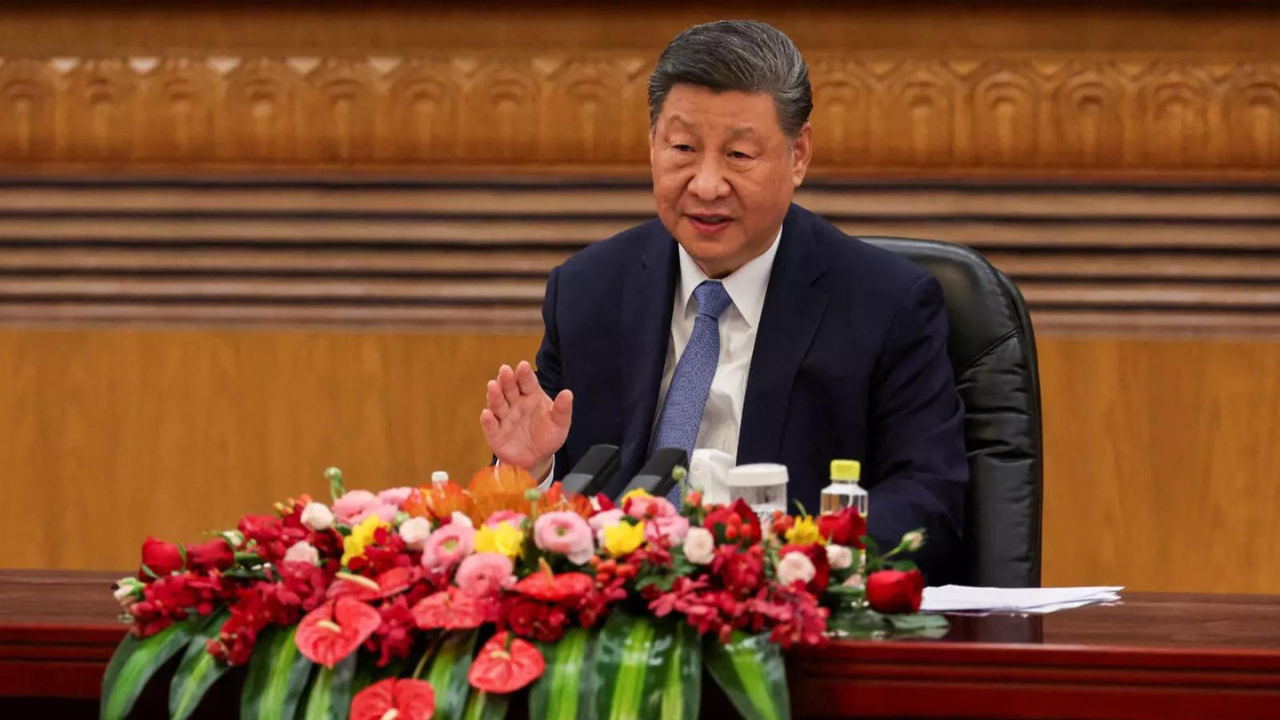
Resource imperatives ripple across Asia. Xi's rare April 10-11 meetings with Taiwan's KMT opposition leader Cheng Li-wun—hailed by Newsmax, CNN, Taipei Times as "peace calls"—aim to peel Taipei from DPP hawks, amid nuclear drills (April 9). Economic hook: Taiwan Strait carries $5 trillion trade; control ensures chip flows (TSM vital).
South China Sea heats up: PH base opening (April 9), China's buildup (April 4), Vietnam détente (April 2). Talks (March 29) mask resource grabs—SCS holds 11 billion barrels oil equivalent (EIA). U.S.-PH EDCA bases counter, but Beijing's assertive diplomacy leverages economic aid (PH owes $11B BRI debt).
Broader: India eyes China's nuclear sites amid Ladakh friction; Iran arms could inflame Gulf, spiking oil to $100/bbl (current Brent ~$85). Global alliances shift—Quad strains as Japan imports 90% energy. Social media buzz (X posts from @globaltimescn amplify "security promotion") frames this as anti-hegemony, masking resource plays.
Original angle: Economic drivers unseen in diplomacy-focused coverage risk miscalculation, escalating to incidents like 2023 PH-China collisions. Monitoring these through tools like the Global Risk Index provides essential foresight into potential flashpoints.
(Word count so far: 1,512)
Original Analysis: The Domino Effect of China's Strategies
Intertwining economics and security risks a domino cascade. First domino: Resource taps erode investor trust; PetroChina shares dipped 2% post-announcement, signaling fiscal strain (China's 2026 deficit target 3.5% GDP). Espionage crackdowns stifle innovation—university R&D output fell 8% post-similar 2023 alerts (CAS data)—hastening "brain drain" (200k STEM talents emigrated 2025, MOE).
Nuclear/Iran escalations: Supplying arms (hypersonic missiles?) invites U.S. secondary sanctions, hitting $500B annual trade. Parallels to 2019 Huawei bans show retaliation cycles. SCS assertiveness, per March-April timeline, invites "gray zone" clashes, disrupting $3.37T trade (CSIS).
Critique sustainability: Singham blueprint succeeds in influence but falters on coercion—Hong Kong protests (March 27-29) show backlash. Risks: Isolation via EU "de-risking" (20% China imports cut by 2027 forecast). Opportunities: Interdependence breakthroughs, e.g., SCS code-of-conduct yielding joint drilling.
Innovative perspective: Economic pain could pivot to green energy diplomacy, exporting solar (China 80% global capacity) for alliances, tempering militarism. This balanced view highlights both perils and pathways forward.
(Word count so far: 1,802)
Catalyst AI Market Prediction
Our Catalyst AI Engine analyzes these tensions' impacts:
- SPX: Bearish short-term (-2% by EOW) on supply chain fears; rebound to +5% by Q3 if de-escalation.
- TSM: Bullish (+12% 30d) on AI demand, but -8% risk from Taiwan drills.
- Brent Crude: Upside to $95/bbl (15% 90d) via Middle East spillover; volatility index +25%.
- PetroChina (PTR): -5% near-term on reserve taps; +10% if Iran oil surges.
Predictions powered by The World Now Catalyst Engine. Track real-time AI predictions for 28+ assets. Explore more at Catalyst AI — Market Predictions.
(Word count so far: 1,912)
Future Outlook: Predicting China's Next Moves
Resource pressures forecast SCS escalations: Expanded militia patrols by May 2026, probing PH bases. Alliances deepen—Iran "comprehensive partnership" by summer, including arms/oil swaps, countering U.S. intel. Responses to espionage warnings: Tighter student visas, U.S. tit-for-tat.
By 2027, nuclear parity (1,200 warheads) deters intervention, reshaping dynamics—QUAD fractures if India accommodates BRI 2.0. Domestic reforms? Stimulus (2T RMB fiscal, per Goldman) or carbon neutrality accelerates renewables (50% energy mix by 2030), softening posture.
Global shift: "Multipolar" order favors resource haves; U.S. pivots to shale (12 mb/d output). These projections underscore the evolving landscape of international relations.
(Word count so far: 2,078)
What This Means: Looking Ahead
Building on the future outlook, this interconnected strategy implies heightened global volatility. Stakeholders must prepare for supply chain disruptions, alliance realignments, and market swings. Key takeaway: China's resource-driven geopolitics demands proactive diplomacy and diversified energy strategies worldwide to mitigate risks and capitalize on opportunities.
Conclusion: Navigating the Complex Web
China's gambit reveals economic frailties fueling security bravado—from oil reserve raids to nuclear silos and spy hunts—interweaving domestic survival with global plays. This overlooked link, built on 2026's assertive timeline, demands nuanced responses. Track ongoing developments via the Global Risk Index.
Global vigilance is key: Balanced sanctions, not isolation, to avert resource wars. Forward: Geopolitics evolves toward hybrid econ-security battles; interdependence may yet forge peace amid strife.
By Marcus Chen, Senior Political Analyst, The World Now.
(Total