
China Severe Weather From Typhoon Dolphin Floods Shanghai Streets
Typhoon Dolphin made landfall in China's Zhejiang province on Aug. 9 as the strongest storm to hit the country in 2026, bringing torrential rain that flooded streets in Shanghai and prompted evacuations of more than 1 million people across eastern provinces amid widespread China severe weather. [1] Dolphin had maximum sustained winds of 151 kmh at landfall in Zhejiang before weakening to a tropical storm, with its rain clouds soaking Anhui, Jiangsu, Shandong and other eastern areas on Aug. 10. [1]
Typhoon Dolphin Makes Landfall in Zhejiang
Dolphin packed maximum sustained winds of 151 kmh near its center when it made landfall in Zhejiang on the evening of Aug. 9 before weakening to a tropical storm. [1] The weather system has lost power after making two landfalls along the coast of Zhejiang Province on Sunday, with China’s National Meteorological Center issuing its least severe typhoon alert yesterday morning. [2] Its remaining rain clouds continued to soak the eastern provinces, including Anhui, Jiangsu and Shandong on Aug. 10. [1] The strongest typhoon to hit China in 2026, Dolphin is forecast to move deeper inland to the central provinces of Hubei and Henan in the coming days while also pushing moisture north. [1]
Flooding Hits Shanghai Streets and Commercial Areas
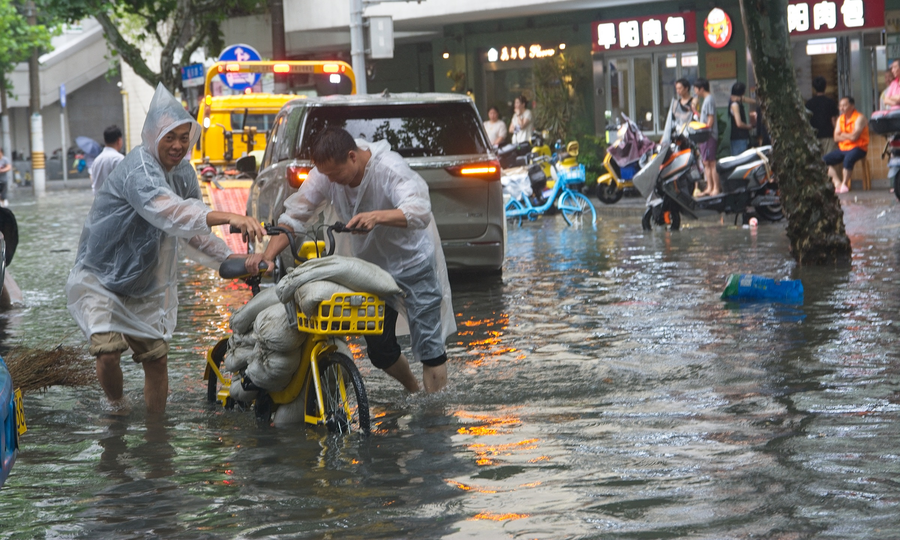
Torrential rain and storms in Typhoon Dolphin's wake have swept through several provinces in China's east, drenching the coastal region and flooding streets in Shanghai, China's second most populated city after Chongqing. [1] Many streets in Shanghai were flooded, including in the main commercial centers. [1] Many streets in Shanghai's suburban Jiading and Qingpu districts around the city center remained waterlogged, according to live-streams shared by residents on social media. [1] The live videos, not verified by Reuters, showed people wading through knee-high murky water. [1] "It rained almost all night last night. When I woke up this morning, I found the neighborhood flooded, and the streets were severely flooded," said 39-year-old Hou Lina, who works in sales in Jiading in Shanghai. [1] "I’ve lived in Shanghai for 10 years, and this is the first time I’ve experienced such inconvenience from a typhoon. This is the first time I’ve encountered such widespread flooding," she said. [1] In Shanghai’s Jinshan, the district authority said non-essential businesses and organizations could temporarily halt operations, classes, outdoor events and transit services, amid forecasts of continued strong winds and heavy rain on Aug. 10. [1] People wade through a flooded street after Typhoon Dolphin brought heavy rain to Shanghai, China, yesterday. [2] Tropical storm Dolphin dumped heavy rain in eastern China on Monday, causing flooding in places after making landfall as a typhoon the previous day. [3]
Mass Flight Cancellations and Transport Disruptions
Shanghai’s two main passenger airports saw 943 flights cancelled, the airport authority said in an online post. [2] The city's two airports cancelled a total of 943 flights due to the typhoon, reducing capacity by nearly 40%, state broadcaster CCTV said. [1] China Eastern Airlines said on Aug. 10 it was trying to resume flights to Shanghai, Zhejiang and other destinations in an "orderly manner". [1] Public transport services, including many local trains, have been suspended. [2] However, some eastern Chinese cities started to restore transportation services. [2] Zhejiang’s Ningbo Lishe International Airport resumed flight operations from midday, but warned that some journeys might still be delayed or canceled since the effects of the typhoon have “not yet completely dissipated.” [2] Provincial capital Hangzhou resumed subway services yesterday morning, after halting some train operations on Sunday. [2]
Evacuations and Emergency Measures Across Provinces
Authorities yesterday issued their most severe flash flood alert for parts of eastern and southern Zhejiang, state broadcaster CCTV said. [2] A weakening Typhoon Dolphin yesterday brought heavy rain and grounded hundreds of flights on in eastern China, where authorities said more than 1 million people had been evacuated over the past few days. [2] The port city of Wenzhou in Zhejiang relocated more than 900,000 people, CCTV said yesterday, adding that more than 1,500 emergency shelters were opened in the city. [2] Authorities also evacuated more than 150,000 people in Fujian Province and more than 200,000 people in Shanghai, Xinhua news agency reported. [2] Powerful winds and lashing rain flipped over a truck in Zhejiang’s Wenzhou, a video posted on TikTok on Aug. 9 showed. [1]
Northern China Braces for Heavy Rain and Flood Risks
Rain and flood warnings for Beijing The strongest typhoon to hit China in 2026, Dolphin is forecast to move deeper inland to the central provinces of Hubei and Henan in the coming days while also pushing moisture north. [1] The authorities in the capital Beijing raised warnings for torrential rain and said the city was prepared to activate its flood control response on the morning of Aug. 11. [1] Beijing is expected to experience "significant rainfall" from Aug. 11 to 13, with the authorities warning of the risk of flash floods in the city and landslides in the surrounding mountainous areas. [1] Northern China is also set for extreme weather this week, with five districts in Beijing issuing red alerts for heavy rain yesterday, some warning of landslide and flooding risks. [2] As the storm clouds meet colder air in the north, Beijing, Tianjin, and Hebei will need to brace themselves for rains into Aug. 13, CCTV said. [1]
Dolphin's Record Travel and Comparison to Past Storms
The typhoon had already travelled 6,000 km before it made landfall, giving it a life cycle three times longer than an ordinary typhoon, and bringing with it an ultra-large cloud system that enveloped China’s east, CCTV said in another report. [1] Dolphin’s impact was also being compared to Typhoon Doksuri in 2023, which caused destruction in south-eastern Fujian Province and unleashed record-breaking rainfall in Beijing. [1] Typhoon Dolphin came two weeks after Typhoon Noul struck southern Guangdong Province, with authorities saying at the time that it was the strongest storm to hit China this year. [2] Extreme weather also wreaked havoc on southern and central China last month, with 39 people killed when Typhoon Maysak triggered devastating floods in the southern Guangxi region. [2] Maysak also caused thunderstorms and gale-force winds that killed 11 people and injured 331 in the central province of Hubei. [2]
What to watch next: Beijing is expected to experience significant rainfall from Aug. 11 to 13, with authorities warning of the risk of flash floods in the city and landslides in the surrounding mountainous areas as the storm's moisture moves north. [1]