Canada Wildfires Send Hazardous Smoke Across Northern US States and Toronto
More than 800 wildfires are burning across Canada, with 857 active fires reported including 112 out of control, sending smoke that has caused hazardous air quality in parts of the northern United States and ranked Toronto's air among the world's worst. [2] Canada wildfires have produced thick plumes that affect air quality from the Upper Midwest through the Great Lakes region and into the northeast. [2]
Scale of the Current Canadian Wildfires
Around 835 active fires were burning in Canada on Wednesday and 112 were considered out of control, according to the government. [1] There are currently 857 fires actively burning in Canada, including 23 new fires on Thursday, according to the Canadian Interagency Forest Fire Centre. [2] According to the Canadian Wildland Fire Information System, the vast majority of wildfires are burning out of control. [2] The large cluster of fires affecting northwestern areas of Ontario are responsible for sending thick plumes of smoke and poor air quality across Thunder Bay and Toronto. [2] The smoke originated from 148 active wildfires burning across northwestern Ontario, where firefighters continue to battle multiple large blazes. [5] In addition, more than 160 wildfires burned across Ontario. [4] These figures illustrate the scale of Canada wildfires that continue to spread in remote northern regions.
Train Surrounded by Flames Near Armstrong
A video that went viral on social media showed a Canadian train surrounded by flames near Armstrong, Ontario. [1] Verified footage filmed from inside a Canadian National Railway locomotive near Armstrong, Ontario, on Monday 13 July captures a freight train crew surrounded by fast-moving wildfire flames, as dense smoke engulfs the tracks and every cab window glows bright orange. [4] The dramatic images illustrate the intensity of one of northern Ontario's rapidly spreading wildfires, with visibility reduced to almost zero. [4] Canadian National Railway said the locomotive was one of three freight trains brought to a halt around 32 kilometres from the remote community of Armstrong, north of Thunder Bay, after fire reached the railway corridor. [4] The trains were carrying combustible and flammable goods, prompting the suspension of rail traffic as a precaution. [4] Canadian National Rail said in a statement that the workers who were trapped outside Armstrong were all safely rescued, and that operations have been temporarily suspended in the region. [2] All crew members were safely evacuated and no injuries were reported. [4] The incident came as more than 160 wildfires burned across Ontario, forcing evacuations in several communities. [4] The dramatic footage has renewed concerns over rail operations during extreme fire conditions, with union leader François Laporte insisting that no freight is worth risking workers' lives. [4]
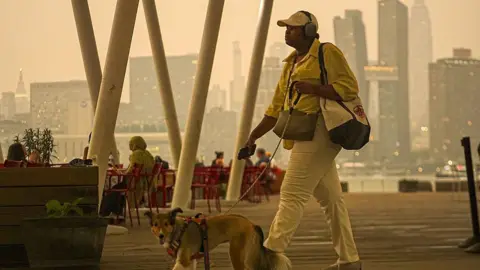
Thick smoke from over 800 Canadian wildfires drifts across northern US states and Toronto. — Source: bbc
Smoke Impact on Toronto and Canadian Cities
Toronto’s skies have turned a hazy yellow as smoke blown in from wildfires blankets Canada’s largest city and sends pollution levels soaring. [3] On Wednesday, Toronto had the worst air quality of any major city in the world, according to Swiss firm IQAir, edging out New Delhi and Kinshasa. [3] Air quality in the Midwestern city of Detroit is currently the worst in the world, Swiss air quality tracker IQAir said, followed by Minneapolis and Toronto. [2] Despite the poor conditions, some residents continued to spend time outdoors, while others wore face masks as the smoke drifted across the city. [5] The deteriorating air quality coincided with a heat alert, with temperatures reaching 33C, close to the record for 15 July. [5] Authorities cancelled outdoor children's programmes and opened cooling centres, while Environment Canada warned that smoky conditions were unlikely to ease before Friday. [5] Howard Shapiro, Toronto's Associate Medical Officer of Health, compared exposure to the smoke to passive smoking, warning that the fine particles contain a mixture of harmful chemicals capable of affecting anyone, regardless of age or underlying health. [5]
Cross-Border Air Quality Alerts in the US
Smoke from the wildfires is causing poor air quality across New York City, with hazy skies captured on Wednesday. [2] The air quality in large parts of the northern states of Michigan, Minneapolis and Minnesota is deemed "hazardous" by the US Air Quality Index program, with people recommended to stay indoors. [2] Alerts span the Upper Midwest, the Great Lakes region and into the northeast, the US national weather service (NOAA) said in an update on Thursday. [2] Northwesterly winds will continue to blow the smoke into northern US states for the rest of this week and into the weekend, leading to concerns smoke will drift into New Jersey where Sunday's World Cup final is due to take place. [2] A change in the wind direction by Monday means that the smoke will tend to be steered across Quebec with an improvement in air quality further south in the US. [2] There will be quite widespread thunderstorms in Ontario over the next few days, but the rain may not be enough to make much of a difference. [2]

Toronto skyline shrouded in hazardous wildfire smoke from Ontario fires. — Source: france24
Evacuations and Damage to First Nations Communities
In addition to the hazardous smoke, the wildfires in northern Ontario have forced hundreds from local First Nations communities to evacuate, with videos showing some fleeing the remote area by boat. [2] Homes and buildings in the area have also been damaged extensively by the flames, said Anishinabek Nation Grand Council Chief Linda Debassige in a statement. [2] The large cluster of fires affecting northwestern areas of Ontario are responsible for sending thick plumes of smoke and poor air quality across Thunder Bay and Toronto. [2] These evacuations highlight the direct human impact of Canada wildfires on remote communities.
Official Responses and Cross-Border Cooperation
Republican lawmakers in the state of Michigan have penned an open letter to Canadian Prime Minister Mark Carney asking for better management of the country's wildfires, expressing frustration for the third year in a row. [2] "A year has passed, the season has come around again, and nothing has changed except that our patience has run out," said the letter, signed by four House representatives from the US state. [2] Pete Hoekstra, the US ambassador to Canada, struck a more diplomatic tone in a statement on Wednesday commending wildfire fighting efforts from both countries. [2] "This challenge knows no borders. The United States will continue to coordinate closely with Canada, just as we have for more than four decades of shared wildfire emergencies," he said. [2] These statements reflect ongoing efforts to address the cross-border effects of Canada wildfires.
What to watch next: Northwesterly winds will continue to blow the smoke into northern US states for the rest of this week and into the weekend, leading to concerns smoke will drift into New Jersey where Sunday's World Cup final is due to take place, while a change in the wind direction by Monday means that the smoke will tend to be steered across Quebec with an improvement in air quality further south in the US.