
Burkina Faso Foils Assassination Plot Against Junta Leader Capt. Ibrahim Traoré, Points Finger at Ivory Coast
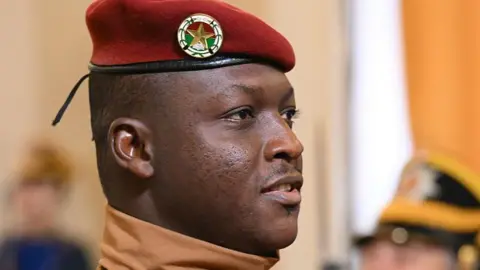
Ouagadougou, Burkina Faso – Burkina Faso's military junta announced on Wednesday that security forces had successfully thwarted a plot to assassinate Captain Ibrahim Traoré, the country's interim president, with the security minister directly accusing neighboring Ivory Coast of funding the operation.
The revelation, made public by Security Minister Mahamoudou Sana, underscores the precarious security environment in the West African nation, which has been grappling with jihadist insurgencies and political instability since a series of military coups. According to reports, the plot was uncovered through intelligence operations, though specific details about the alleged perpetrators, methods, or timeline beyond the announcement remain limited.
Sana's statement implicated Ivory Coast, claiming the neighboring country provided financial backing for the assassination attempt. "The security services have foiled a plot to assassinate the head of state, financed by Côte d'Ivoire," Sana declared, as reported by the BBC. This accusation has heightened diplomatic tensions between the two nations, which share a 500-kilometer border and have historically maintained complex relations amid regional security challenges.
Escalating Regional Tensions
Burkina Faso, under Traoré's leadership since he seized power in a September 2022 coup, has pivoted toward greater self-reliance in combating Islamist militants affiliated with groups like al-Qaeda and the Islamic State. The country expelled French forces in 2023 and deepened ties with Russia, including the deployment of Wagner Group-affiliated mercenaries, now rebranded as Africa Corps. These shifts have strained relations with West African neighbors, including members of the Economic Community of West African States (ECOWAS), from which Burkina Faso, Mali, and Niger withdrew in January 2024 to form the Alliance of Sahel States (AES).
Ivory Coast, a relatively stable ECOWAS powerhouse under President Alassane Ouattara, has positioned itself as a counterweight to the Sahel juntas. Abidjan has hosted opposition figures from Burkina Faso and expressed concerns over cross-border jihadist spillovers. While Ivory Coast has not yet responded publicly to the assassination allegations, past frictions include Burkina Faso's claims of Ivorian support for dissidents and mutual accusations of harboring militants. In 2023, Burkina Faso summoned the Ivorian ambassador over alleged incursions, highlighting longstanding border disputes exacerbated by the Sahel's jihadist violence.
The foiled plot occurs against a backdrop of intensified terrorist activity in Burkina Faso. The country has faced a surge in attacks by Jama'at Nasr al-Islam wal-Muslimin (JNIM) and Islamic State in the Greater Sahara (ISGS), displacing over two million people and claiming thousands of lives since 2015. Just last month, JNIM claimed responsibility for an ambush in the north that killed dozens of soldiers, prompting Traoré to extend his transitional rule until 2029. Analysts note that assassination plots against junta leaders are not unprecedented in the region; similar threats targeted Mali's interim President Assimi Goïta in 2022.
Broader Context of Instability
Burkina Faso's jihadist insurgency began in 2015, spilling over from Mali, and has since evolved into one of Africa's deadliest conflicts. By 2024, the violence had spread to coastal states like Benin and Togo, with over 8,000 fatalities recorded since 2018, according to the Armed Conflict Location & Event Data Project (ACLED). The military government's "total war" strategy, involving village militias and scorched-earth tactics, has drawn UN accusations of human rights abuses, further isolating Ouagadougou internationally.
Traoré, a 37-year-old artillery captain popular among youth for his anti-imperialist rhetoric, rose to power after ousting Lt. Col. Paul-Henri Sandaogo Damiba in 2022. His administration has focused on nationalizing resources and forging non-Western alliances, but critics argue it has failed to stem territorial losses—militants now control over 40% of the country.
The assassination accusation against Ivory Coast could signal internal dissent within Burkina Faso, possibly involving exiled opposition or military factions opposed to Traoré's prolonged rule. No independent verification of the plot's details has emerged, and Ouagadougou's control over information remains tight amid a media blackout.
Outlook Amid Regional Volatility
As Burkina Faso rallies domestic support around the foiled plot, the allegations risk diplomatic fallout with Ivory Coast, potentially complicating ECOWAS efforts to mediate Sahel crises. Abidjan may seek arbitration through the African Union, while AES members Mali and Niger have voiced solidarity with Traoré on social media.
In the short term, heightened border vigilance is likely, with possible retaliatory rhetoric escalating cross-border frictions. For Burkina Faso, the incident reinforces the junta's narrative of external threats justifying extended emergency powers. However, without transparency on the plot's architects, questions persist about its origins—whether jihadist-inspired, politically motivated, or a pretext for consolidating power.
The event highlights the Sahel's fragility, where terrorism, coups, and interstate rivalries intertwine, threatening broader West African stability. International observers, including the UN, urge dialogue to prevent further escalation.
(Word count: 712)