
Belgium and Germany Lift Final Evacuation Orders as High Fens Wildfire Is Contained
Evacuation Orders Lifted in Belgium-Germany Border Region
Authorities in Belgium and Germany lifted the last remaining evacuation orders on Wednesday in the border region where firefighters appeared to be gaining the upper hand against the massive High Fens wildfire. [1] The fire, which spread across 3,000 hectares, “has been contained and should no longer be able to spread,” said crisis cell spokesman Tony Hosmans. [1] Villagers in two Belgian hamlets were given the all-clear to return home, while the German town of Monschau also posted a notice telling residents living near the border it was safe to go back. [1] The High Fens fire grew over the weekend to half the size of Manhattan, charring a huge expanse of peatland, pine trees and hiking trails. [1]
Firefighters Encircles Blaze Despite Difficult Peat Terrain
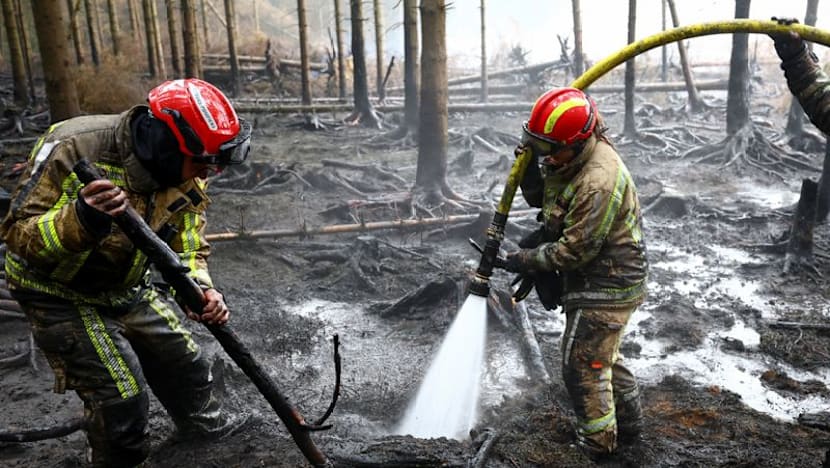
After being grounded by bad weather, water-dropping aircraft were back out helping to quell Belgium's largest wildfire in a century, after fire crews hacked their way through boggy terrain overnight to fully "encircle" the blaze. [1] Aircraft flown in from Norway, Germany, Sweden and the Netherlands had been pinned on the ground by low-hanging clouds, but both helicopters and planes were able to resume operations Wednesday and were dropping water on the site. [1] New flare-ups were still emerging across the vast site, with the blaze smouldering underground in the peaty soil, but were being "brought under control" one by one. [1] Regional government spokesperson Stephanie Ernoux called the latest developments "reassuring," while the local governor's office said it was weighing whether to start scaling back the firefighting deployment on the ground. [1] On-site operations have been complicated by the fens' terrain, a patchwork of heath, peat bogs and raised wooden boardwalks. [1]
Zombie Fire Risk in Peatland Requires Prolonged Dousing
Even once it is brought under control, officials have warned it will take weeks or even months of soaking and dousing to prevent the blaze from reigniting. [1] "The fire is burning in the peat, so it is actually underground, sometimes quite deep," explained area fire chief David Covens on a trip into the fire zone. [1] In peatland terrain like the High Fens, a fire can keep burning underground and resurface some distance away, a phenomenon known as a "zombie fire" that can also attack tree roots, increasing the risk of them collapsing. [1] "At first glance, it may seem under control, but it can flare up again because it re-emerges, sometimes from great depths," said the regional government's Ernoux. [1] To detect flare-ups more effectively, firefighters were using drones equipped with heat-sensing detectors. [1] "Whenever we disturb the ground, when we cut down a tree and expose the soil, the fire can reignite," said fire chief Covens. [1] "We're doing everything we can with the resources available, but we know this is going to take a long time." [1]
New Wildfire Erupts in Northwestern Greece
A forest fire broke out Wednesday in the Zagorochoria region of northwestern Greece. [2] The Fire Service said one water-dropping helicopter was helping a small force of 12 firefighters with two fire engines on the ground battle the flames near the village of Vovoussa. [2] No injuries or damage to property were immediately reported. [2] Civil protection authorities said that roughly half of Greece, mostly the central and southern mainland as well as eastern Crete and the Aegean Sea islands, would face a category-3 risk of wildfire Thursday. [2] The rest of the country will be on category 2 in Greece’s 5-notch scale. [2]
Indonesia Ramps Up Aerial and Weather Modification Efforts
Indonesia's Forestry Minister Raja Juli Antoni said support from the National Disaster Management Agency (BNPB) is strengthening efforts to tackle forest and land fires amid an El Nino weather pattern. [4] BNPB has provided support through ground and aerial operations, including weather modification and water-bombing missions. [4] The Forestry Ministry and BNPB have conducted weather modification operations to mitigate fire risks, with 17 operations conducted over 169 days from February through July 2026, involving 291 flight sorties. [4] BNPB has also deployed 40 aircraft, including 10 patrol planes, 27 water-bombing helicopters, and three weather-modification aircraft. [4] In six priority provinces, BNPB deployed 36 aircraft, comprising 12 patrol aircraft, 21 water-bombing helicopters, and three weather-modification planes. [4] BNPB support was also evident in fighting fires at Bromo Tengger Semeru National Park, where an integrated team used two BNPB water-bombing helicopters to reach difficult slopes and the fire that burned from Aug. 3 to Aug. 16 was eventually extinguished. [4]
Damage Assessments Continue After Deadly Greek Fires
Government inspectors have condemned five buildings that were severely damaged by this week’s wildfire on the island of Salamina, just off Athens, that killed two elderly residents. [5] On-site visits in the island’s Aianteio region resulted in three homes and two sheds being deemed as uninhabitable and due for demolition. [5] Another ten buildings were found to be damaged but not beyond repair. [5] Overall, over the past week inspectors looking into wildfire damage to 427 buildings all over Greece have condemned 151, 111 of them in the Porto Germeno, Psatha and Mandra region west of Athens and 25 in the Rethymno area of Crete. [5]
What to watch next: Officials in the High Fens region will continue weighing whether to scale back ground deployments while monitoring for new flare-ups with heat-sensing drones, and Greek civil protection authorities will track the category-3 wildfire risk across half the country on Thursday.