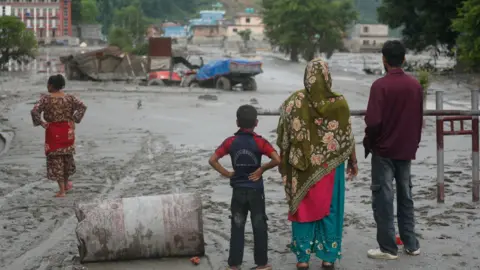
165 dead and over 1,400 missing after Nepal flood from glacial collapse amid natural disasters
A glacial collapse and avalanche on the north face of Mount Langtang Lirung in Nepal triggered a massive debris flow and flood on August 26, 2026, killing at least 165 people, leaving more than 1,400 missing across Nepal and Tibet, and devastating infrastructure along the Trisuli River amid natural disasters. [1]
Disaster strikes Rasuwa district
The flood originated from an avalanche that blocked and then burst the Lhende Khola river on the Nepal-China border, sending mud, water and boulders downstream into the Timure, Rasuwagadhi and Syabrubesi areas. [1] [2] Experts cite satellite imagery from Planet Labs and note debate on whether a 4.4 magnitude earthquake triggered the event or resulted from it. [1] The floods rapidly impacted settlements, markets and infrastructure in those locations, with flood waves estimated to have been as large as those seen in prior events. [2]
Rising toll and missing foreigners
By August 27, Nepal reported 162 deaths and 826 missing including nearly 600 foreigners from over 20 countries. [3] [5] Tibet reported 3 deaths with additional missing, for a combined total near 1,500 unaccounted for. [5] Nine of ten isolated South Korean workers from a hydropower project were rescued by helicopter while one remained on site. [3] Nine other South Koreans remain missing, prompting a Korean rapid response team. [3]
Cause tied to glacial collapse
Scientists are still divided about whether the earthquake caused the slope collapse on the north face, or whether the avalanche was so massive that it caused the seismic event. [1] If the tremor was the trigger, it shook a mountain on which the snow and ice were already unstable due to global warming during the tail end of the monsoon season. [1] This disaster follows similar recent Himalayan events in 2021-2025 linked to glacial lake outbursts, permafrost melt and monsoon conditions, highlighting transboundary risks from the Tibetan Plateau. [1]
Infrastructure devastation
At least six hydropower plants, transmission lines, the 25 MW solar plant in Nuwakot, a dozen bridges and highways were destroyed or heavily damaged, with losses projected in the billions of dollars. [1] The disaster hit the Nepal-China border checkpoint for trade and tourism, along with highways and hydroelectric plants that were just being repaired from previous natural disasters. [1]
International response and rescue
An MSF team experienced in providing emergency responses has arrived in Nepal to assess people’s immediate needs and stands ready to provide urgent humanitarian and medical assistance. [2] Nepal Army helicopter operations conducted rescues of survivors following the flash flood. [3] South Korea’s 11-member rapid response team departed for Nepal to work with the embassy and Nepalese authorities on search and rescue. [3] Foreign Minister Cho Hyun held phone talks with Nepalese Foreign Minister Shisir Khanal and expressed condolences while asking for support in locating missing South Koreans. [3]
Longer-term climate and policy implications
This disaster will bring up the issue of the Loss and Damage fund that Nepal has been raising in international climate negotiations regarding the economic impact of the climate crisis, especially in vulnerable mountain countries. [1] In the longer term, Nepal will need to have an effective strategy to deal with seismic and climate change-induced disasters that are almost certainly going to increase in the future. [1]
What to watch next: Access to the affected area remains difficult due to widespread damage and rugged terrain, with further discussions on the ground needed for search and rescue operations. [3]