112,000 Displaced in Yemen as Houthis Seize More Ground in Most Dangerous Countries
Reporting based primarily on egyptindependent.com.
More than 112,000 people have been displaced in Yemen, one of the most dangerous countries, as Houthi forces seized additional ground amid renewed fighting with Saudi-backed Yemeni government troops. [1]
Displacement from Houthi Advances
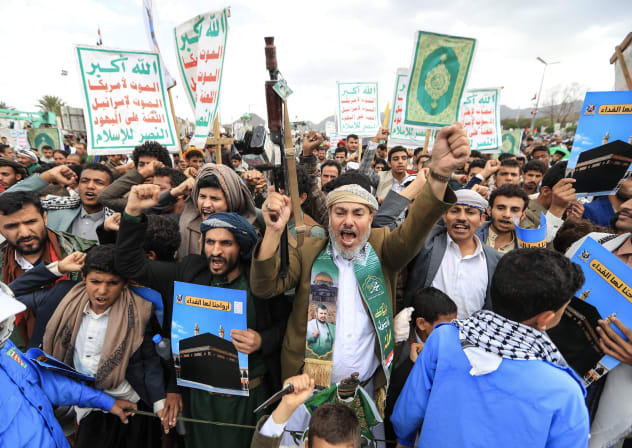
More than 112,000 people have been displaced in Yemen as Houthi forces seized additional ground amid renewed fighting with Saudi-backed Yemeni government troops. [1] Pro-Houthi demonstrations erupted in Yemen after Saudi Arabia accused the military group of targeting the Muslim holy site of Mecca. [1] The renewed fighting follows a 2022 UN-brokered truce. [2] Saudi-backed Yemeni government forces started fighting the Houthis more than a decade ago during Yemen’s brutal civil war. [2] The fighting has resumed and intensified in recent weeks. [2]
Houthi Seizure of Red Sea Island
Dramatic recent Houthi advances include the seizure of a strategically important island in the Red Sea, with the goal of asserting control over the Bab al-Mandeb Strait. [2] Although US officials acknowledge the Yemeni rebel group is advancing with the goal of ultimately asserting control over the critical Bab al-Mandeb Strait, the Trump administration is signaling it has little interest in using the American military to stop them. [2] The Houthis’ Red Sea push is emboldening the IRGC. [2] The Houthi have spent a lot of time in the last months preparing their forces for just this kind of move. [2] They punched through the Saudi-aligned and Yemeni government-aligned forces, not surprisingly, just punched through them – the forces just disintegrated. [2]
US Policy on Military Involvement
The Trump administration is unwilling to conduct offensive strikes against the Houthis, providing only intelligence and targeting data to Saudi Arabia, which has been unable to stop the advances. [2] President Donald Trump has made clear that his current red line is direct US participation in kinetic strikes against the Houthis. [2] To date, US military support has been strictly providing intel and targeting data for Saudi strikes. [2] “No offensive strikes,” said a US official. [2] The US “solidified the ceasefire” with the Houthis during a meeting in Oman this weekend, the US official said – a message that underscores the administration’s unwillingness to get involved. [2] “The Americans sent a message,” a senior Houthi official familiar with the matter told CNN Thursday, “that they don’t want to join the Saudis and be part of the conflict.” [2] “We received this message positively,” the source added. [2]
Saudi Arabia's Frustrations and Capabilities
The Saudis accused the Houthis of targeting Mecca, and the Houthis claim to have shot down a Saudi F-15 fighter jet. [2] Saudi Crown Prince Mohammed bin Salman spoke twice with Trump last week to ask for US strikes against the Houthis. [2] That request, so far, has been rebuffed. [2] Even with additional US intelligence and targeting support, Saudi Arabia has not been able to effectively stop the Houthis from taking key coastal towns in Yemen, frustrating Gulf and American officials. [2] Sources who spoke with CNN expressed doubt that the Saudis would be able to stop the Houthis on their own. [2] For about a decade, the Saudis have been training Yemen’s military, and so far, those forces have been unable to effectively push back the Houthis. [2] Saudi strikes, backed by US intelligence and precision targeting, have prevented the militia from exercising a firm command over some of the territory they have taken, but advances have not been wholly rebuffed. [2]
UN Security Council Response
The UN Security Council condemned Houthi attacks on Saudi Arabia, affirmed Saudi Arabia's right to self-defense, and demanded the release of 73 detained UN personnel in Yemen. [3] The Council affirms Saudi Arabia's right to self-defense. [3] The Council demands release of 73 detained UN personnel in Yemen. [3]
Regional and Iran War Context in Most Dangerous Countries
The renewed fighting follows a 2022 UN-brokered truce, with the Houthis receiving support from Iran's IRGC, and the situation complicating regional negotiations including those over the Strait of Hormuz. [2] Saudi-backed Yemeni government forces started fighting the Houthis, who are supported and trained by Iran’s Islamic Revolutionary Guard Corps (IRGC), more than a decade ago during Yemen’s brutal civil war. [2] A 2022 UN-brokered truce had brought a period of relatively low levels of hostilities between the two sides. [2] However, the fighting has resumed and intensified in recent weeks. [2] Amid this frustration over the Houthis advances, many Gulf sources believe the offensive represents a new front in the Iran war that could prolong the conflict. [2] Despite some efforts to deal with the issues separately, sources increasingly believe there is unlikely to be progress on Iran without dealing with the Houthis. [2] “The Huthis’ Red Sea push is emboldening the IRGC. The Saudis have to get this fixed, otherwise they are negotiating with a gun on the table and they won’t do that,” said Joey Hood, a former US ambassador who spent much of his career working in the Middle East. [2] “Iran is in an existential battle now and pulling on all of their proxies to fight. The Huthis are not remote-controlled by Iran but they need fuel from them. So, the Huthi statements of why they are carrying out this offensive now are not a complete reflection of reality,” said Hood. [2] The situation in Yemen has complicated the other negotiations, including those over the Strait of Hormuz. [2] A first meeting between Gulf Cooperation Council (GCC) countries and Iran since the US-Iran war began was canceled earlier this week. [2] Saudi Arabia decided not to attend amid concerns around the language of a potential agreement between Oman and Iran to open the Strait of Hormuz and other Gulf countries followed suit. [2] “Due to the Huthi attacks and the situation near the Bab-el-Mandeb corridor, it’s affecting the Strait of Hormuz deal,” a regional source told CNN. [2] “The Saudis are demanding an all-or-nothing approach, which is understandable, but it delays the process.” [2]
What to watch next: A first meeting between Gulf Cooperation Council countries and Iran was canceled earlier this week amid concerns around the language of a potential agreement to open the Strait of Hormuz, with Saudi Arabia deciding not to attend and other Gulf countries following suit.