
11 Killed in Lebanon Airstrikes as Hezbollah Ceasefire Framework Nears Collapse
Lebanon Airstrikes Test Fragile Ceasefire
Israeli airstrikes in southern Lebanon killed at least 11 people including three children and two women, threatening to collapse a fragile US-brokered June ceasefire framework aimed at Hezbollah disarmament and Israeli withdrawal. [1] The strikes hit a house in Ansar village killing seven including three children and two women, and four more died in Deir ez-Zahrani. [1] Israel said it targeted Hezbollah infrastructure and Radwan unit commander Ali Samir al-Hadjs Hassan whose family members were also in the building. [1] Lebanese officials condemned the civilian deaths and viewed the attacks as sabotage of ongoing negotiations. [1] Hezbollah threatened retaliation raising risks of renewed tit-for-tat escalation. [1] At least 11 people died and 19 were wounded in the strikes, which Lebanese health authorities and the state news agency described as one of the heaviest attack series in recent weeks. [1] In Ansar a residential house was struck, resulting in seven deaths that included three children and two women, while four additional fatalities occurred in the Deir ez-Zahrani area. [1] Israeli forces stated they had struck Hezbollah infrastructure and a commander of the group’s elite Radwan unit after three Israeli soldiers were wounded in the security zone. [1] The attacks have raised particular concern because the June political framework reached through US mediation was intended to end armed clashes and settle the situation in southern Lebanon. [1] Under the plan Israeli forces would gradually withdraw from areas under their control, the Lebanese army would assume control, and Hezbollah would hand over its heavy weapons. [1] Implementation of the agreement has been fragile from the start since the Shia organization itself did not sign it and its leadership has repeatedly stated it will not accept disarmament imposed by Israeli or American pressure. [1] The Israeli army claimed the Ansar building was in fact a Radwan unit center and that commander Ali Samir al-Hadjs Hassan was killed in the strike. [1] Israeli statements noted that family members were also present in the building but were not the targets. [1] Lebanese leadership sharply criticized this justification. [1] Prime Minister Nawaf Salam stated that the women and children killed cannot be considered military targets. [1] President Joseph Aoun assessed the attack as a clear signal against the US-mediated negotiations. [1] Hezbollah has threatened a response, once again raising the danger of mutual retaliation that has repeatedly pushed the two sides toward full-scale war in recent years. [1] The pattern is familiar: a border attack is followed by an Israeli airstrike, which prompts rocket or drone fire, after which responses reach deeper into the other side’s territory. [1] One of the current strikes counted among the deepest Israeli attacks in Lebanon in the previous two months. [1] If Hezbollah delivers a response that causes heavy Israeli losses, the June political framework could easily become inoperable. [1]
Disarmament as the Core Sticking Point
The disarmament of Hezbollah remains the most difficult element of the June framework. [1] The group’s reliance on its arsenal for political identity and legitimacy, Israel’s insistence on security guarantees before withdrawal, and the resulting impasse with Beirut and Washington have created a fundamental tension. [1] For the Lebanese government the question of Hezbollah’s weapons has been a state sovereignty problem for decades. [1] The organization maintains its own military structure, missile stockpile, security apparatus and strong political network. [1] Iranian financial, military and political support has allowed it to build armed capabilities in certain areas that far exceed those of the Lebanese state. [1] At the same time the government cannot allow disarmament to lead to internal armed conflict because memories of the civil war and the sectarian balance continue to shape the country’s politics. [1] Israel starts from a different logic. During the 2026 war it occupied a strip in southern Lebanon and maintains that it will not withdraw as long as the Hezbollah military threat remains. [1] Defense Minister Israel Katz stated this week that troop withdrawal is tied to the organization’s disarmament. [1] Washington has indicated that a permanent Israeli military presence is incompatible with the commitments of the agreement. [1] This creates a basic tension: Israel wants security guarantees first, yet Lebanon can hardly politically accept Hezbollah disarmament while the occupation continues. [1] For the organization its weaponry forms part of its political identity. [1] Hezbollah has justified its separate armed force for decades as resistance against Israel and continues to use this as an important source of legitimacy among its supporters. [1] The June war caused it severe losses and its leaders and infrastructure became targets, yet its full military elimination did not occur. [1] The Radwan unit remains a particularly sensitive issue for Israel because this elite formation was trained for border operations and a possible incursion into northern Israel. [1] International mediators are therefore applying pressure in two directions. [1] They expect Beirut to ensure the army actually takes control of the southern region and limits Hezbollah’s armed movements. [1] They expect Israel to adhere to gradual withdrawal and not treat the security zone as an indefinite occupation. [1] The task is made harder by the minimal trust between the parties and the fact that every new attack serves as evidence of the other side’s unreliability. [1] In this situation Hezbollah’s next step becomes decisive. [1] The organization must signal to its own supporters that it will not leave the heavy losses unanswered, yet a powerful retaliation could trigger another Israeli operation. [1] The Lebanese government is meanwhile trying to keep the conflict in the political channel and have the United States enforce the agreement’s elements on both sides. [1] The 11 victims show how easily the process can turn back toward open war. [1]
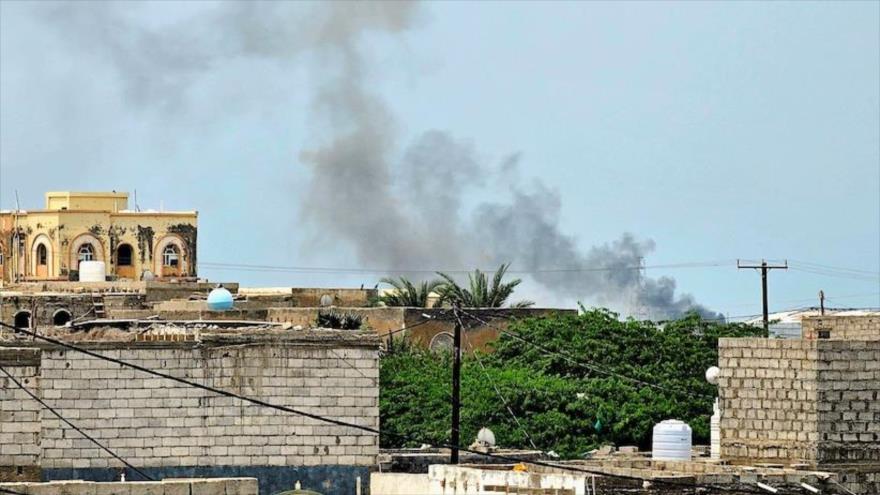
Israeli airstrikes hit residential areas in southern Lebanon killing 11 including children and women. — Source: gdelt
Yemen's Escalation Against Saudi Positions
In Yemen, Houthi forces launched ballistic missiles and drones at Saudi-linked positions in Marib and Mocha, imposed a Red Sea blockade and struck an Aramco refinery in Jizan, warning Riyadh that escalation will reach Saudi territory. [2] Yemeni armed forces reported a new wave of ballistic missile and drone attacks against Saudi-linked military positions in Mocha and Marib province. [2] According to a military source cited by the local Saba news agency the attacks were direct and precise, caused casualties and destroyed several weapons stores and depots. [2] The Riyadh-backed faction linked to the fugitive former president Abdu Rabu Mansur Hadi acknowledged the attacks and stated that six ballistic missiles and four drones were launched against Marib over the weekend. [2] The new operations occur amid an escalation of tensions between Yemen and Saudi Arabia. [2] Sanaa announced on 20 July a maritime blockade against the kingdom in the Bab el-Mandeb strait, alleging that Riyadh has maintained a siege against Yemen for nearly 12 years. [2] In this context high-ranking Supreme Political Council member Abdulaziz bin Habtour warned Saudi Arabia that its territory and interests will not remain outside the conflict if the military escalation continues. [2] The Yemeni official considered that betting on US and Zionist support and transferring the confrontation inside Yemen through local forces that act as agents of foreign powers, allowing the Saudi side to stay outside the consequences of the escalation, is a mistaken bet. [2] Bin Habtour maintained that Yemen will not accept its territory becoming a battlefield while Saudi territory and interests remain beyond the reach of the war. [2] He warned that Sanaa will adopt the “necessary measures” to protect its security and sovereignty against any attempt to impose new military equations. [2] The statements followed reports that Yemeni forces carried out a drone attack on an Aramco refinery in Jizan in southern Saudi Arabia. [2] According to Sanaa the operation responded to Saudi violations of its airspace and sovereignty in Saada and Hajjah provinces. [2] Saudi civil defense reported activation of early-warning systems in Jizan while reports from the area noted that warning sirens were activated. [2] The Jizan refinery operated by Aramco has a capacity of about 400,000 barrels daily and forms part of an industrial complex that also includes electricity generation and petrochemical facilities. [2] The escalation has also affected activities at the port of Mocha on the Red Sea. [2] Yemeni forces have carried out missile and drone operations against Riyadh-linked positions in Marib and other zones as part of the campaign Sanaa presents as a response to the blockade and Saudi military operations. [2] The conflict dates back to March 2015 when Saudi Arabia and its allies launched an offensive against Yemen with military, political and logistical backing from the United States and some Western countries. [2] The war has left tens of thousands of Yemenis dead while Saudi Arabia has not achieved its main objective of restoring a regime in Sanaa aligned with its interests. [2]
Gaza's Shifting Public Opinion After Ceasefire
In Gaza, support for Hamas has fallen to 33 percent from 41 percent ten months ago according to a new poll, as mass burials continue for bodies recovered from 2023 strikes and residents say any Trump-brokered deal comes too late after over 73,000 deaths. [3] A completely fresh opinion poll shows that support for Hamas is falling sharply among residents of Gaza. [3] Human remains and skulls belonging to 112 people lay on the ground between destroyed houses in the Al-Sabra neighborhood of Gaza City. [3] The remains, now draped with Palestinian flags, were recently dug out from tons of concrete and other building debris in the ruins of what were once apartment blocks. [3] According to surviving family members those now being buried were killed nearly three years ago. [3] Because of Israeli attacks and the ongoing war no one was able to dig them out until now. [3] The attacks are said to have occurred in several separate strikes against homes in the opening months of Israel’s attacks on Gaza after the Hamas-led attack on Israel on 7 October 2023. [3] Nidal Abu Shariaa (55) is one of the surviving family members. [3] “The first attack occurred on 20 October 2023. Then 14 people were killed. A month later, on 22 November, a new attack killed a total of 100 people in the same family,” he said. [3] “It was a deception,” Nidal added. [3] “First an Israeli missile hit a building and the survivors fled to a relative in another house. Then new missiles hit that house.” [3] Two of his sisters were killed in the attack. [3] Traces of the attacks remain visible in Al-Sabra: collapsed single-family homes, destroyed multi-story apartment blocks, burned palm trees, gardens and cars. [3] “Several of them were alive under the rubble but they died of suffocation, starvation or blood loss because no one could remove the rubble or even move,” Nidal said. [3] Ali Abu Shariaa, another family member, told VG: “These remains belong to schoolchildren, business people, traders, university students and housewives.” [3] Civil defense spokesperson Mahmoud Basal told VG that rescue crews managed to retrieve the remains of the extended family after 17 days of intensive work in the neighborhood. [3] They were identified using forensic findings, clothing, jewelry, injuries or other distinguishing marks. [3] Rescue teams are now working in this way across the entire Gaza Strip to retrieve bodies from the rubble. [3] “Since the ceasefire began on 10 October 2025 rescue crews have retrieved more than 800 people from the rubble in Gaza,” Basal said. [3] The mass burial comes at a time when the way forward for Gaza is completely uncertain. [3] At the end of July President Donald Trump declared that his peace council had reached agreement with Hamas on disarmament, which he called “a monumental step toward lasting peace and security.” [3] Trump claimed Hamas had agreed to full disarmament and that Israeli forces would withdraw from Gaza after disarmament is completed. [3] Hamas for its part stressed that Israeli forces, which today occupy nearly 70 percent of the Gaza Strip, must withdraw before they lay down their weapons. [3] And that was also the problem: on 9 August Israeli Prime Minister Benjamin Netanyahu took the podium and rejected the Trump plan. [3] “Israel will not carry out any withdrawal until Hamas is genuinely disarmed and we will continue to prevent threats against our forces and citizens,” Netanyahu said. [3] The way out of the war is therefore, for now, blocked. [3] Gaza residents are exhausted. [3] Israeli warfare continues and claims lives almost daily. [3] At the same time many are very dissatisfied with Hamas, which still controls the areas Israel does not occupy. [3] Yousef Abu Alaa (66), a displaced man living in a tent with his family, told VG that any agreement comes “too late” anyway. [3] Abu Alaa believes Hamas should have accepted the terms right from the start of the war. [3] “We know the agreement is not fair, but Hamas should have accepted it earlier. It could have saved thousands of Palestinian lives that have been killed by Israel,” he said. [3] A new opinion poll among Gaza residents conducted by the Palestinian Center for Policy and Survey Research between 5 and 8 August shows that support for Hamas in Gaza is falling. [3] Only 33 percent of those surveyed say they support Hamas, compared with 41 percent ten months ago. [3] Support is also falling among Palestinians outside Gaza, in the West Bank. [3] The survey also shows that more and more Palestinians are questioning “whether armed struggle has produced meaningful results” after the destruction in Gaza. [3] Support for “armed struggle as the most effective means to achieve a Palestinian state” fell from four in ten to under three in ten. [3] Support for negotiations rose from just over a third to just under half — the highest level in four years. [3] Salem, another resident VG met who previously worked as a construction worker in Israel, lost his son last summer. [3] “If the agreement had come earlier my son could have been alive. He was killed when he tried to fetch flour during the famine period,” he said. [3] Khader Qannouna (48), a displaced father of nine children from a refugee camp in central Gaza, said he is very angry because a possible agreement comes too late. [3] He believes Hamas should have accepted the agreement two years ago. [3] “Maybe then we could have lived in our homes now, far from hot tents, rats and mosquitoes,” he said. [3] “The only way to get the agreement implemented is more pressure from Trump. The mediators in the negotiations are too weak,” he said. [3] Back in the neighborhood where the mass burial is taking place, Ali Abu Shariaa (52), who survived the 2023 attacks, said his family was hit by six different attacks during the war. [3] In the last attack he lost his brother, six cousins and a little girl, Ahed (8). [3] It happened in August, in the middle of the famine catastrophe, and was one of Israel’s last major offensives against Gaza City before the ceasefire. [3]

Israeli airstrikes killed 11 in southern Lebanon including three children as ceasefire nears collapse. — Source: vg
West Bank Siege in Qusra Highlights Settler Violence
In the West Bank, Israeli settlers and soldiers have besieged 15 Palestinians including two children in three Qusra homes for over a week, blocking water, food, electricity and aid convoys in what analysts call a pattern of strategic terror and ethnic cleansing. [4] As the blockade enters its second week, 15 Palestinians including two children remain besieged inside three homes in the Ras al-Ain area of Qusra, south of Nablus. [4] Surrounded by armed Israeli settlers and military battalions and convoys, the families are cut off from food, water and electricity. [4] The United Nations reported that the residents are “trapped inside their homes in a state of terror, unable to attend to their basic needs and without access to water or electricity.” [4] The humanitarian crisis remained acute on Sunday when the Israeli army intercepted a UNICEF convoy attempting to deliver aid to the trapped families. [4] While the entry of two vehicles provided temporary relief regarding food, military forces blocked and expelled a water tanker from the vicinity of the homes, sustaining the severe deprivation of basic resources. [4] The day prior, settlers attacked municipal workers and a bulldozer attempting to repair utility lines. [4] Qusra Mayor Abdel Azim Wadi told Al Jazeera, “We were unable to restore electricity and water to the three besieged homes in the town.” [4] Wadi emphasized the severity of the situation, stating, “Humanely, we have often heard about human rights, about children’s rights, and about women’s rights, but today what our families in Jabal Ras al-Ain are experiencing is truly stripped of humanity.” [4] Al Jazeera’s Laith Jaar, reporting from Qusra, witnessed the military’s direct involvement in enforcing the blockade. [4] “The Israeli army is the one providing this support to these settlers, and the Israeli army is moving in the area with the participation of settlers who are trying to distance Palestinians and expel them from their homes,” Jaar reported. [4] Describing the military and settler coordination, he added, “We are talking about continuous siege operations that completely tighten the stranglehold on the Palestinians.” [4] Inside the cordoned area, residents remain defiant despite the encroaching military and settler presence. [4] The Israeli army has converted a home at the top of the hill into a military barracks and declared the area a closed military zone to expel international solidarity activists and members of the Israeli group Peace Now. [4] However, the military has simultaneously refused to execute nine eviction orders against the illegal outpost established on the western outskirts of the town by the Hilltop Youth militia in Area B — the very outpost from which the settlers are operating and besieging the Palestinian homes. [4] Qusai Abu Reida, a besieged resident, communicated his resolve to Al Jazeera. [4] “We will remain steadfast and we will remain patient, meaning even if they cut off our food, nourishment, and medicine, and meaning even if we drink water and salt, we made a pact with ourselves and our neighbors Youssef and Rizq that we will not leave here except as martyrs,” Abu Reida said. [4] He affirmed, “It is impossible for us to leave this house, as this is our effort and the effort of the land of our ancestors, meaning we will not take it lightly and give it to them.” [4] Political analysts and human rights advocates view the siege of Qusra as a calculated blueprint for broader ethnic cleansing. [4] Mustafa Barghouti, Secretary-General of the Palestinian National Initiative, told Al Jazeera that the operation has a clear tactical and strategic purpose. [4] “The first tactical goal is to seize these lands and thousands of dunams and seize this area and expel these people and ethnically cleanse them from their homes through threatening them with terrorism,” Barghouti said. [4] He warned that the true danger lies in the precedent being set for the rest of the occupied territory, stating, “But the strategic goal is a message to all the villages of the West Bank that this that is happening in Qusra will happen in other places.” [4] Erika Guevara Rosas, Amnesty International’s Senior Director for Research, Advocacy, Policy and Campaigns, echoed this assessment. [4] She stated that “the horrors unfolding in Qusra reflect the relentless escalation and expansion of an accelerating and well-documented pattern of coordinated and strategic settler terror, enabled, backed and funded by the State of Israel.” [4] This systemic violence aligns with a rapid settlement expansion campaign, with the Wall and Settlement Resistance Commission reporting that settlers have established over 300 outposts since October 2023, while the Israeli government has advanced plans for 104 new settlements. [4]
Tigray Clashes Risk Regional Spillover
In recent fighting between TPLF and Ethiopian forces near the Sudanese border, cross-border shelling, mutual accusations of supporting each other’s rebels, involvement of Eritrean and RSF elements and analysts’ caution against wider war have been reported. [5] On August 1 clashes erupted in the Shererina area of western Tigray, near the Sudanese border, between forces of the Tigray People’s Liberation Front (TPLF) and Ethiopian federal forces. [5] Heavy artillery and drones were used in the fighting. [5] Shelling also crossed into Sudan, hitting refugee camps on Sudanese territory and resulting in an unspecified number of casualties, according to the Sudanese Interior Ministry and Commission for Refugees. [5] After a day of clashes the fighting subsided, but an unspecified number of civilians and wounded TPLF fighters fled towards Sudan and are now receiving treatment in hospitals in eastern Sudan, according to a correspondent for Ayin in the region. [5] On August 10 an Ethiopian army drone hit a secondary school and nearby riverbed in Merewa, killing three TPLF fighters and injuring seven others, the BBC reported. [5] These clashes were not merely a passing border incident. [5] They followed months of mutual military buildups, escalating tensions between Addis Ababa and the Tigrayan leadership, deteriorating relations between Ethiopia and Eritrea, and the increasing interconnectedness of the crisis in northern Ethiopia with the Sudanese war. [5] Crucially, the fighting erupted in a region geographically close to Sudan and bordering Eritrea. [5] Here, three wars intersect: the Tigrayan war, the Sudanese war, and a brewing Ethiopian-Eritrean conflict. [5] What appears today as a skirmish on the edge of an Ethiopian region could, if it expands, escalate into a crisis that transcends borders. [5] Both Sudan’s national army and Ethiopia’s government continue to trade accusations over supporting their opponents. [5] On one hand, Ethiopian authorities claim that the Sudanese army is supporting elements of the TPLF, while TPLF fighters also support Sudan’s army in the current Sudanese conflict. [5] The relationship between the Sudanese army and the Tigray People’s Liberation Front (TPLF) is not entirely new. [5] Historically, the Sudanese border has been a crucial strategic depth for Ethiopian opposition forces, and eastern Sudan has served as a transit point for refugees, fighters, and weapons throughout various periods of the Horn’s history. [5] In the context of the current conflict, multiple sources have observed movements of Tigrayan forces — specifically the Army 70 — in eastern Sudan along the border with Ethiopia. [5] The Ethiopian government considers the refugee camps in Sudan, which house Tigrayan refugees who fled during the 2020-2022 war, to be recruitment centres for fighters from the Tigrayan authorities. [5] Earlier, Ayin quoted a source in Um Rakuba camp in Gedaref State, who says the TPLF are conducting military recruitment drives within the camp that houses thousands of refugees from Ethiopia’s Tigray ethnic group. [5] The source claims that officials from the Tigray People’s Liberation Front (TPLF) organised extensive mobilisation efforts and broadcast calls to arms via loudspeakers in the camp. [5] In contrast, Sudanese authorities have accused the Addis government of arming and training the Rapid Support Forces (RSF) within its territory, while the TPLF claims the RSF participated in this month’s fighting in western Tigray. [5] “If this allegation is true, then this is a major escalation into the war,” says political analyst Chalachew Tadesse. [5] “But I do not think the RSF were involved in this one-day conflict. The TPLF are trying to regionalise the war because it is advantageous for them to do so; involving Eritrea and Sudan will help their war effort.” [5] In February, Reuters, citing sources and satellite imagery, revealed a secret camp in Ethiopia’s Benishangul-Gumuz region, which it said was being used to train an estimated 4,300 RSF fighters. [5] Both RSF and allied Sudan People’s Movement Liberation-North commanders have stated that Ethiopia has provided them with military support via Asosa, the capital of Beninshangul-Gurmuz. [5] Reuters also reported that the United Arab Emirates (UAE) funded the camp’s construction, something Abu Dhabi categorically denies. [5] Ethiopia has also rejected these claims, while other political analysts question the strategic rationale for hosting such a camp. [5] Nonetheless, a recent military attack by the RSF and allied forces in parts of Geisan, a town bordering Ethiopia, suggests that their forces crossed into Sudan via the Ethiopian border, analysts say. [5] According to security expert and former Sudanese army Major-General Jaafar Hassan Mohamed, the real crisis for Sudan lies in this exchange of accusations between Sudan and Ethiopia. [5] Both sides may respond in kind, facilitating or supporting rebel factions — whether the TPLF or the RSF — and escalating a potential regional conflict. [5] The fact that Eritrea, seen as supporting Sudan’s army, has now swapped sides and supports the TPLF, adds to the stakes. [5] During the previous battle, the Eritrean army fought the TPLF alongside Ethiopian and Amhara forces. [5] Some of the tension between the two countries stems from the lack of consultation with Eritrea during the 2022 peace talks and accusations that Eritrean forces occupied Ethiopian territory afterward. [5] The Red Sea becomes another significant factor. [5] Ethiopia, which has been landlocked since Eritrea gained independence in 1993, wants sea access. [5] Eritrea sees any Ethiopian attempt to gain access by force as a threat to its security and sovereignty. [5] In this sense, the Tigray crisis is no longer separate from the struggle for control of the Red Sea. [5] While political analysts do not believe the conflict in the Shererina area of western Tigray earlier this month will necessarily trigger a longer, wider conflict, regional influences could provide the spark. [5] For one, Tadesse told Ayin, neither Sudan nor Ethiopia wants to be dragged into a wider conflict. [5] “Both Sudan and Ethiopia know their limits,” he said. [5] “Ethiopia is entangled in an internal war within Oromia and in Amhara, and Sudan is also involved in an internal war. So I don’t think either side is interested in escalating any conflicts in Tigray.” [5] Researcher Khalid Taha, a specialist in Horn of Africa affairs, also rules out the likely possibility of a wider, regional war in Tigray but does not rule out the potential influence of Eritrea and regional actors such as Egypt, Saudi Arabia, and the United Arab Emirates. [5] Taha says that regional alignments in the area do not form rigid blocs, as key powers pursue distinct, self-interested agendas. [5] While Egypt prioritises Nile water rights and Saudi Arabia focuses on Red Sea security and Sudanese stability, the UAE maintains deep strategic ties with Ethiopia and is accused of supporting Sudan’s Rapid Support Forces. [5] “What is important and certain is that the Gulf rivalry is part of the regional environment within which the Ethiopian-Sudanese crisis is unfolding, and the region is moving according to the intersections of interests, shifting rivalries, and the independent calculations of each country,” Taha told Ayin. [5] “This is precisely what makes the situation more dangerous.” [5]
What to watch next: The next Hezbollah response in Lebanon and any further cross-border incidents in Tigray will test whether the June framework and regional stability can hold amid ongoing mutual accusations and military buildups.