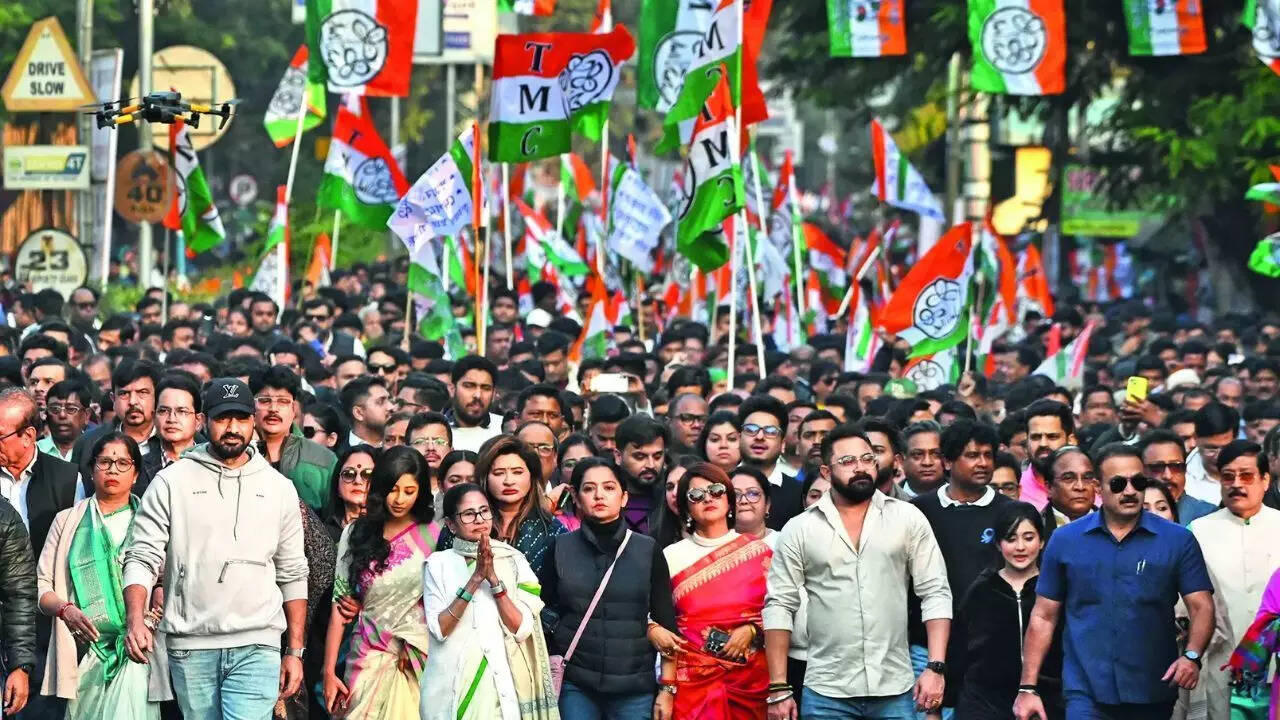

West Bengal CM Mamata Banerjee Leads 6-Km Protest March Against ED Raids, Files FIRs for Alleged Theft and Trespass
Kolkata, India – West Bengal Chief Minister Mamata Banerjee on Friday spearheaded a high-profile 6-kilometer protest march against the Enforcement Directorate (ED), accusing central agency officials of theft and trespass during raids on an election consultancy firm's office and the residence of its director. The demonstration, which began around 1:39 PM GMT on January 9, 2026, has escalated political tensions in the state, with Banerjee lodging two First Information Reports (FIRs) against the officials and framing the actions as an attempt by the central government to misuse investigative agencies ahead of upcoming elections.
The protest, led by Banerjee and supporters of her Trinamool Congress (TMC) party, targeted what the chief minister described as "thief-like" behavior by ED personnel. According to reports, the ED had conducted searches at the office of I-PAC (Indian Political Action Committee), a data analytics and political consultancy firm, as well as the residence of its director. Banerjee's march symbolized a direct counter-offensive, drawing hundreds of participants and amplifying accusations of political vendetta by the BJP-led central government.
In a fiery address during the march, Banerjee reportedly questioned the ED's conduct, asking, "Why did you come like a thief?" This rhetoric underscores the TMC's long-standing narrative that central agencies like the ED and CBI are being weaponized against opposition-ruled states. The FIRs, filed at local police stations, specifically allege theft and trespass, marking a rare instance of a state government initiating legal action against federal probe agency officials.
Escalating Tensions Amid Raids and Political Rivalry
The immediate trigger for the protest stems from the ED's operations at I-PAC's premises. I-PAC, known for providing strategic consulting services to political parties during elections, has been under scrutiny in recent probes related to financial irregularities. The raids, part of an ongoing investigation into alleged money laundering, reportedly involved seizing documents and electronic devices, prompting Banerjee's sharp response.
Banerjee's actions have injected fresh unrest into West Bengal's volatile political landscape. The medium-severity civil unrest, characterized by public demonstrations and rallies, reflects broader friction between the state and union governments. Supporters gathered along the protest route in Kolkata, chanting slogans against the ED and the Centre, leading to temporary disruptions in traffic and heightened police deployment to maintain order.
This episode is not isolated. West Bengal has witnessed repeated clashes over central agency interventions. The TMC has frequently protested ED summons to its leaders, including Banerjee's nephew Abhishek Banerjee, in cases linked to coal smuggling and school recruitment scams. Critics from the BJP counter that these probes are legitimate enforcement of law, targeting corruption in the state.
Background: A Pattern of Agency-State Confrontations
The Enforcement Directorate, established under the Prevention of Money Laundering Act (PMLA) of 2002, has expanded its role significantly in recent years, conducting high-profile raids across opposition strongholds. In West Bengal, ED actions have intensified since the 2021 state assembly elections, where TMC secured a resounding victory despite predictions of a BJP surge.
Banerjee has positioned herself as a defender of federalism, often alleging that the Modi government's "federal overreach" aims to destabilize her administration ahead of key electoral battles. With national and state polls on the horizon—potentially including the 2026 West Bengal assembly elections—the timing of these raids has fueled speculation of electoral strategy. The TMC views I-PAC's involvement as particularly sensitive, given the firm's role in data-driven campaigning that helped TMC's 2021 win.
Legal experts note that FIRs against ED officials could lead to jurisdictional battles, as central agencies operate under union jurisdiction while state police handle local complaints. Past instances, such as the 2023 Sandeshkhali unrest or ED arrests in the cattle smuggling case, have similarly polarized the state, resulting in protests and counter-protests.
Outlook: Broader Implications for Federal Dynamics
As investigations continue, the protest risks deepening the divide between New Delhi and Kolkata. The ED is likely to challenge the FIRs in higher courts, potentially escalating to the Supreme Court, which has previously ruled on agency autonomy versus state rights. Public unrest remains contained but could amplify if similar raids target other TMC affiliates.
Political analysts observe that Banerjee's street mobilization—combining legal filings with mass protests—reinforces her image as a grassroots leader. For the BJP, it provides ammunition to portray TMC as shielding corruption. With elections looming, this standoff exemplifies India's federal fault lines, where law enforcement intersects with partisan politics.
The events of January 9 underscore a deepening crisis of trust in institutions, with both sides digging in. Authorities urge calm, but the charged atmosphere signals more confrontations ahead in West Bengal's restive political arena.
(Word count: 612)






