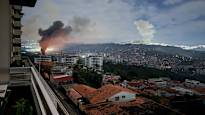
U.S. Captures Venezuelan President Nicolás Maduro in Dramatic Military Operation Amid Drug Trafficking Indictment

Latest from X
U.S. Captures Venezuelan President Nicolás Maduro in Dramatic Military Operation Amid Drug Trafficking Indictment
In a stunning development, Venezuelan President Nicolás Maduro and his wife, Cilia Flores, have been captured by U.S. forces in a military operation and indicted on charges of corruption, drug trafficking, and narco-terrorism. The operation, which unfolded under the cover of night, marks one of the most direct U.S. interventions in Latin America in decades. U.S. authorities allege that Maduro has orchestrated a decades-long scheme to flood the United States with thousands of tons of cocaine, enriching himself and his inner circle while collaborating with narco-terrorist organizations.
According to reports, the operation to apprehend Maduro was meticulously planned, with U.S. authorities tracking his movements since last summer. The final decision to act was influenced by favorable weather conditions, allowing for a surprise raid that caught Maduro off guard in the early hours. Former President Donald Trump, who has been vocal about the operation, reportedly watched the events unfold in real-time, describing the experience as akin to watching a television program. Following their capture, Maduro and Flores were flown out of Venezuela, with Trump confirming during a press conference on January 3, 2026, that the couple would be transported to New York to face trial on American soil.
The superseding indictment, unsealed by the U.S. Department of Justice, paints a damning picture of Maduro’s regime. It accuses him of leveraging his positions of power—both as president and previously as minister of foreign affairs—to facilitate drug trafficking operations over a span of more than 25 years. The charges include narco-terrorism conspiracy, cocaine trafficking, and corruption, alleging that Maduro and his associates worked with drug traffickers to import vast quantities of cocaine into the U.S. The indictment further claims that these activities enriched not only Maduro but also his wife, son (a member of Venezuela’s National Assembly), and members of the country’s political and military elite. Prosecutors assert that state-sponsored gangs were used to protect and support these illicit operations.
This is not the first time Maduro has faced such accusations. In 2020, U.S. prosecutors in New York, Washington, D.C., and Florida charged Maduro and 14 other Venezuelan officials with similar crimes, though the latest indictment expands to include his wife and son. The allegations have long painted Maduro’s government as a criminal enterprise, with the U.S. offering a $15 million reward for information leading to his arrest in previous years. However, the capture of Maduro represents a significant escalation, with Trump stating during the January 3 press conference that the U.S. will “run” Venezuela temporarily in the wake of this operation—a statement that has raised questions about the future of the country’s governance.
Background on Venezuela’s Political and Criminal Landscape
Venezuela has been mired in political and economic crises for over a decade, with Maduro’s leadership widely criticized as authoritarian and corrupt. Since assuming power in 2013 following the death of Hugo Chávez, Maduro has faced accusations of rigging elections, suppressing dissent, and mismanaging the country’s vast oil wealth, leading to hyperinflation and widespread poverty. The U.S. and several other countries have refused to recognize his legitimacy as president, instead backing opposition leader Juan Guaidó as the interim president in 2019—a move that deepened the political standoff.
The drug trafficking allegations add another layer to the complex crisis. Prosecutors claim that Maduro’s regime has systematically collaborated with narco-terrorist groups, turning Venezuela into a hub for cocaine trafficking into the U.S. and beyond. This has not only fueled violence and instability within Venezuela but also contributed to the international drug trade, with significant implications for global security.
Outlook: What Happens Next?
The capture of Maduro and the subsequent U.S. indictment raise significant questions about Venezuela’s future. With Trump’s assertion that the U.S. will oversee the country temporarily, international observers are watching closely for signs of how this intervention will unfold. The power vacuum left by Maduro’s removal could lead to further instability, especially given the deep divisions within Venezuelan society and the military’s historical allegiance to the ruling regime.
Meanwhile, legal proceedings against Maduro and his family are expected to draw global attention. If convicted, the charges of narco-terrorism and drug trafficking carry severe penalties under U.S. law, potentially resulting in life imprisonment. However, the political nature of the case may complicate the judicial process, with Maduro’s supporters likely to denounce the operation as an imperialist overreach by the United States.
As this unprecedented situation develops, posts on X from verified accounts, including major news outlets, reflect the gravity of the event. Updates from sources like Reuters and The Associated Press highlight the long-standing nature of the accusations against Maduro, while more recent posts underscore the shock and uncertainty following his capture. The international community remains on edge, awaiting clarity on what this dramatic turn of events means for Venezuela and U.S.-Latin American relations.
Track this story live
Original Sources
- •
- •
- •
Editorial process: This article was synthesized from the original sources cited above using The World Now's AI editorial system, with byline accountability from our editorial team. We grade every story for source grounding, factual coherence, and on-topic match before publication. Read more about our editorial standards and contributors. Spot something inaccurate? Let us know.
Last updated: January 11, 2026






