
US and Iran Clash at UN Over Bahrain Attacks and Hormuz Control
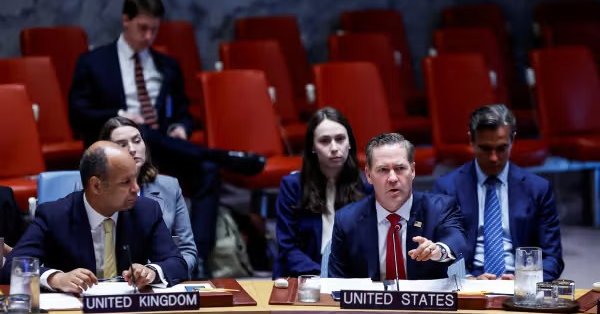
The United States and Iran clashed at the UN Security Council on Thursday, with the US warning that President Donald Trump’s patience was not unlimited amid Iranian attacks on Arab neighbors, commercial shipping, and continued insistence on control of the Strait of Hormuz. [1]
US-Iran Clash at UN Security Council
US Ambassador Michael Waltz confronted Iran at the UN over attacks on Bahrain and Hormuz tensions. [1] The United States and Iran clashed at the UN Security Council on Thursday as US Ambassador Michael Waltz warned that President Donald Trump’s patience was “not unlimited” in the face of Iranian attacks on its Arab neighbors and commercial shipping. [1]
Dispute Over Strait of Hormuz Tolls
The Trump administration offered to release billions in frozen Iranian funds if Tehran dropped its demand to charge tolls on ships passing through the Strait of Hormuz, but Iran rejected the proposal. [2] The Trump administration has offered to release billions of dollars in frozen Iranian funds if Tehran abandons its demand to charge ships for passage through the Strait of Hormuz, but the regime rejected the proposal and continues to insist it controls the strategic waterway. [2]
Iranian Attacks on Gulf Targets
Iranian attacks during and after the recent US-Israel war on Iran targeted military bases, airports, energy facilities, and hotels in Gulf countries including Bahrain and Kuwait. [5] Since the war broke out on February 28, Iranian attacks have targeted military bases hosting US troops as well as some civilian sites, including airports, energy facilities and hotels in some Gulf countries. [5] Even after Tehran and Washington reached a memorandum of understanding to end the war earlier this month, the Iranian military launched missiles and drones at targets in Bahrain and Kuwait in skirmishes with the US. [5] The US and Israeli war on Iran and its hugely negative impact on Gulf states created an unprecedented security crisis for GCC members. [5]
Gulf States Seek Security Diversification
Gulf states are accelerating efforts to diversify security partnerships with countries such as Pakistan, China, Russia, Turkey, and European nations while maintaining ties with the US and opening economic dialogues with Iran. [5] Even before the war, Saudi Arabia signed a defence pact with Pakistan, an alliance that could expand to other countries in the region. [5] For years, Gulf states have been buying defence systems from some European countries, while maintaining friendly relations with Russia and China. [5] Seeking new security partners is not aimed at replacing the US. [5] The focus for countries like Saudi Arabia is the regional balance of power and pushing back on both Iran and Israel. [5] This means diversifying partnerships and setting up platforms like the so-called quad group of Saudi Arabia, Turkiye, Egypt and Pakistan. [5] It also means developing their own domestic defensive capabilities and developing more regional autonomy. [5] GCC countries will likely look to diversify their security alliances and deepen ties with China, Turkiye and Europe. [5] The Gulf will want to maintain its security relationship with the United States, but it will no longer want to be in a position where it is relying on the United States. [5] US forces in the region not only proved unreliable in preventing Iran’s attacks, but the presence of the US military in Gulf countries had the opposite of a deterrent effect. [5] These military bases became targets. [5] Gulf countries have kept lines of communication open with Tehran, even at the security level. [5] Several GCC countries are moving to mend ties and deepen economic relations with their neighbour across the Gulf. [5] If Gulf and Iranian economic interests are intertwined, Tehran would think twice before striking the region. [5] Gulf states are likely to try a different approach, whereby they try to make it more costly for Iran to strike them in the future by tying themselves more closely to Iran, such as through electricity infrastructure. [5] The Emiratis are having conversations with the Iranians that have never happened before, including with the IRGC, about various types of economic incentives. [5]
Syria Reassures Lebanon on Non-Intervention
Syrian Foreign Minister Asaad al-Shaibani visited Beirut and assured Lebanese leaders that Damascus has no intention of military intervention against Hezbollah despite US pressure. [4] Syrian Foreign Minister Asaad al-Shaibani told Lebanon's president on Thursday that Damascus had no intention of intervening militarily in his country despite US pressure to do so, according to the Lebanese presidency. [4] Shaibani, who also invited President Joseph Aoun to Syria, is visiting Beirut, where he met parliament speaker Nabih Berri, a Hezbollah ally, for the first time. [4] Shaibani told Aoun he wanted to clear up the confusion sparked by reports of a potential Syrian military intervention in Lebanon, adding that Syria had no intention of undertaking such a move. [4] Shaibani also extended to Aoun an invitation from Sharaa to visit Syria, which would be a first. [4] After meeting Berri, Shaibani told reporters that he did not rule out the possibility of a meeting with Hezbollah in the future. [4] At a joint appearance with Shaibani on Thursday, Salam announced the creation of a high-level committee tasked with developing economic partnerships and security agreements between the countries. [4] The new Syrian authorities are hostile to Hezbollah, which was allied with Assad, and have announced arrests of alleged cells affiliated with the group. [4] Hezbollah denies having any presence in Syria. [4] Since late 2024, Hezbollah's former Syrian supply routes have been cut and Damascus authorities say several attempts to smuggle weapons to Lebanon have been foiled. [4] During his trip, Shaibani met with the leaders of Christian parties that had opposed Syrian tutelage. [4] This visit lays the foundation for a new phase in relations with Lebanon and the different Lebanese political factions based on partnership and cooperation. [4]
Ukraine’s Urgent Appeal for Patriot Missiles
Ukraine’s Defense Minister appealed to nearly 40 allies for urgent transfers of Patriot missiles following a major Russian aerial assault on Kyiv that killed at least 22 people. [3] Defense Minister Mykhailo Fedorov has appealed to nearly 40 partner countries to urgently transfer Patriot missiles from their stockpiles in July in exchange for future deliveries already contracted for Ukraine. [3] The appeal comes after Russia launched one of its largest-ever aerial assaults against Kyiv overnight on July 2, killing at least 22 people and overwhelming Ukraine's air defenses with dozens of ballistic and cruise missiles alongside hundreds of drones. [3] Ukraine has already signed contracts for hundreds of PAC-2 Patriot missiles with German support, but deliveries are not expected to begin until the coming years. [3] Kyiv has also taken a step toward purchasing around 100 additional Patriot missiles through a 1 billion euro loan backed by the European Union, while European partners have begun transferring missiles from their own stockpiles for the first time this year. [3] Ukraine has more than doubled the effectiveness of Patriot systems against maneuvering Russian Iskander missiles by implementing NATO's After Action Review standard. [3] However, this is not enough. Ukraine critically needs additional Patriot missiles, which are available in partners' stockpiles. [3] Protecting Ukraine's skies depends on swift decisions, including expanding the Prioritized Ukraine Requirements List, a NATO-coordinated mechanism for purchasing U.S.-made weapons for Ukraine, and procuring missiles through JUMPSTART, a U.S. program that speeds up delivery of PAC-3 missiles. [3] In his evening address on July 2, President Volodymyr Zelensky reiterated that the most effective and sustainable way for Ukraine to defend itself against Russian ballistic threats is to produce its own Patriot interceptors. [3] We have been discussing licenses for the production of Patriots with the U.S. administration for a long time already. [3] I want to thank all the countries helping through the PURL program, which enables us to purchase interceptors, specifically for Patriots. However, to reliably protect lives, we need our own production. [3] Speaking at the site of a Russian strike in Kyiv's Darnytskyi district earlier in the day, Zelensky said delayed military aid had cost Ukrainian lives. [3] If our partners had delivered what they promised on time, I think we could have saved more homes and, frankly, more lives. [3] The president said Ukraine would need at least 140 Patriot missiles to intercept an attack involving around 70 ballistic missiles. [3] We are fighting on our own. The casualties are exclusively Ukrainian. We simply need our partners to do what they agreed to do. We're not even asking for more. [3] Patriot is the only air defense system in Ukraine's arsenal capable of intercepting Russian ballistic missiles. [3]
What to watch next: Gulf states are likely to try a different approach by tying themselves more closely to Iran through economic incentives such as electricity infrastructure, while Ukraine continues to press partners on the PURL and JUMPSTART initiatives for faster Patriot deliveries and discusses licenses for domestic production of interceptors.