
Armenia Rules Out Russia in US-Backed Trump Route Project
Armenia Rejects Russian Role in TRIPP Project
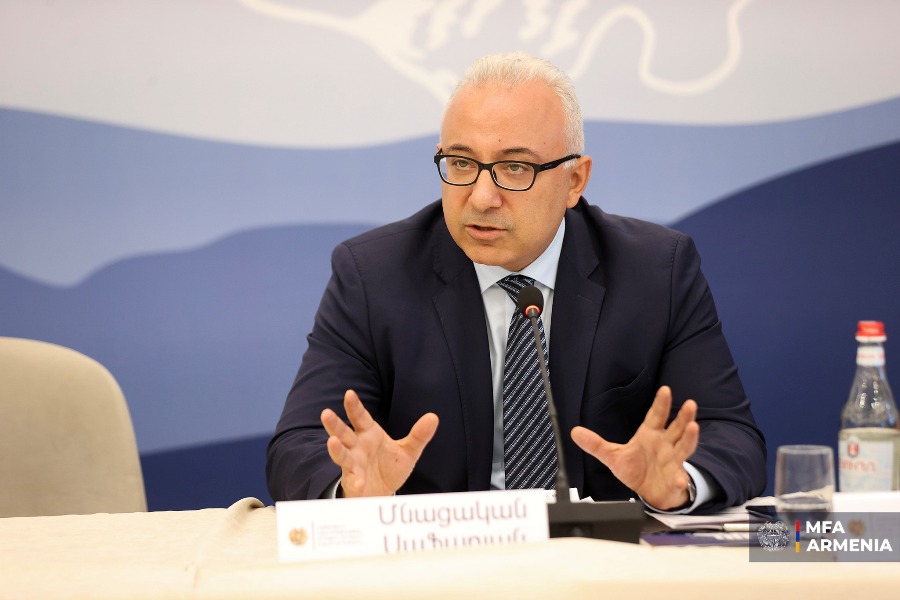
Armenia has rejected Russian involvement in the Trump Route for International Peace and Prosperity project, a bilateral initiative with the United States to establish a transport corridor through southern Armenia linking Azerbaijan to its Nakhchivan exclave. [1] Armenian Deputy Foreign Minister Mnatsakan Safaryan stated that TRIPP is not part of the bilateral agenda with Russia and that Yerevan is not discussing the project with Moscow. [1] The project forms part of Armenia’s Crossroads of Peace initiative to reopen regional transport links. [1] An Armenia-US framework agreement gives the US a 74% stake in a joint company, with Armenia holding 26% initially, rising to 49% after 49 years. [1] Safaryan said the issue is not part of the bilateral agenda between Armenia and Russia. [1] He added that at this stage TRIPP is moving forward as an Armenia-US project, with an agreement signed and implementation now under way. [1]
Russian Deputy Minister’s Comments
Russian Deputy Foreign Minister Mikhail Galuzin argued that the project would benefit from Russian participation due to Russian Railways’ operation of Armenia’s rail network, EAEU customs rules, and Russian border guards in the area, and suggested using Russia’s broad-gauge standard. [1] Galuzin recalled that Armenia, Russia and Azerbaijan had discussed the issue in a trilateral format in 2022 and 2023. [1] He said the discussions and dialogue within the trilateral working group stopped through no fault of their own and that it is now extremely difficult to resume them because Armenia has promised 49% of the authorised capital of the future railway to the American side. [1] Galuzin expressed skepticism, citing potential opposition from Iran and China. [1] He said some experts believe China was unlikely to accept US control over a section of the transport and logistics corridor linking Central Asia and Europe. [1] He also questioned whether Tehran, following the recent US and Israeli military strikes against Iran, would welcome an American presence north of its borders. [1] Armenian officials say they have addressed Iran’s concerns and see no customs problems under EAEU rules. [1] Iran has not issued any recent statements opposing the project’s implementation. [1] Galuzin argued that one way or another Russia’s position, as well as that of the EAEU, must be taken into account. [1] He also argued that the Trump Route should use Russia’s broad-gauge railway standard to ensure seamless connectivity with Azerbaijan. [1]
Implementation and Customs Status
The project forms part of Armenia’s Crossroads of Peace initiative to reopen regional transport links in all directions. [1] Armenia and the United States have signed a framework agreement on strategic cooperation to implement the Trump Route project. [1] Under the agreement the two countries will establish a joint Armenian-US company with the US side holding a 74% stake and the Armenian government owning the remaining 26%. [1] After the initial 49-year term expires the Armenian government’s share will increase to 49%. [1] Asked how transit under TRIPP would operate given Armenia’s membership of the Eurasian Economic Union, Safaryan said the bloc’s customs regulations would apply. [1] He stated that Armenian customs authorities implement the EAEU’s customs rules so there are no problems in that regard. [1] Safaryan said he would rather not speculate about the future and does not think it is appropriate to say anything about the future at this stage. [1] He did not directly answer questions about when work on the ground including railway construction would begin. [1]
Oil Prices Drop After US-Iran Talks
Oil prices fell for a third day after US-Iran talks in Doha showed progress on Strait of Hormuz issues, with Brent at $70.80 and WTI at $67.74. [4] Oil prices dropped about one per cent on Thursday down for a third consecutive day after Qatar said Iran and the US had made progress in indirect talks focused on the Strait of Hormuz which handled one-fifth of global oil supply before the war. [4] The discussions produced positive progress on issues related to the memorandum that halted the war in June a Qatar Foreign Ministry spokesperson said. [4] Brent futures lost 77 cents or 1.1 per cent to $70.80 a barrel by 0256 GMT while US West Texas Intermediate crude fell 84 cents or 1.2 per cent to $67.74 a barrel. [4] Both benchmarks also fell more than 1 per cent in the previous session hitting their lowest levels in four months. [4] As the strait stays open and crude oil flows out there are growing expectations of oversupply and competition for market share is pushing prices down Haitong Futures said in a note. [4] Opec+ oil-producing countries will likely agree to a further hike in their output targets from August when they meet on Sunday sources said on Wednesday. [4] UBS on Thursday cut its Brent forecasts citing the US-Iran Islamabad Memorandum of Understanding and the subsequent increase in oil shipping through the Strait of Hormuz. [4] It cut its average Brent price forecast for the September quarter by $25 and for the December quarter by $10. [4] The bank now expects the benchmark to average $80 a barrel during the second half of the year and $75 in 2027. [4] The next meeting between Iran and US negotiators will take place after funeral processions for Iran’s supreme leader Ayatollah Ali Khamenei who was assassinated on July 9 Qatar’s Foreign Ministry also said. [4]
G7 to Address AI in Defense and Finance
G7 will discuss AI defense standards amid concerns over cyberattacks. [2] The Group of Seven nations will discuss standards on artificial intelligence security and defense Finance Minister Satsuki Katayama has said. [2] Speaking in a recent interview Katayama said that financial institutions need to decide the order of priority for fixing their systems in order to prepare for the possibility of advanced AI models detecting a large number of vulnerabilities in their systems. [2] She added that the G7 nations which include Japan will discuss related criteria and work together to tackle cyberattacks. [2] State-of-the-art AI models such as Claude Mythos developed by US startup Anthropic are believed to be highly proficient in identifying system vulnerabilities. [2] Katayama has been negotiating with the United States to ensure that major financial institutions in Japan have access to these technologies. [2] She indicated that it would be challenging for financial institutions to tackle all vulnerabilities emphasizing the need to identify critical areas beforehand such as measures against deposit outflows and money laundering. [2] AI competition is currently centered around the three US firms of Anthropic Alphabet which is the parent of tech giant Google and OpenAI which is known as the developer of the ChatGPT generative AI chatbot. [2] Experts however believe that it is only a matter of time before Chinese companies catch up. [2] Acknowledging the current technological gap Katayama said the AI hierarchy with the United States at the top has already been established. [2] She highlighted the importance of cooperation among Japan the United States and Europe over the possibility that future advanced AI models released by Chinese companies may be exploited and used in cyberattacks. [2] She aims to act as a bridge between the United States and Europe at meetings among G7 finance ministers and central bank chiefs. [2] Japan’s Financial Services Agency is considering using advanced AI models to conduct cyberattack response drills at financial institutions. [2] Although we’ll consult with the National Cybersecurity Office it is possible that the financial industry will hold such drills ahead of other industries she said. [2]
India Expands Nuclear Arsenal Amid Rivalries
India has expanded its nuclear arsenal to 190 warheads by January 2026 while facing hybrid threats from Pakistan and China. [3] Last month the Stockholm International Peace Research Institute reported that India expanded its nuclear arsenal to an estimated 190 warheads by January 2026 driven by its longstanding rivalry with Pakistan and an increased strategic emphasis on countering China. [3] According to SIPRI India grew its stockpile from 180 warheads in 2025 by steadily developing and maturing a nuclear triad composed of aircraft land-based missiles and nuclear ballistic missile submarines. [3] This ongoing expansion is heavily driven by deep-seated regional rivalries and heightened tensions seen in Operation Sindoor in May 2025 involving Indian conventional strikes on Pakistani bases with nuclear missions. [3] To build a secure second-strike capability and strengthen deterrence against China India is investing in longer-range weapon systems while continuing to produce fissile materials. [3] This expansion is driven by significant technological advances such as the military’s recent deployment of MIRVs on the Agni-V intermediate-range ballistic missile. [3] Additionally India is shifting its peacetime posture by placing land missiles in canisters and deploying a small number of nuclear warheads on a single submarine conducting occasional deterrence patrols signaling a move toward mating warheads with operational launchers. [3] SIPRI reported that China had 620 nuclear weapons as of January 2026 up from 600 in 2025. [3] SIPRI reported that the US had deployed 1770 nuclear weapons as of January 2026. [3]
What to watch next: The next meeting between Iran and US negotiators will take place after funeral processions for Iran’s supreme leader Ayatollah Ali Khamenei on July 9. [4] G7 finance ministers and central bank chiefs will discuss AI security standards and cooperation against cyberattacks. [2]