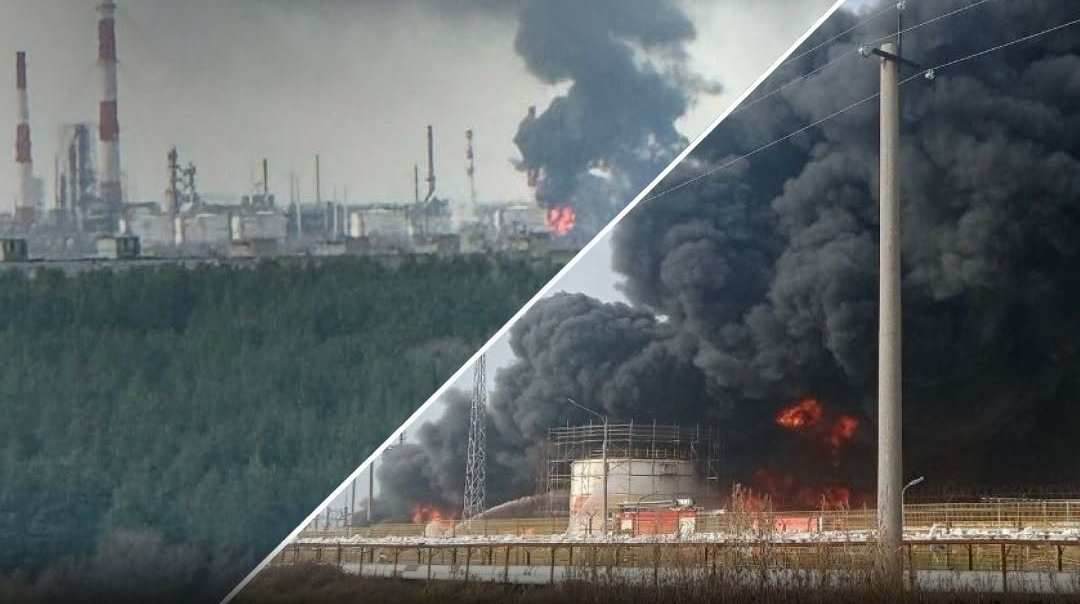

Ukraine Strikes Russian Oil Facilities in Recent Attacks
Ukraine has struck four key oil facilities in Russia as part of efforts to reduce Russia's military and economic potential.[1] These actions come amid intensified military exchanges, with Ukraine conducting strikes on a Baltic Sea port and industrial sites along the Volga river.[3] In response, Russia hit a port and a power facility in Ukraine overnight.[5] At least one person was killed and 26 injured in Russian attacks across Ukraine over the past day.[2] These developments highlight the reciprocal nature of the ongoing conflict, where both sides target critical infrastructure to impact the other's capabilities.
Ukrainian Military Strikes on Russian Targets
Ukraine's defence forces carried out precision strikes on four major facilities within Russia's oil refining sector during the night of 17-18 April.[1] This operation was explicitly aimed at diminishing the military and economic potential of the Russian armed forces, targeting assets vital for fuel production and distribution that sustain military operations.[1] The selection of oil refining infrastructure underscores a strategic focus on disrupting Russia's logistical backbone, as refined petroleum products are essential for powering vehicles, aircraft, and other military hardware.[1]
In addition to the oil facilities, Ukraine executed strikes on a Baltic Sea port and industrial sites situated along the Volga river.[3] The Baltic Sea port serves as a crucial node for maritime activities, potentially affecting the movement of goods and resources that support Russia's broader economic and military endeavors.[3] Meanwhile, the industrial sites along the Volga river, one of Russia's most significant waterways, represent key manufacturing and production hubs.[3] The Volga river facilitates extensive inland transport, making these locations strategically important for industrial output that could contribute to the war effort.[3]
These Ukrainian strikes demonstrate a coordinated approach, combining attacks on energy infrastructure with disruptions to ports and industrial zones.[1][3] By hitting multiple targets in a single operation, Ukraine aims to create compounded effects on Russia's ability to maintain its military tempo and economic stability.[1] Reports from Ukrainska Pravda include video evidence of the oil facility strikes, confirming the scope and timing of the assault.[1] The Straits Times further corroborates the port and Volga strikes, emphasizing their geographical spread across critical Russian regions.[3] This multi-faceted targeting reflects Ukraine's intent to impose sustained pressure without overextending resources, leveraging long-range capabilities to reach deep into enemy territory.[1][3]
The timing of these strikes—overnight on 17-18 April—allowed for reduced visibility and potential surprise, maximizing impact while minimizing immediate countermeasures.[1] Economically, oil refining capacity losses could lead to shortages in fuel supplies, indirectly hampering Russia's war machine by increasing costs and logistical challenges.[1] Militarily, any degradation in refining output directly correlates with reduced operational readiness for Russian forces.[1] Combined with the port strike, which could impede exports or imports, and the Volga industrial hits, which threaten production lines, these actions form a deliberate pattern of attrition.[3] Ukraine's military leadership has framed such operations as necessary responses to aggression, with the goal of leveling the playing field in a protracted conflict.[1]
Russian Military Strikes on Ukrainian Targets
Russia conducted overnight strikes targeting a port and a power facility in Ukraine, continuing its pattern of infrastructure attacks.[5] These hits occurred in the immediate aftermath of Ukrainian actions, suggesting a tit-for-tat dynamic in the escalation.[5] The port, a vital component of Ukraine's logistics network, likely faced disruptions in cargo handling and maritime access, impacting both civilian and military supply chains.[5] Similarly, the power facility strike threatens energy supply stability, potentially affecting electricity distribution to residential, industrial, and defense-related areas.[5]
The Straits Times reported these developments, noting the overnight timing which aligns with tactics used to exploit darkness for precision or area-effect munitions.[5] Such strikes on ports echo previous patterns where Russia has sought to isolate Ukraine's coastal regions and hinder international aid or exports.[5] Power infrastructure remains a frequent target, as its damage cascades into broader societal and military disruptions, from blackouts to impaired command and control systems.[5]
These Russian operations parallel the Ukrainian strikes in scope, focusing on dual-use assets that serve economic and military purposes.[5] By hitting a port, Russia aims to constrict Ukraine's trade routes and reinforcement pathways, much like Ukraine's Baltic Sea port strike seeks to do in reverse.[3][5] The power facility attack compounds vulnerabilities in Ukraine's energy grid, which has been under repeated pressure throughout the conflict.[5] This reciprocity illustrates how both belligerents prioritize high-value targets to erode the opponent's sustainment capacity over time.[5]
{IMAGE_2}
Casualties and Injuries from Attacks
Russian attacks across Ukraine over the past day resulted in at least one fatality and 26 injuries.[2] These figures, reported by the Kyiv Independent, encompass strikes in multiple locations, underscoring the widespread nature of the assaults.[2] The human toll highlights the immediate consequences of infrastructure targeting, where collateral damage affects civilians and possibly military personnel in proximity to the sites.[2]
The casualty count—at least one killed and 26 wounded—reflects the intensity of the barrages, likely involving missiles, drones, or artillery that struck populated or operational areas.[2] "Over the past day" provides a tight timeframe, indicating a concentrated wave of activity synchronized with the broader exchanges.[2] Injuries of this magnitude suggest varying degrees of severity, from shrapnel wounds to blast trauma, straining Ukraine's medical resources amid ongoing hostilities.[2]
This reported toll serves as a stark reminder of the costs borne by Ukraine in these reciprocal strikes, with each incident adding to the cumulative suffering.[2] The Kyiv Independent's coverage emphasizes the verified minimums, implying potential for higher numbers as assessments continue.[2] Such losses not only impact families and communities but also test Ukraine's resilience in maintaining defensive postures.[2]
Overview of Targeted Sites
The mutual strikes reveal a focus on high-impact locations: Ukraine hit four key oil facilities, a Baltic Sea port, and Volga river industrial sites in Russia.[1][3] Conversely, Russia targeted a port and a power facility in Ukraine.[5] This overview maps the geography and typology of these sites, all central to sustaining prolonged conflict.
Russia's oil refining facilities, struck on 17-18 April, form the core of its energy production, processing crude into usable fuels.[1] Their "key" status denotes large-scale operations critical for national output.[1] The Baltic Sea port strike disrupts northern maritime access, a gateway for Baltic trade routes.[3] Volga river industrial sites leverage the river's navigability for heavy industry, possibly including manufacturing tied to defense needs.[3]
On the Ukrainian side, the struck port handles significant throughput, essential for Black Sea or regional connectivity.[5] The power facility contributes to the national grid, powering everything from homes to factories.[5] These sites' selection—energy, ports, industry—mirrors across both sides, indicating shared strategic calculus.[1][3][5]
Geographically, Ukrainian strikes span Russia's northwest (Baltic) to central (Volga) and oil regions, showcasing reach.[1][3] Russian strikes hit Ukrainian infrastructure, likely in southern or energy-vulnerable zones.[5] This symmetry in targeting ports (Baltic vs. Ukrainian), energy (oil/power), and industry amplifies economic warfare elements.[1][3][5]
{IMAGE_3}
Context of Ongoing Exchanges
These strikes exemplify the persistent military exchanges between Ukraine and Russia, with each side retaliating against infrastructure to weaken the other.[1][2][3][5] Ukraine's 17-18 April oil facility hits, port, and Volga strikes aim to curb Russia's war-sustaining economy.[1][3] Russia's overnight port and power attacks, alongside the past day's casualties, counter with similar intent.[2][5]
The pattern—Ukraine strikes Russian assets, Russia responds on Ukrainian ones—defines the current phase, marked by overnight operations for tactical advantage.[1][5] Casualties from Russian actions add a human dimension to the infrastructure focus.[2] Sources from Ukrainska Pravda, Kyiv Independent, and Straits Times document this cycle without deviation.[1][2][3][5]
This back-and-forth erodes capacities incrementally: Ukraine targets refining and logistics to starve fuel and production; Russia hits ports and power to disrupt Ukraine's sustainment.[1][3][5] The 17-18 April timeline overlaps with "overnight" and "past day" reports, confirming near-simultaneous escalation.[1][2][5] No de-escalation signals appear, positioning these as standard conflict progression.[1][2][3][5]
Key Facts Summary
At least one person was killed and 26 injured in Russian attacks across Ukraine over the past day, per Kyiv Independent reports.[2] Ukraine conducted strikes on a Baltic Sea port and industrial sites along the Volga river, as noted by The Straits Times.[3] Russia hit a port and a power facility in Ukraine overnight.[5] These actions reflect ongoing military exchanges between Ukraine and Russia, with Ukraine's oil strikes forming a centerpiece.[1] This distillation captures the essence of verified developments.
What to watch next: Further Russian responses to Ukraine's oil facility and port strikes, alongside potential Ukrainian follow-ups on industrial targets, as the exchanges continue to target energy and logistics infrastructure.[1][3][5]