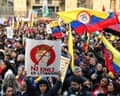

Thousands Rally Outside U.S. Embassy in Colombia Against Trump's Venezuela Intervention
BOGOTÁ, Colombia — Thousands of protesters gathered outside the U.S. Embassy in Colombia on January 4, 2026, chanting "Out with the Yanks!" in a show of solidarity with Venezuela amid escalating tensions over U.S. President Donald Trump's military intervention in the neighboring country. The demonstrations, rated as medium severity civil unrest, highlight growing public anger in Colombia over perceived foreign interference in Venezuelan affairs.
The protests erupted early on Sunday, January 4, at 02:13 GMT, outside the U.S. Embassy, drawing crowds voicing support for Venezuela's government and decrying U.S. actions. According to reports from The Guardian, demonstrators expressed fury over Trump's decision to intervene militarily in Venezuela, a move that has inflamed regional sentiments. Placards and chants accused the United States of imperialism, with protesters demanding an end to what they called aggressive "Yankee" meddling.
Eyewitness accounts described a lively but tense atmosphere, with participants from various leftist groups, student organizations, and Venezuelan expatriate communities uniting in opposition. Colombian police maintained a visible presence to ensure public order, but no major clashes were reported in initial coverage. The unrest underscores the spillover effects of Venezuela's protracted political crisis into Colombia, a nation that shares a 2,200-kilometer border and has hosted millions of Venezuelan migrants fleeing economic collapse.
Escalating Regional Tensions
The demonstrations come against the backdrop of Trump's inauguration earlier in 2025 and his administration's hawkish stance on Latin America. Trump has long criticized Venezuelan President Nicolás Maduro's regime, labeling it a dictatorship and imposing sanctions during his first term. Recent reports indicate that U.S. military actions—potentially including airstrikes or special operations—have targeted Venezuelan military assets, prompting Maduro to rally international support from allies like Russia, China, and Cuba.
In Colombia, public opinion appears divided. While President Gustavo Petro's left-leaning government has pursued dialogue with Maduro and criticized past U.S. policies, it has also grappled with domestic challenges from hosting over 2.8 million Venezuelan refugees as of late 2025, according to United Nations data. Protests like these reflect a segment of the population sympathetic to anti-imperialist narratives, particularly among urban youth and labor unions.
The Guardian reported that the rallies built on smaller gatherings in the days prior, with anger "building" over Trump's rhetoric framing Venezuela as a national security threat. Organizers framed the event as a defense of sovereignty, drawing parallels to historical U.S. interventions in the region, such as the 1989 invasion of Panama.
Historical Context of Colombia-Venezuela Relations
Colombia and Venezuela have endured a rocky relationship marked by border skirmishes, ideological clashes, and migration pressures. Under former President Iván Duque (2018-2022), Colombia backed U.S.-aligned opposition leader Juan Guaidó against Maduro. Petro's 2022 election shifted toward normalization, including trade reopenings and joint anti-deforestation efforts. However, Venezuela's economic woes—hyperinflation exceeding 1 million percent in 2018 and ongoing oil sector collapse—continue to drive migration, straining Colombian resources.
U.S. involvement has historically been contentious. The Monroe Doctrine's legacy lingers, and Trump's "America First" policies have reignited debates over hemispheric influence. Recent polls by firms like Invamer show mixed Colombian views on Venezuela: 45% favor stricter borders, while 30% support humanitarian aid without intervention.
No official statements from the Colombian government had been issued by January 8, 2026, but Foreign Ministry spokespeople urged peaceful expression. U.S. Embassy officials confirmed awareness of the protests and advised American citizens to avoid the area.
Outlook Amid Broader Unrest
As of January 8, the protests remained contained, but organizers have called for nationwide actions if U.S. intervention escalates. Analysts note that similar unrest could spread to cities like Medellín and Cali, where pro-Venezuela sentiment runs high among diaspora communities.
The events signal deepening polarization in Latin America, where Trump's return has prompted renewed alliances. Brazil's President Luiz Inácio Lula da Silva condemned U.S. actions, while Mexico echoed calls for diplomacy. For Colombia, balancing U.S. trade ties—worth $15 billion annually—with regional solidarity will test Petro's administration.
International observers, including the Organization of American States, are monitoring developments. With Venezuela's crisis entering its eighth year, these protests outside the U.S. Embassy serve as a barometer of how external powers' moves reverberate across borders, potentially fueling further civil unrest if tensions persist.
(Word count: 612)






