
Terrorism in Mali: Defence Minister Killed in Coordinated Attacks
Mali's Defence Minister Sadio Camara was killed in jihadist attacks on April 25, 2026, amid a wave of terrorism in Mali that saw militants launching assaults across multiple localities.[5] Militants claimed responsibility for the attacks, which struck various parts of the country, escalating security concerns in the region.[1] The Economic Community of West African States (ECOWAS) condemned the terrorist attacks and called for regional unity in response.[2] The Malian military confirmed the incidents, reporting that they had neutralized many assailants during the confrontations.[3] Additionally, the United Nations urged an international response to terrorism in the West Africa Sahel region following these events.[4]
Overview of the Attacks
The terrorist attacks on April 25, 2026, represented a significant escalation in the ongoing security challenges facing Mali, with militants carrying out operations across multiple localities in the country.[2] These assaults, described as coordinated and widespread, underscored the persistent threat posed by jihadist groups operating in the region.[5] Militants publicly claimed responsibility for the attacks, signaling their intent to disrupt stability and challenge government control in various areas.[1] This claim of responsibility aligns with patterns seen in previous incidents, where such groups have used public statements to amplify their impact and sow fear among the population.
The timing of the attacks on a Saturday highlights the opportunistic nature of these operations, targeting a weekend when military and civilian movements might be less predictable.[2] ECOWAS's prompt condemnation emphasized the cross-border implications of such violence, noting that the incidents occurred in the Republic of Mali and affected multiple sites simultaneously.[2] This multi-locality approach suggests a level of planning and resource allocation by the militants, potentially drawing on networks that span the Sahel region.[1] The attacks fit into a broader context of jihadist activity in Mali, where groups have historically exploited remote and under-governed areas to launch strikes against state forces and infrastructure.
While specific details on the number of sites or the exact tactics employed remain limited in initial reports, the militants' open claim of responsibility indicates confidence in their execution and aims to project strength.[1] ECOWAS's statement framed the attacks as a direct challenge to regional peace, pointing to the need for collective vigilance against such threats.[2] This overview reveals how the events of April 25 not only strained Mali's internal security apparatus but also rippled outward, prompting immediate regional attention.[1][2]
Key Incident: Death of Defence Minister
The death of Mali's Defence Minister Sadio Camara stands as the most prominent outcome of the jihadist attacks on April 25, 2026, occurring amid coordinated terror operations that targeted key military and government figures.[3][5] Reports confirmed that Camara was killed following assaults carried out by jihadist groups, marking a severe blow to Mali's leadership in counter-terrorism efforts.[5] This incident unfolded during what has been described as a major weekend assault, with the minister reported dead in the chaos of the engagements.[4]
The Malian military's statement acknowledged the attacks while highlighting their response, noting that the assailants suffered an immediate setback and that many were neutralized.[3] Camara's killing elevates the attacks from routine insurgent activity to a high-profile strike against the state's defense apparatus, potentially aimed at decapitating command structures.[5] Sources describe the event as part of broader coordinated terror attacks, suggesting that jihadist elements specifically targeted high-value individuals to maximize psychological and operational impact.[3]
Further details indicate that the assaults were large-scale, with the defence minister's death reported in the immediate aftermath, underscoring the intensity of the confrontations.[4] This loss comes at a critical juncture for Mali, where the defence portfolio is central to coordinating responses against jihadist threats. The confirmation of Camara's death by multiple outlets, including those citing jihadist involvement, paints a picture of a deliberate operation that succeeded in eliminating a key figure.[5] The military's report of neutralizing assailants provides some counterbalance, indicating that while the attackers achieved a symbolic victory, they faced significant resistance.[3]
Analysis of the incident reveals vulnerabilities in protecting top officials during such widespread assaults, as the coordinated nature allowed jihadists to press multiple fronts simultaneously.[3][4] Camara's role as Defence Minister positioned him at the forefront of Mali's fight against terrorism, making his elimination a potential rallying point for both insurgents and government forces.[5] Reports from the scene and official statements emphasize the rapid sequence of events, with the minister killed shortly after the jihadist attacks commenced.[5] This key incident not only mourns a national figure but also prompts questions about immediate succession and the continuity of military strategy in the face of such losses.[3][4][5]
Regional Responses
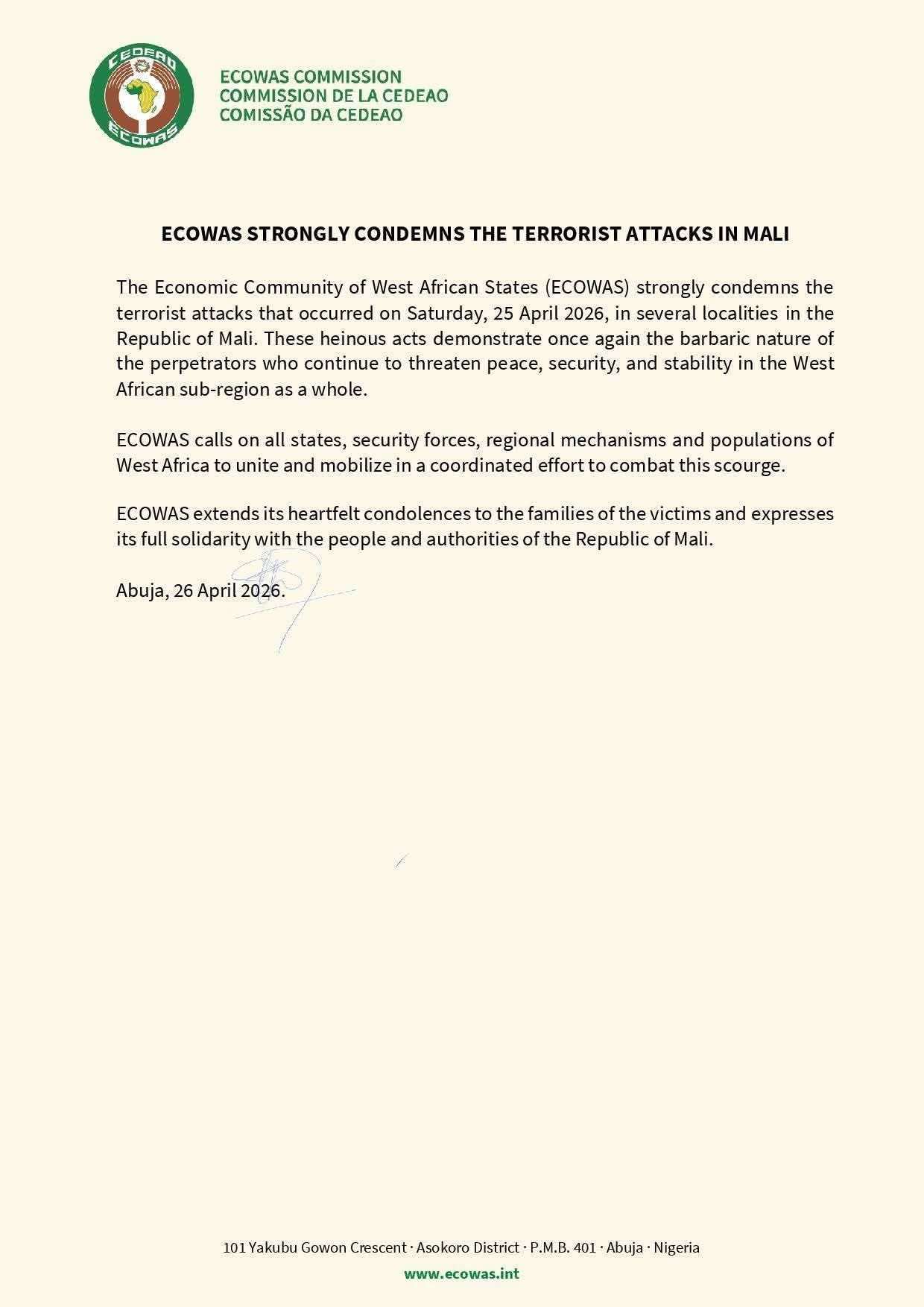
ECOWAS issued a strong condemnation of the terrorist attacks in Mali on April 25, 2026, explicitly calling for regional unity to counter the violence.[2] The Economic Community of West African States highlighted the attacks across multiple localities, framing them as a shared threat that transcends national borders.[2] This response underscores ECOWAS's role as a stabilizing force in West Africa, where jihadist activities have increasingly spilled over into neighboring countries.
The call for unity reflects a recognition that isolated national responses may prove insufficient against networked militant groups.[2] By condemning the attacks promptly, ECOWAS signaled solidarity with Mali while urging member states to bolster collective security measures. This regional stance aims to foster coordination in intelligence sharing, joint operations, and resource allocation, drawing on past precedents of ECOWAS interventions in the Sahel.[2]
The organization's statement positions the attacks as a pivotal moment requiring heightened cooperation, potentially leading to summits or enhanced peacekeeping efforts.[2] Such responses historically have galvanized diplomatic and military support, though implementation often faces logistical hurdles. ECOWAS's emphasis on unity serves as a diplomatic tool to isolate the militants and reaffirm commitment to democratic governance amid instability.[2]
Military and International Reactions
The Malian military responded to the coordinated terror attacks by confirming the incidents and reporting that many assailants were neutralized, describing the militants as suffering an immediate setback.[3] This official acknowledgment demonstrates the armed forces' engagement with the threats, even as they mourned the loss of Defence Minister Sadio Camara.[3] The military's statement, released in the aftermath, aimed to project resilience and operational effectiveness despite the high-profile casualty.
On the international front, the United Nations called for a robust response to violence and terrorism in the West Africa Sahel region following the large-scale assaults on April 25, 2026.[4] This appeal highlights the global dimensions of the crisis, with the Sahel's instability affecting migration, trade, and security beyond Africa. The UN's position advocates for multinational cooperation, potentially involving troop contributions, funding, and sanctions against jihadist networks.[4]
The interplay between Mali's military actions and international calls illustrates a multi-layered reaction strategy.[3][4] While the military focused on tactical neutralization, the UN emphasized strategic, long-term measures to address root causes and prevent escalation.[4] These reactions collectively aim to deter further attacks by combining immediate firepower with diplomatic pressure.[3][4]
What to watch next: Observers should monitor ECOWAS's follow-through on regional unity initiatives and the United Nations' push for an international response, alongside Mali's military updates on neutralizing remaining threats in the Sahel.[2][3][4]