
Tensions Flare Over Greenland as Denmark Warns US Move Could End NATO, France Prepares Contingency Plans
Copenhagen/Paris/Washington — Escalating geopolitical friction surrounding Greenland intensified this week after a provocative social media post hinted at U.S. territorial ambitions, prompting stark warnings from Denmark about the potential collapse of NATO and contingency planning by France alongside European allies.
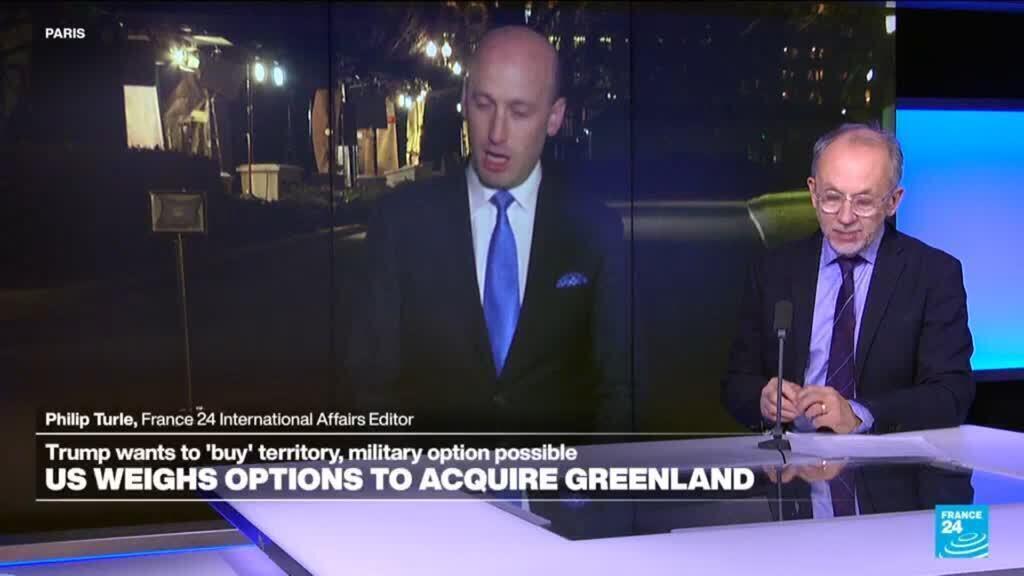
The controversy ignited on January 4, 2026, when Katie Miller, wife of senior Trump aide Stephen Miller, shared an image on social media depicting Greenland overlaid with a U.S. flag and captioned "SOON." Denmark quickly voiced irritation over the post, interpreting it as a signal of renewed American interest in acquiring the Arctic territory. By January 7, the White House confirmed that President Donald Trump is actively considering options to purchase Greenland, explicitly including the possibility of military action, further stoking transatlantic alarm.
Denmark, which administers Greenland as an autonomous territory, issued its strongest rebuke yet. Foreign Ministry officials described any forcible U.S. takeover as catastrophic, warning it would "simply mean the end of NATO." A spokesperson emphasized that such a move would halt "everything," severing 80 years of close transatlantic security cooperation forged since World War II. "Denmark has warned any move to take Greenland by force would mean everything would stop," the ministry stated, according to reports from France24. This rhetoric underscores Greenland's pivotal role in NATO's defense architecture, particularly through the U.S.-operated Thule Air Base, a key outpost for missile warning and space surveillance in the Arctic.
France, a fellow NATO member, moved swiftly to coordinate a response. On January 7, a French minister revealed that Paris is collaborating with European partners on a contingency plan should the U.S. act on its threats. "France is working with partners on a plan on how to respond should the United States act on its threat to take over Greenland," the minister said. This development reflects broader European anxieties over Trump's ambitions in the region, amid fears of unilateral U.S. actions straining the alliance.
The White House's statements have amplified these concerns. Officials reiterated Trump's long-standing desire to acquire Greenland, citing strategic imperatives. Reports from Al Jazeera highlight ongoing debates about whether Russia and China represent genuine national security threats to the U.S. in Greenland, justifying such aggressive posturing. Moscow and Beijing have expanded their Arctic footprints in recent years, with Russia militarizing its northern frontier and China investing in infrastructure and rare earth minerals under its "Polar Silk Road" initiative. Greenland's vast untapped resources— including uranium, rare earths, and potential oil reserves—along with its position astride emerging Arctic shipping routes melted open by climate change, make it a flashpoint in great-power competition.
Historical Context and Strategic Stakes
Trump's interest in Greenland is not new. In 2019, during his first term, he publicly floated the idea of purchasing the island, dismissing Danish objections and briefly canceling a state visit to Copenhagen in protest. That episode drew ridicule but also spotlighted Greenland's geostrategic value: its location provides oversight of the polar region, critical for monitoring Russian nuclear submarines and hypersonic missiles. The U.S. maintains a permanent presence via Thule, established in 1951 under a defense agreement with Denmark.
Greenland's Inuit-led government has consistently rejected sale overtures, emphasizing self-determination. With a population of just 56,000, the territory relies heavily on Danish subsidies but has pursued economic independence through mining and tourism. Any U.S. bid—diplomatic or otherwise—would challenge Denmark's sovereignty claims under international law and the UN Charter, potentially invoking Article 51 on self-defense only if aggression occurs.
Russia and China's activities add layers of complexity. Russian naval exercises near Greenland have increased, while Chinese firms have bid on mining projects, raising U.S. espionage concerns. The Pentagon's 2024 Arctic Strategy identifies both as challengers, warning of dual-use infrastructure that could support military logistics.
Implications for Alliances and the Arctic
European leaders' responses signal deepening rifts within NATO, already tested by Trump's criticisms of alliance burden-sharing. A Danish official's NATO warning evokes Cold War-era solidarity, when U.S.-Danish pacts fortified the alliance against Soviet expansion. France's planning, potentially involving EU mechanisms, hints at a hedging strategy—bolstering European defense autonomy as discussed in recent NATO summits.
As of January 7, no immediate U.S. actions have been announced, but the rhetoric has chilled diplomatic ties. Greenland's premier has not publicly commented recently, though past statements affirm ties to Denmark. Analysts note that legal acquisition remains improbable without Inuit consent, leaving military options as provocative saber-rattling.
The saga places the Arctic—warming three times faster than the global average—squarely in superpower crosshairs. With melting ice unlocking $1 trillion in trade routes by 2050, per U.S. estimates, Greenland symbolizes the high stakes of climate-driven geopolitics. For now, transatlantic partners urge de-escalation, but the "SOON" post and White House escalations risk turning speculation into crisis.
(Word count: 712)






