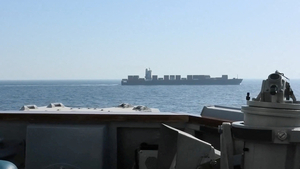

Strike on Iran: US Seizes Cargo Ship Near Hormuz Strait Amid Blockade
The United States seized an Iranian-flagged cargo ship near the Strait of Hormuz on Sunday while it was attempting to evade a US naval blockade, in what has been described as a strike on Iran that prompted Tehran to vow a swift response, labeling the action an act of piracy.[1][2] This incident, the first interception since the blockade of Iranian ports began last week, has heightened tensions in the region, with Iran's joint military command calling it a violation of a fragile ceasefire set to expire soon.[1]
The Main Incident
The core event unfolded when a US destroyer intercepted and seized an Iranian-flagged cargo ship in the Gulf of Oman, near the strategically vital Strait of Hormuz.[2] According to reports, the ship was attempting to evade the US naval blockade imposed on Iranian ports, which had been in place for just one week prior to this encounter.[1] US forces are said to have attacked and boarded the vessel, marking the first such interception under the blockade.[1][4][5]
Details from the scene indicate that the US destroyer fired on the cargo ship as part of the operation to halt its progress.[2][4][5] President Trump confirmed that the destroyer had hit the Iranian cargo ship precisely because it was trying to run the blockade, underscoring the direct enforcement action taken by US naval assets.[4][5] The location in the Gulf of Oman places the incident in a chokepoint critical for global oil shipments, amplifying its significance amid ongoing regional frictions.[1][2] This boarding operation, described in some accounts as an armed action, directly confronted the ship's efforts to bypass US restrictions, setting the stage for immediate diplomatic fallout.[1]
The timing on Sunday adds to the precarious nature of the event, occurring just as international observers were monitoring compliance with existing agreements in the area.[1] Eyewitness accounts and official statements highlight the intensity of the interception, with the US asserting its right to enforce the blockade against vessels linked to Iran.[4][5] This was not a passive blockade runner; the ship's maneuvers necessitated a forceful response from the destroyer, involving what has been reported as firing and subsequent seizure.[2]
Iran's Response and Statements
Iran's official reaction was swift and condemnatory, with Tehran labeling the US action as "armed piracy" and warning that its forces would respond in kind.[1][2] The joint military command of Iran described the armed boarding as a blatant act of piracy and a direct violation of the fragile ceasefire, which is days away from expiration.[1] State broadcasters relayed these statements, emphasizing the provocative nature of the US intervention.[1]
Tehran vowed retaliation soon after the incident, framing it within the broader context of Middle East hostilities.[2] Iranian officials made it clear that the firing by the US destroyer on their flagged vessel would not go unanswered, with promises of a measured but firm response from their military.[2] This rhetoric from Iran's leadership underscores a pattern of strong verbal pushback against perceived aggressions, particularly in sensitive maritime zones like the Gulf of Oman.[1][2]
The characterization of the event as piracy elevates the diplomatic stakes, positioning Iran's narrative against what it sees as unlawful US overreach.[1][2] By invoking the ceasefire violation, Iranian statements aim to rally domestic and international support, portraying the seizure as an unprovoked escalation.[1] These pronouncements came rapidly via official channels, signaling high-level coordination in Tehran's crisis response.[2]
Context of the US Blockade
The US naval blockade of Iranian ports, initiated last week, provides the immediate backdrop for this interception.[1] This was explicitly the first time US forces had acted to seize a vessel under this new measure, highlighting its enforcement phase.[1] The blockade aims to restrict maritime traffic linked to Iran, particularly in the Strait of Hormuz area, a move that has already strained regional dynamics.[1]
Coming just days before the ceasefire's expiration, the blockade's timing intersects with a period of tenuous calm.[1] US strategy appears focused on preventing evasion attempts, as demonstrated by the cargo ship's actions, which prompted the destroyer's intervention.[1][4][5] The Gulf of Oman's proximity to the Strait of Hormuz makes it a focal point for such operations, where naval presence is heightened to monitor compliance.[2]
This context reveals the blockade not as a static policy but an active operation requiring direct confrontations, as seen in this inaugural seizure.[1] The week's duration since implementation suggests rapid escalation from declaration to enforcement, altering shipping patterns and testing Iran's resolve.[1]
Potential Implications
The strike on Iran via this ship seizure throws the fragile ceasefire into question, especially with its expiration looming.[1] Iran's vows of a swift response could unravel the agreement, as the joint military command has already deemed the action a violation.[1][2] Broader tensions in the Middle East may intensify, given the live updates tracking the situation and Tehran's warnings of retaliation.[2]
Reported statements indicate that this incident risks a cycle of reprisals, with the US blockade now tested in practice.[1][2] The ceasefire's fragility, coupled with the first interception's high profile, amplifies fears of renewed hostilities.[1] Iran's description of "armed piracy" frames potential responses as defensive, which could justify escalatory moves.[2] Analysts monitoring the liveblog note how this event fits into ongoing war dynamics, potentially drawing in other regional actors.[2]
The implications extend to maritime security, where future evasions might provoke more US actions, further straining the ceasefire.[1] With Iran poised to act, the post-incident period becomes critical for de-escalation efforts.[1][2]
Related US Statements
US President Trump directly addressed the incident, stating that the destroyer hit the Iran cargo ship as it tried to evade the blockade.[4][5] This confirmation from Trump provides official validation of the operation's intent and execution, aligning with reports of the destroyer's role.[4][5] His remarks emphasize the enforcement imperative behind the strike on Iran, portraying it as a necessary measure against blockade runners.[4][5]
These statements from US leadership offer context on the decision-making, reinforcing the naval action's legitimacy under the blockade framework.[4][5] Trump's public acknowledgment underscores confidence in the destroyer's capabilities and the broader strategy.[4][5]
What to watch next: Observers should monitor Iran's vowed military response and any developments around the ceasefire's expiration, as Tehran has warned of swift retaliation following the US seizure.[1][2]





:quality(30):format(webp):focal(0.5x0.5:0.5x0.5)/aceh/foto/bank/originals/Balas-AS-Iran-Mulai-Operasi-Saeqeh-ke-11-Gempur-Pangkalan-AS-di-Bahrain.jpg)