
Strike in Ukraine: Russia Launches 142 Drones, With 113 Downed by Defenses
In a significant escalation of aerial operations during the ongoing conflict, Russia launched 142 drones, including jet-powered UAVs, against targets in Ukraine.[1] Ukrainian air defense forces successfully downed or jammed 113 of these drones, though some strikes were recorded amid the intense overnight barrage.[1] This strike Ukraine event underscores the persistent drone warfare tactics employed by Russian forces, met with robust countermeasures from Ukrainian defenses.
Overview of Russian Drone Attacks
Russia's latest drone offensive involved the deployment of 142 unmanned aerial vehicles, marking a substantial aerial assault on Ukrainian territory.[1] Among these were jet-powered UAVs, which represent an evolution in Russia's drone capabilities, alongside more conventional types such as Shahed drones and others.[1] The attacks unfolded overnight, targeting various locations across Ukraine, as part of a broader pattern of drone-based strikes aimed at infrastructure, military positions, and civilian areas.[1]
The sheer volume of 142 drones highlights the scale of this operation, which Ukrainian authorities described as one of the larger barrages in recent weeks.[1] Shahed drones, known for their long-range capabilities and explosive payloads, formed a key component of the launch, with additional types contributing to the mix.[1] Jet-powered UAVs add a layer of speed and difficulty in interception, potentially allowing for deeper penetration into Ukrainian airspace before detection.[1] This combination of drone varieties suggests a strategic intent to overwhelm air defenses through numbers and diversity of threats.[1]
Reports from Ukrainian sources indicate that the drones were launched from multiple vectors, likely originating from Russian territory or occupied areas, following established patterns in previous assaults.[1] The overnight timing is a common tactic to exploit reduced visibility and shift changes in defense operations, maximizing the chances of successful impacts.[1] While specific targets were not detailed in initial reports, the nature of past drone strikes points to energy facilities, logistics hubs, and frontline positions as likely objectives.[1] This attack fits into Russia's sustained use of drones to exert pressure on Ukraine's air defense resources, forcing the allocation of missiles and electronic warfare assets to counter the threat.[1]
The inclusion of jet-powered UAVs is noteworthy, as these faster-moving platforms challenge traditional interception methods, requiring advanced radar and missile systems.[1] Overall, the launch of 142 drones represents a calculated effort to test Ukrainian resilience, with the partial success in causing some strikes indicating that not all threats were neutralized despite defensive efforts.[1]
Ukrainian Defensive Measures
{IMAGE_2}
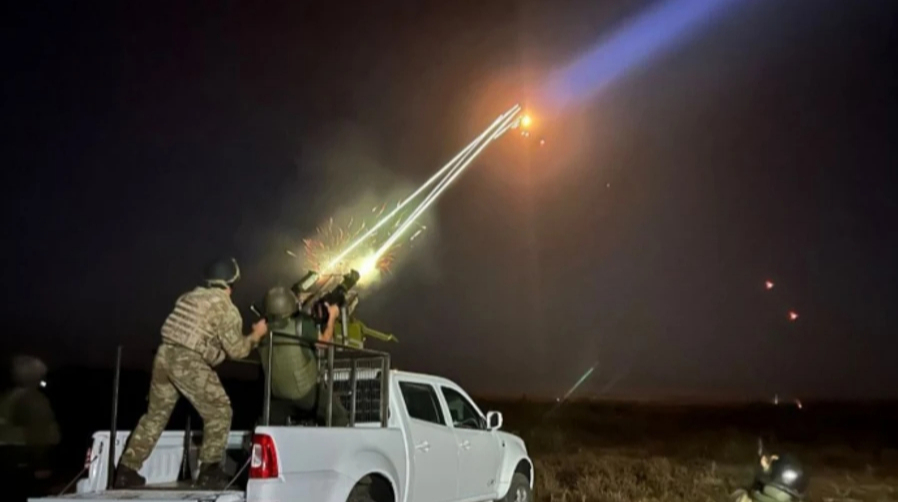
Ukrainian air defense forces demonstrated considerable effectiveness in countering the Russian drone assault, destroying or jamming 113 out of the 142 launched drones.[1] This interception rate reflects a high level of operational readiness, involving a combination of anti-aircraft missiles, electronic warfare systems, and fighter aircraft.[1] The jamming aspect is particularly significant, as it renders drones inoperable without physical destruction, preserving interceptor munitions for higher-priority threats like ballistic missiles.[1]
The downing or disruption of 113 drones—approximately 80% of the total—illustrates the maturation of Ukraine's integrated air defense network.[1] Systems such as mobile air defense units and ground-based radars played a pivotal role in detecting and engaging the incoming swarm early in their flight paths.[1] Shahed drones, which are slower and more predictable, proved vulnerable to these measures, while jet-powered UAVs likely required more sophisticated responses due to their velocity.[1]
Despite this success, the fact that some strikes were recorded points to the challenges posed by the volume and variety of threats.[1] A portion of the drones evaded interception, either through decoy tactics, low-altitude flight paths, or sheer saturation of defenses.[1] Ukrainian military reports emphasize that the engagement was nationwide, with air alerts sounding across multiple regions to coordinate the response.[1] This defensive posture has become routine, with forces trained to prioritize threats based on trajectory and payload assessments.[1]
The ability to jam signals further depletes the operational effectiveness of Russian drones, disrupting command links and causing them to crash or wander off course.[1] Over repeated barrages, this has strained Russian production and logistics, as each lost drone represents a resource investment.[1] Ukrainian defenses continue to adapt, incorporating Western-supplied systems that enhance detection ranges and interception accuracy.[1] The outcome of this strike Ukraine defense operation reaffirms the resilience of Ukraine's skies against massed drone incursions.[1]
Ukrainian Strikes on Russian Oil Infrastructure
President Volodymyr Zelenskyy reported that Ukrainian long-range strikes inflicted at least $2.3 billion in losses to Russia's oil industry during March.[3] These operations targeted key elements of Russia's energy sector, which funds a significant portion of its military efforts.[3] Zelenskyy highlighted the financial toll, stating that the strikes wiped out US$2.3 billion in Russian oil revenues for the month.[3]
The long-range strikes, likely involving drones and missiles, disrupted oil refining, storage, and export facilities.[3] This $2.3 billion figure underscores the strategic impact, equivalent to a substantial dent in Russia's wartime economy.[3] Zelenskyy emphasized that these actions were deliberate, aimed at undermining the revenue streams that sustain Russia's aggression.[3] Reports confirm that the strikes caused billions in overall losses, aligning with Zelenskyy's assessment.[2]
Russia's oil industry has been a focal point for Ukrainian counterstrikes, given its role in generating funds for the conflict.[3] The March losses represent a cumulative effect from multiple precision hits, affecting production capacity and export volumes.[3] Zelenskyy's public statement serves to both inform and rally support, detailing the tangible economic pressure exerted on Moscow.[2][3] These operations demonstrate Ukraine's growing capability in deep-strike warfare, reaching high-value targets far behind Russian lines.[3]
The financial repercussions extend beyond immediate damage, potentially leading to reduced investments and heightened vulnerabilities in Russia's energy infrastructure.[3] By targeting oil revenues, Ukraine aims to constrain Russia's ability to procure weapons and sustain frontline operations.[2][3] This approach has proven effective in March, with the $2.3 billion loss cited as a direct result of coordinated long-range efforts.[3]
Ukrainian Operations Against Russian Drone Production
{IMAGE_3}
Ukrainian forces conducted a precise strike on a Russian plant in Taganrog that produces Molniya and Orion drones, as confirmed by military sources.[4][5] The General Staff of Ukraine's Armed Forces reported the attack on the facility and associated logistics depots, which has reduced Russia's offensive potential.[5]
Located in Russia's Taganrog, the plant is a critical node in Moscow's drone manufacturing ecosystem, churning out Molniya and Orion models used extensively in strikes against Ukraine.[5] These drones are integral to Russia's attrition strategy, providing reconnaissance, strike, and loitering capabilities.[5] The Ukrainian operation involved long-range weapons that penetrated Russian air defenses to hit the production site directly.[4]
Military confirmation underscores the success of the strike, with damage to manufacturing lines and storage areas impairing output.[4][5] By targeting this facility, Ukraine disrupts the supply chain for drones like those launched in the recent 142-drone barrage.[5] The reduction in Russia's offensive potential is a key outcome, as fewer drones mean diminished pressure on Ukrainian defenses.[5]
The Taganrog plant's role in producing advanced UAVs makes it a high-priority target, with logistics depots amplifying the strike's impact by affecting drone deployment.[5] Ukrainian intelligence likely guided the operation, ensuring accuracy against a defended industrial complex.[4] This strike exemplifies Ukraine's proactive stance, shifting from defense to offense against Russia's war machine.[5]
Broader Implications of the Strikes
The interplay of Russian drone launches and Ukrainian counterstrikes reveals a dynamic escalation in the conflict's aerial domain.[1] With 142 drones deployed and 113 neutralized, Russia achieved limited penetration, yet the persistence of such attacks strains resources on both sides.[1] Concurrently, Ukrainian strikes yielding $2.3 billion in Russian oil losses in March highlight economic warfare's role.[3]
Targeting drone production in Taganrog, including Molniya and Orion facilities, directly counters Russia's UAV offensive, reducing future threats.[5] Some strikes from the drone barrage still occurred, indicating gaps that Ukraine must address.[1] Zelenskyy's report on oil revenue wipeouts frames these as strategic victories, pressuring Russia's funding.[2][3]
This strike Ukraine cycle—massed drones met by defenses and reprisals—alters operational tempos, with Ukrainian deep strikes eroding Russian advantages.[1][5] Losses to oil infrastructure and drone plants compound, potentially slowing Moscow's momentum.[3][5] The jet-powered UAVs and Shaheds in the attack signal adaptation, matched by Ukraine's jamming and precision hits.[1]
Overall, these events signal a war of attrition where defensive successes and offensive gains intertwine, reshaping capabilities.[1][3][5]
What to Watch Next
Monitor Russia's response to the Taganrog strike and oil losses, as further drone production disruptions could lead to intensified barrages or shifts in tactics.[5][3] Ukrainian defenses will face ongoing tests from remaining drones, while long-range strike outcomes may influence economic pressures on Russia.[1][2]