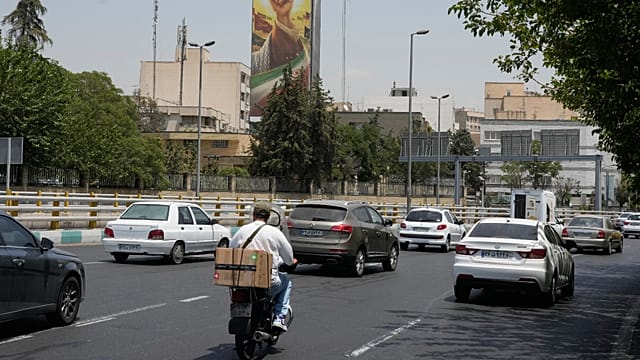

Shipping in Strait of Hormuz Stalls as Iran Warns Against U.S. Seizure of Khargh Island
In the ongoing Iran war, Tehran has received mediation proposals as its exchanges of airstrikes and attacks with the United States continue, with both sides targeting infrastructure and edging closer to all-out war after last month's interim deal collapsed. [1]
Current Military Exchanges
The U.S. conducted a new round of airstrikes early Monday, hitting an area around a northwestern city believed to be home to underground missile bases, after announcing the death of another American service member. [1] Iran responded with attacks targeting Bahrain, home of the U.S. Navy's 5th Fleet, and Kuwait. [1] The latest strikes showed how the two sides have inched closer to all-out war as last month's interim deal meant to permanently end the fighting has crumbled and shipping traffic in the Strait of Hormuz has largely stalled. [1] Both sides have targeted civilian infrastructure relied on by millions of people. [1] What began largely as strikes against military infrastructure has increasingly extended to facilities with direct consequences for civilian life, including energy infrastructure and desalination plants that are essential to freshwater supplies across parts of the Gulf. [3] Transport infrastructure, including bridges, has also been targeted. [3] Iran's focus has shifted westward, with Kuwait hit hardest in recent weeks, including critical infrastructure. [4] Iranian drones have struck desalination plants that produce fresh water from seawater. [4] Drones have also flown toward Jordan. [4]
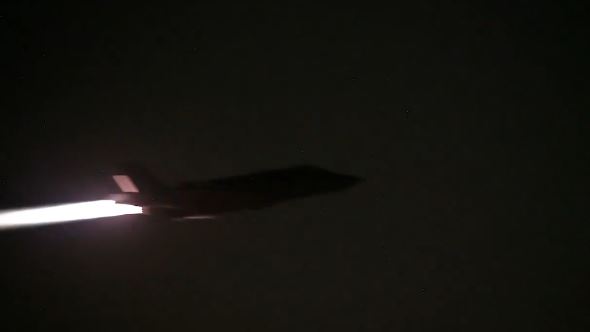
U.S. airstrikes target Iranian underground missile bases near northwestern city. — Source: gdelt
Diplomatic Efforts and Iranian Response
Iran said Monday it has received proposals from mediators as back-and-forth attacks with the United States continue. [1] "Proposals have been put forward and conveyed to us by the mediators. We have received them, but please excuse me from going into their details," Foreign Ministry spokesperson Esmail Baghaei said at a briefing. [1] He said the diplomatic apparatus had been active and that ideas from some mediators had reached Tehran. [1] Baghaei dismissed U.S. statements about being open to diplomacy. "We have seen and tested their so-called readiness before," he said. "When the U.S. talks about diplomacy, it actually means dictation, intimidation, threats and sanctions." [1] He said Iran's response would be to defend its dignity and national sovereignty as long as Washington sought to impose its demands. [1] When asked about reports that the U.S. might consider a ground operation to seize Khargh Island, home to the terminal through which Iran exports most of its oil, Baghaei warned of consequences. "I think there are people in those regions (southern Iran), and their number is not small, and they are looking forward to welcoming those guys (U.S. troops)," he said. [1] U.S. President Donald Trump has previously threatened to take the island. [1] Baghaei also said Iran had repeatedly urged neighboring countries to stop the U.S. from using their territory and facilities for attacks. [1] "What we are doing is self-defense," he said. "As long as these crimes and military aggression against Iran continue, our armed forces will continue to respond." [1]
Breakdown of the June Agreement
The memorandum of understanding (MoU) signed by the US and Iran on June 17 seemed to offer a pathway away from escalating confrontation. [3] Markets stabilised, regional tensions eased and there was cautious optimism that Washington and Tehran had stepped back from the brink. [3] That optimism has proved remarkably but unsurprisingly short-lived. [3] US military strikes have resumed and Iran has retaliated against American and its allies across the Gulf. [3] Many of the MoU's core provisions have become sources of dispute. [3] Israel has continued military operations in Lebanon, despite expectations that regional hostilities would subside. [3] Washington initially signaled greater economic flexibility towards Iran, including easing restrictions on oil exports and discussions surrounding Iranian assets. [3] Yet sanctions have subsequently expanded and further economic measures have been introduced. [3] From Tehran’s perspective, these actions represent a breach of the spirit – and, in some cases, the letter – of the agreement. [3] From Washington’s perspective, they are responses to continued Iranian activity that it considers destabilising. [3] The Strait of Hormuz illustrates how quickly ambiguity can become renewed confrontation. [3] Article 5 of the MoU envisaged Iran facilitating the safe passage of commercial shipping through the waterway. [3] Commercial traffic initially increased following the agreement. [3] But disagreement soon emerged after Oman – in coordination with the International Maritime Organization and with US backing – established a temporary maritime corridor closer to the Omani coast. [3] Tehran viewed this as inconsistent with the agreed framework and argued that it undermined Iranian responsibility for administering safe passage. [3] Washington rejected that interpretation, maintaining that additional security measures were necessary to protect international shipping. [3] The competing interpretations rapidly became another source of escalation. [3]
Strait of Hormuz and Regional Disruptions
The number of ships has dropped significantly now that strikes have intensified. [4] A few weeks ago, during the cease-fire, there were 20–30 tankers carrying oil, gas, fertilizers, agricultural goods. [4] Today there are fewer than ten — and on some days none. [4] OECD statistics show that some oil tankers still move — important for Europe — but LNG exports from the region have essentially stopped. [4] Iran’s proxy allies, the Houthis, have declared themselves ready to close the Red Sea chokepoint at the Bab-el-Mandeb Strait, which has provided an alternative transit route for some oil exports, particularly from Saudi Arabia. [3] Trump has promised to take control of the Strait of Hormuz and charge ships for passage. [4] It would require physically seizing islands belonging to Iran. [4] That brings us back to the ground operation that has been discussed — which has disappeared from the table for now, but could return with the next escalation. [4]

Iranian military assets targeted in US airstrikes amid escalating conflict in the Strait of Hormuz. — Source: asiatimes
Expert Assessments on Prolonged Conflict
The confrontation with Iran is fundamentally different from previous conflicts. [3] It is unlikely to require the occupation of territory and no serious or sustained attempt to directly remake the Iranian state. [3] Instead, it is fought through air strikes, cyber operations, sanctions, maritime confrontation, intelligence activity and proxy warfare. [3] Military escalation is followed by diplomacy, diplomacy gives way to renewed confrontation, and each episode is presented as a separate crisis. [3] Viewed collectively, these episodes are better understood as the latest phase of a strategic confrontation that began with the 1979 Iranian Revolution rather than as isolated crises. [3] The deeper problem is that the strategic objectives of the main players here remain fundamentally incompatible. [3] The US continues to insist that Iran’s nuclear program and regional influence must be constrained. [3] Iran regards those same capabilities as essential to its security and deterrence. [3] Israel continues to view a strategically stronger Iran as an unacceptable security threat. [3] These objectives cannot all be achieved simultaneously. [3] As a result, diplomacy struggles – not because negotiators lack skill, but because they are attempting to reconcile goals that remain at odds. [3] The MoU temporarily reduced tensions, but it did not alter the structural realities driving the conflict. [3] The US and Iran are settling into a prolonged cycle of calibrated confrontation that lasts far longer than many currently anticipate. [3] Trump promised to end America’s forever wars. Ironically, his presidency may instead come to symbolize the evolution of a new kind of forever war without a clearly defined beginning or end. [3] The greatest danger may therefore not be another Iraq. [3] It may be the gradual normalization of an enduring conflict that repeatedly disappears from the headlines, only to return in new forms because the political conditions necessary for genuine peace have yet to emerge. [3]
Iranian Capabilities and Stalemate
Iran has asymmetric warfare capabilities. [4] In late February and especially in March, the main blows were felt by its southern neighbors, primarily the United Arab Emirates. [4] But now Iran's focus has shifted westward. [4] The tension is lower than in March, but the attacks are real, and the escalation over the past two weeks has only gone in one direction — upward. [4] You cannot eliminate drone attacks. [4] Drones are easy to launch from various places and easy to produce. [4] Iran clearly has the capability to keep the attack tempo high — and it is a very large country. [4] There has been no change in demands. [4] The cease-fire that was announced was simply a gesture of willingness to understand each other. [4] But there has been no fundamental breakthrough. [4] For the U.S., the number one issue is Iran's nuclear capability and its unequivocal abandonment of it. [4] In addition, Iran's regional activities, including its missile program, which threatens neighbors and other regional states. [4] Curtailing or abandoning the missile program is what the U.S. seeks. [4] Iran, on the other hand, signals that it is ready to discuss all of this — but then comes a list of its demands: lifting sanctions, paying reparations for current war damages, and likely some form of control over the future of the Strait of Hormuz. [4] These preconditions are things no one will grant without Iran making concessions. [4] Listening to what both sides demand, it seems like a dead end. [4] Neither side can make concessions. [4] A long, drawn‑out conflict is always possible. [4] We've seen conflicts that remain suspended, lingering like a cold war. [4] Both sides are in a stalemate. [4] Eventually it must tilt one way or the other, and we will know when that moment comes. [4] A turning point in this region will not remain secret — but it has not happened yet. [4]
What to watch next: The risk of escalation on the Middle East has noticeably grown compared with assessments of recent weeks, with Israel coordinating closely with U.S. Central Command and preparing operational options for various scenarios while both Washington and Tehran seek to avoid full-scale regional war. [5]





