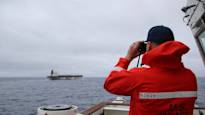

Russia Accuses US of Escalating Tensions with Seizure of Oil Tanker, Amid Surprise Prisoner Swap
Moscow has sharply criticized the United States for seizing a Russian-flagged oil tanker, labeling the action a violation of international maritime law and a provocative escalation in bilateral relations. The incident, involving the vessel Marinera, coincides with Russia's release of a French researcher in a rare prisoner exchange that also implicates U.S. authorities, highlighting persistent frictions amid broader geopolitical strains.
On January 8, 2026, Russia's Foreign Ministry issued a stern rebuke against the U.S. decision to take control of the Marinera, an oil tanker operating under the Russian flag. Moscow described the move as "illegal" and urged Washington to "immediately cease its actions against the Marinera and other vessels engaged in legitimate activities." The ministry's statement, reported by Anadolu Agency, underscores Russia's view that the seizure contravenes established norms of international maritime law, potentially disrupting lawful commercial shipping.
Finnish public broadcaster Yle echoed this sentiment, quoting Russian officials who claimed the U.S. action "tightens tensions" between the two nuclear-armed powers. The tanker seizure appears linked to ongoing U.S. efforts to enforce sanctions related to Russia's full-scale invasion of Ukraine, now in its fourth year. While specific details on the Marinera's cargo or destination remain limited in available reports, such interdictions have become a flashpoint in the economic warfare between the West and Moscow. Russia has repeatedly accused the U.S. and its allies of using maritime enforcement as a tool to strangle its energy exports, which fund much of its war effort.
In a parallel development on the same day, Russia announced the release of Laurent Vinatier, a French researcher imprisoned for nearly three years on charges of failing to register as a "foreign agent." According to France 24, Vinatier, who had been serving a sentence for violating Russia's strict foreign agent laws, was pardoned by President Vladimir Putin. The pardon paves the way for an exchange with Daniil Kasatkin, a Russian basketball player detained by U.S. authorities and accused of hacking activities.
Russian media outlets reported the swap as a humanitarian gesture, though it carries clear geopolitical undertones. Vinatier, affiliated with Swiss think tanks and known for his studies on post-Soviet societies, was arrested in 2023 amid a broader Kremlin crackdown on perceived foreign influences. His case drew international attention, with France and human rights groups decrying it as politically motivated. Kasatkin, meanwhile, faces U.S. charges that Russia dismisses as fabricated, fitting into a pattern of tit-for-tat detentions between the countries.
Background on U.S.-Russia Frictions
These events unfold against a backdrop of deepened U.S.-Russia animosity, exacerbated by the Ukraine conflict that began with Russia's invasion in February 2022. The U.S. has imposed sweeping sanctions on Russian entities, including restrictions on oil shipments above a certain price cap, enforced through naval patrols and seizures in international waters. Previous incidents, such as the 2023 U.S. seizure of the Russian tanker Suzaku (formerly Pablo), set precedents for targeting vessels suspected of sanctions evasion.
Russia's "foreign agent" registry, expanded under laws signed by Putin in recent years, requires individuals and organizations receiving foreign funding to disclose ties and label their work accordingly. Critics, including Amnesty International and the European Union, argue it stifles dissent and targets academics, journalists, and NGOs. Vinatier's release marks one of the few high-profile pardons, reminiscent of swaps like the 2024 exchange involving U.S. journalist Evan Gershkovich and others.
The Marinera seizure adds to a series of maritime disputes. In late 2025, similar U.S. actions against shadow fleet tankers—aging vessels used to circumvent sanctions—prompted Russian threats of retaliation, including potential restrictions on U.S. shipping in the Black Sea region.
Diplomatic Implications and Outlook
Neither event has prompted immediate military responses, but they signal no thaw in relations. Russia's Foreign Ministry statement on the tanker explicitly warns of "consequences" for continued U.S. "piracy," while the prisoner swap, though cooperative on the surface, reinforces narratives of Western hostility on both sides.
Analysts note that such exchanges can build limited trust channels, as seen in past deals during the Cold War era. However, with U.S. elections looming and Russia's war in Ukraine grinding on—complete with recent escalations in drone strikes and mobilization efforts—these incidents risk further isolating Moscow economically.
As of January 8, 2026, no further U.S. comment on the tanker seizure or swap had been issued, leaving open questions about escalation. Diplomatic backchannels, often mediated by countries like Turkey or the UAE, may yet play a role in de-escalation. For now, the episodes underscore the fragile state of great-power competition, where economic coercion and human rights clashes intersect with high-stakes security dilemmas.
(Word count: 712)






