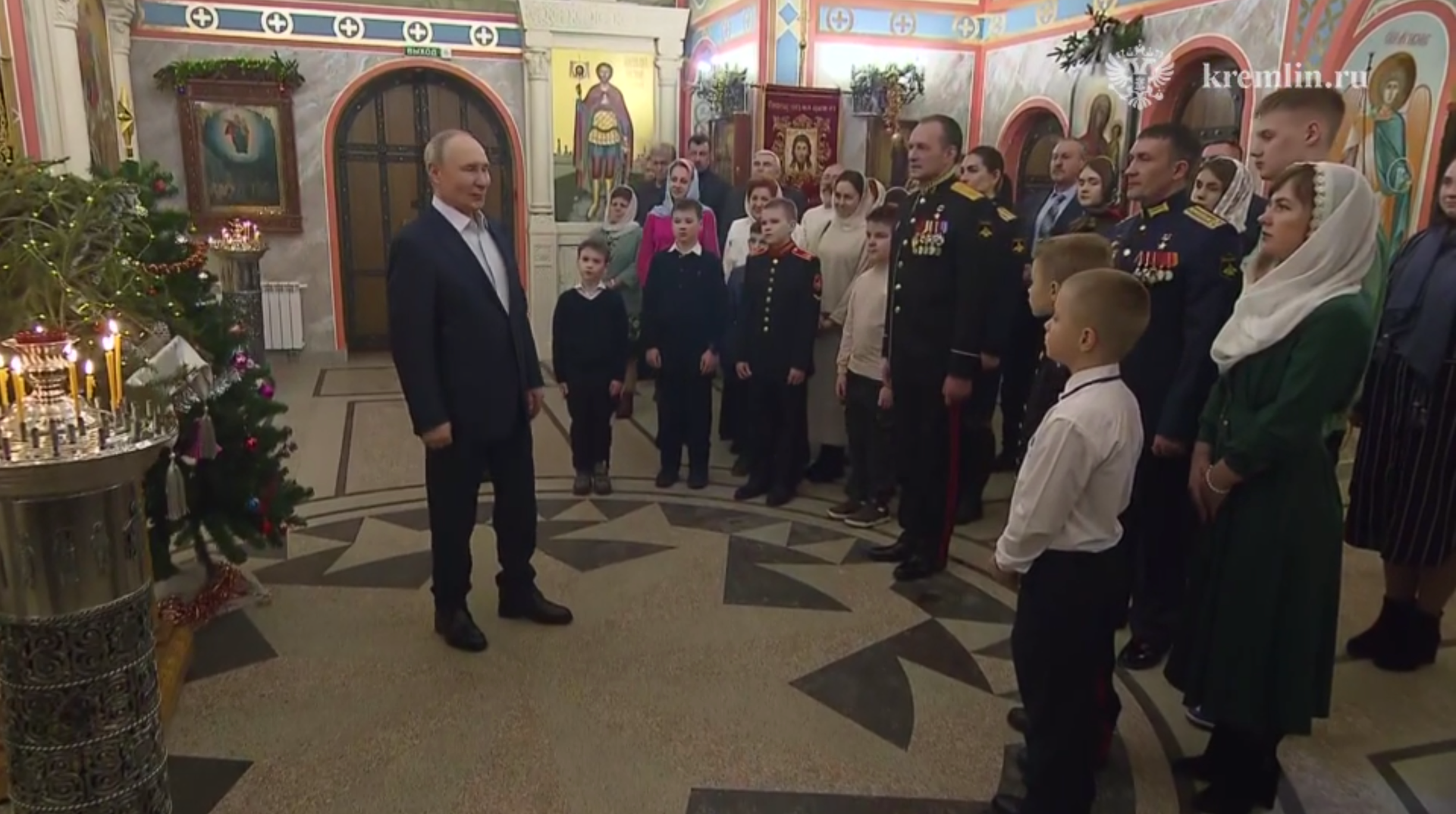

Putin Marks Orthodox Christmas at Military Base Church Amid Prolonged Ukraine Conflict
Moscow/Kyiv — Russian President Vladimir Putin observed Orthodox Christmas on January 7, 2026, at a church located within a military base, according to reports from independent Russian media cited in a live update from the Kyiv Independent. The event underscores the intertwining of religious observance and military posture as Russia's full-scale invasion of Ukraine enters its fourth year, with analysts highlighting shifting human resource dynamics as a key factor in the conflict's trajectory.
The Kyiv Independent's live war blog, updated on January 7, detailed that Putin attended services at the church, a move interpreted by some observers as a signal of resolve amid ongoing hostilities. Independent Russian outlets, operating under increasing restrictions, reported the president's presence at the facility, which is associated with military operations. Orthodox Christmas, celebrated on January 7 by the Russian Orthodox Church following the Julian calendar, has frequently been leveraged by Kremlin leadership to project unity and spiritual backing for national endeavors, including the war effort.
This development comes against the backdrop of the Russia-Ukraine war, which erupted on February 24, 2022, when Russian forces launched a multi-front invasion of Ukraine. Classified as a "CRITICAL" severity event by global monitoring platforms, the conflict has resulted in tens of thousands of military and civilian casualties, widespread destruction of infrastructure, and a humanitarian crisis displacing millions. Ukraine's defenses, bolstered by Western military aid, have stalled Russian advances in key areas, leading to a protracted war of attrition characterized by trench warfare, drone strikes, and artillery duels, particularly in eastern regions like Donetsk and Kharkiv oblasts.
As the war persists into 2026, attention has turned to "Ukraine Conflict Dynamics in 2026," rated as "HIGH" severity. Discussions in analytical circles focus on the potential impact of human resources—encompassing troop mobilization, recruitment challenges, and demographic strains—on the conflict's evolution. Russia has faced significant manpower shortages, prompting repeated waves of partial mobilization and reliance on convicts and mercenaries from groups like the Wagner network (now rebranded as the Africa Corps). Ukraine, meanwhile, grapples with its own conscription pressures amid population losses and emigration, with recent legislative changes lowering the draft age and tightening enforcement to sustain frontline numbers.
Putin's Christmas appearance at the military base church aligns with a pattern of public messaging. In previous years, he has used religious holidays to visit troops or invoke divine support for the "special military operation," as Russia officially terms the invasion. The choice of a military venue on this occasion may aim to rally domestic support and reassure forces deployed along the 1,000-kilometer front line. Independent Russian media, such as Meduza and others operating in exile, have documented similar events, often highlighting contrasts with Putin's pre-war public image.
Broader Context of the Russia-Ukraine War
The invasion began with Russian claims of "denazification" and protection of Russian-speaking populations in Donbas, regions partially controlled by Moscow-backed separatists since 2014. Ukraine, under President Volodymyr Zelenskyy, framed the response as an existential fight for sovereignty, garnering unprecedented international support. NATO allies have provided over $100 billion in aid, including advanced systems like HIMARS rockets, Patriot air defenses, and F-16 fighter jets, shifting the battlefield balance.
By early 2026, the conflict shows no signs of resolution. Russian forces hold roughly 18% of Ukrainian territory, including Crimea (annexed in 2014) and parts of four eastern oblasts. Ukraine's incursion into Russia's Kursk region in August 2024 marked a bold counteroffensive, though gains have been contested. Winter conditions typically slow major operations, but drone and missile exchanges continue unabated, with both sides targeting energy infrastructure.
Human resource constraints loom large. Russia reports daily casualties exceeding 1,000, per Western estimates, straining its 1.5 million-strong active forces. Ukraine, with a pre-war population of 44 million now reduced by war and exodus, faces similar binds. A January 2026 analysis notes that demographic fatigue could dictate 2026 dynamics, potentially forcing negotiations or escalations if mobilization falters.
Outlook and International Response
Western leaders continue to urge resolve, with the U.S. under a new administration navigating aid debates and Europe ramping up defense production. Zelenskyy has called for sustained support to pressure Russia into peace talks, while Putin insists on Ukrainian capitulation on Moscow's terms.
Putin's Orthodox Christmas observance at the military site serves as a microcosm of the war's fusion of faith, nationalism, and militarism. As human resource pressures mount, the coming year may test both sides' endurance, with global ripple effects on food security, energy prices, and geopolitical alignments.
(Word count: 612)






