
Protesters Rally Outside U.S. Embassy in London Against Reported American Military Strikes on Venezuela
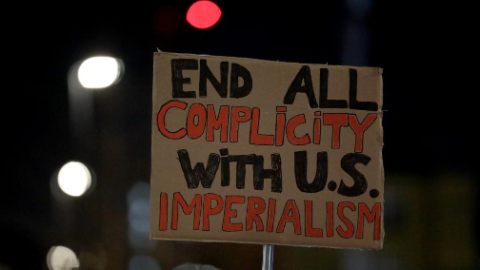
LONDON — Demonstrators gathered outside the U.S. Embassy in London on January 4, 2026, to protest what they described as U.S. military strikes on Venezuela, marking a notable expression of civil unrest in the British capital amid heightened international tensions.
The protests, which began early on Sunday, January 4, at 00:13 GMT, unfolded at the U.S. Embassy located in the Nine Elms district of south London. According to reports from Xinhua, the action was a direct response to an alleged U.S. "attack" on Venezuela, reflecting broader global opposition to perceived American military intervention in Latin America. Classified as medium severity civil unrest by event tracking platforms, the demonstration did not escalate into violence or widespread disruption, focusing instead on vocal dissent against U.S. foreign policy.
Eyewitness accounts and initial coverage highlighted a crowd assembling in the vicinity of the embassy, a modern fortress-like structure that has frequently served as a focal point for international protests. Security measures around the embassy were heightened, as is standard protocol for such events, with Metropolitan Police monitoring the situation to ensure public safety. No arrests or injuries were reported in connection with the initial gathering, underscoring the contained nature of the unrest.
Escalating Tensions Between the U.S. and Venezuela
The protests come against a backdrop of longstanding friction between the United States and Venezuela, exacerbated by political and economic disputes dating back over two decades. Venezuela has been under the leadership of the United Socialist Party of Venezuela (PSUV) since 1999, first under Hugo Chávez and then Nicolás Maduro. The U.S. has imposed extensive sanctions on Venezuelan officials and entities since 2017, citing human rights abuses, electoral fraud, and corruption. In 2019, the Trump administration recognized opposition leader Juan Guaidó as interim president, leading to a prolonged political crisis.
While no prior verified U.S. military strikes on Venezuelan soil have occurred in recent history, the reported actions prompting these protests represent a potential escalation. U.S.-Venezuela relations have fluctuated, with brief thaws under the Biden administration, including limited sanctions relief in exchange for oil production commitments and migration deals. However, accusations of U.S. aggression have persisted from Caracas, often framed within anti-imperialist rhetoric. The timing of the London protests, shortly after the alleged strikes, aligns with rapid international mobilization patterns seen in previous global flashpoints.
London has a history of hosting protests related to U.S. foreign policy, particularly at the embassy. Similar demonstrations have occurred against U.S. actions in Iraq (2003), Gaza conflicts, and support for Israel amid the Israel-Hamas war. The Venezuelan cause has drawn support from leftist groups, solidarity networks, and diaspora communities in the UK, where an estimated 20,000-30,000 Venezuelans reside, many having fled economic collapse and political repression.
Broader Context of Civil Unrest in the UK
The United Kingdom has experienced intermittent civil unrest in recent years, often tied to global events. In 2024, widespread riots erupted following misinformation about a Southport stabbing, leading to clashes in multiple cities. Anti-austerity protests, pro-Palestine marches, and farmer demonstrations against inheritance tax changes have also drawn thousands to London's streets. The U.S. Embassy protests fit into this pattern of medium-scale actions, where participants exercise free speech rights under strict policing.
Organizers of the Venezuela protest likely included groups such as the Venezuela Solidarity Campaign UK, which has campaigned against sanctions and for diplomatic engagement. Placards and chants typically condemn "Yankee imperialism," echoing historical Latin American solidarity movements in Europe. Xinhua's coverage, published on January 8, 2026, at 06:39 GMT, emphasized the event as a public outcry, amplifying voices critical of U.S. policy from a state-affiliated Chinese perspective.
The British government's response has been measured. The Foreign, Commonwealth & Development Office (FCDO) routinely monitors such protests without direct commentary on U.S. actions. Prime Minister Keir Starmer's Labour administration, in power since July 2024, has prioritized domestic issues like economic recovery and NHS reforms but maintains close U.S. ties through NATO and the AUKUS pact. No official UK statement on the Venezuela strikes has been issued as of the latest reports.
International Ripple Effects and Outlook
The London protests are part of a wider wave of global reactions to the reported U.S. strikes. Similar demonstrations have been noted in cities like Madrid, Berlin, and Caracas itself, where state media has rallied support for Maduro. Venezuela's government has long accused the U.S. of orchestrating coups and hybrid warfare, claims dismissed by Washington as baseless propaganda.
As of January 8, 2026, the protests appear to have remained localized and peaceful, with no indications of expansion into broader unrest. Event monitors classify it as medium severity, suggesting limited risk of escalation absent further provocations. Organizers have called for continued vigilance, potentially planning follow-up actions if U.S. involvement persists.
The episode highlights the interconnectedness of global politics, where distant conflicts can mobilize streets in allied capitals like London. With U.S.-Venezuela dynamics at a flashpoint, diplomatic channels—possibly through the UN or Organization of American States—may see renewed activity. For now, the UK remains a barometer of international sentiment, where free assembly allows voices of dissent to echo without derailing bilateral relations.
(Word count: 748)