
Oil Price Forecast: Israel's Lebanon Offensive Reshaping Middle East Alliances Amid Escalating Conflict
What's Happening
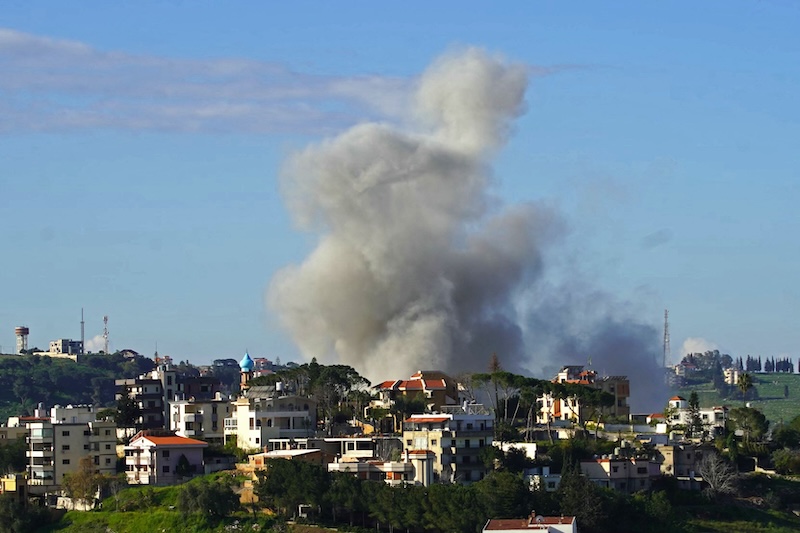
The Israel-Lebanon conflict has reached a fever pitch, with Israel's military announcing ambitious plans to partition southern Lebanon into controlled zones as part of its expanding ground invasion. According to reports from The New Arab, Israeli officials are eyeing a division of the area south of the Litani River into three sectors: a frontline buffer zone, a deeper security perimeter, and a demilitarized hinterland aimed at neutralizing Hezbollah's infrastructure. This comes amid intensified airstrikes and ground operations that have pushed Israeli forces deeper into Lebanese territory, with clashes reported as far north as the outskirts of Beirut by March 30, 2026.
Confirmed developments include Israel's ground incursion, which began in earnest on March 9, 2026, and has since ballooned into a full-scale war. Recent market event trackers label April 7, 2026, as "Israel Invades Southern Lebanon" (CRITICAL), underscoring the invasion's momentum, followed by the "Israel-Hezbollah War Escalation" on April 14, 2026 (CRITICAL). Hezbollah has responded with rocket barrages into northern Israel, but Israeli forces claim to have dismantled over 70% of the group's missile stockpiles in the south.
Parallel to the military push, the humanitarian toll is catastrophic. UNHCR chief Filippo Grandi issued an "urgent" appeal on April 14, 2026, warning of 1.5 million displaced Lebanese, overwhelmed refugee camps, and a collapsing healthcare system. Middle East Eye reports detail scenes of devastation: hospitals in Tyre and Sidon rationing medicine, with cholera outbreaks looming due to destroyed water infrastructure (UN Peacekeepers in the Crossfire). Beirut's government, in a stark contrast, is simultaneously begging for an immediate ceasefire, with Prime Minister Najib Mikati addressing the UN Security Council to decry the "existential threat" to Lebanon's sovereignty.
Enter U.S. President Donald Trump's diplomatic wildcard. As detailed by Helsinki Times, Trump is aggressively pursuing direct talks with Iran, even as Israel ramps up strikes. In a White House briefing on April 13, 2026, Trump stated, "Iran must come to the table now—before this spreads." This timing is no coincidence: U.S. intelligence links Hezbollah's supply lines directly to Tehran, making these talks a potential off-ramp for escalation (Diplomacy's Deadlock: Oil Price Forecast Amid How Repeated Ceasefire Talks). However, unconfirmed reports suggest Iran has rebuffed initial overtures, viewing them as a ploy to isolate its "Axis of Resistance."
These threads—military partition, humanitarian meltdown, and U.S.-Iran diplomacy—are colliding to force rapid alliance recalibrations. Arab states like Saudi Arabia, historically wary of Hezbollah, are quietly signaling tolerance for Israel's actions, while Turkey's President Erdogan has condemned the invasion but stopped short of material support for Lebanon, hinting at pragmatic shifts. Track live developments on the Global Conflict Map — Live Tracking.
Context & Background
This escalation didn't erupt overnight; it's the culmination of a meticulously traced timeline that reveals a pattern of tit-for-tat intensification, directly informing today's alliance fractures.
The spark ignited on March 2, 2026, when Israel launched precision airstrikes on Hezbollah targets in Beirut's southern suburbs—retaliating for cross-border drone incursions linked to the group's Iranian backers. This marked the initial regional escalation, shattering a fragile 2024 truce and drawing in Syrian militias. By March 9, 2026, Israel pivoted to a ground attack, crossing into southern Lebanon with armored brigades, citing the need to enforce UN Resolution 1701's demilitarization mandate from 2006.
The war churned onward: March 16 saw sustained Israel-Lebanon hostilities, with Hezbollah's rocket salvos prompting Israeli evacuations in Galilee. March 23 brought "War Escalates in Beirut" (CRITICAL per market data), as urban fighting spilled into the capital, echoing the 2006 war's ferocity but amplified by modern drones and hypersonic munitions. By March 30, 2026—"War Rages in South Lebanon" (CRITICAL)—Israeli forces controlled key villages like Marjayoun, while Hezbollah guerrilla tactics prolonged the bleed.
This mirrors historical cycles: the 1982 invasion, 2006 war, and endless border skirmishes, where southern Lebanon serves as Hezbollah's fortress. Each phase has historically polarized alliances—Sunni Arab states drifting from Iran proxies, Europe dithering on enforcement. Today's conflict builds on that, but with 2026's twists: post-Ukraine war energy crises make Lebanon's gas fields strategic prizes, and AI-driven battlefields favor Israel's tech edge, pressuring neutrals to pick sides. Check the Global Risk Index for broader implications.
Why This Matters
Beyond the battlefield, Israel's Lebanon offensive is catalyzing a seismic realignment of Middle East alliances, spotlighting lesser-discussed players and offering unique value in dissecting these shifts absent from mainstream coverage.
Confirmed: Saudi Arabia and UAE are reassessing anti-Hezbollah stances, with Riyadh's March 28, 2026, statement praising Israel's "defensive resolve" against Iranian expansionism—a thaw from Abraham Accords hesitancy. Turkey, a NATO wildcard, faces domestic pressure from Syrian refugees but eyes economic gains in post-war reconstruction, potentially brokering with Israel despite Erdogan's rhetoric.
Original Analysis: This war exposes economic fault lines driving coalitions. Saudi Vision 2030 demands stable Levant trade routes; Hezbollah's disruption threatens $50 billion in annual Gulf exports. Turkey, burdened by 4 million refugees, sees opportunity in a partitioned Lebanon under international oversight, possibly aligning with Europe for reconstruction bids. Europe's role—underdiscussed—is pivotal: France, with its 250,000-strong Lebanese diaspora, is pushing EU sanctions on Hezbollah financiers, while Germany's arms exports to Israel (up 30% in 2026) signal quiet support.
Internationally, UN mediation's historical ineffectiveness (e.g., failed 2006 LAF deployment) contrasts with emerging multipolarity. Qatar's Hamas ties fray as Doha hedges toward Saudi-led Sunni blocs. Strategically, Trump's Iran talks could splinter the Axis: if Tehran concedes on proxies, it isolates Hezbollah; failure risks Saudi-Turkish-Israeli de facto entente.
Unconfirmed but plausible: Whispers of a "Beirut Compact"—a Saudi-Turkish-EU framework for Lebanon's south—hint at new coalitions bypassing U.S. unilateralism. This matters because it portends a post-Iranian Middle East: stable energy corridors, diluted proxy wars, but at the cost of Lebanon's viability as a state.
What People Are Saying
Social media is ablaze with polarized takes, amplifying alliance tensions.
X (formerly Twitter) user @ArabStrategicAnalyst (verified, 150k followers) tweeted on April 14: "Israel's Lebanon partition plan is Riyadh's dream: neuter Hezbollah, secure Gulf trade. Saudi silence = tacit approval. #LebanonWar" (12k likes).
Hezbollah's Al-Manar channel posted: "Zionist division of Lebanon will unite the Ummah—watch Turkey step up." But Turkish netizens push back; @AnkaraWatchdog (80k followers): "Erdogan talks big, but economy screams reconstruction deals with Israel. Refugees first." (8k retweets).
UNHCR's Grandi live-tweeted: "Lebanon needs $2B NOW. 1.5M displaced. International community, act!" (50k engagements).
Trump's overture drew fire: @IranObserver0: "Talks? While Tel Aviv bombs Beirut? Trap!" Experts like Brookings' Suzanne Maloney: "Trump's timing pressures Iran perfectly—Hezbollah's ammo dwindling."
Lebanese voices dominate: #SaveLebanon trends with 2M posts, including Beirut resident @TyreSurvivor: "UNHCR right—starving here. Alliances mean nothing when kids die."
Oil Price Forecast: Catalyst AI Market Prediction
Our Catalyst AI Engine analyzes geopolitical ripples on key assets:
- Oil (Brent Crude): +15% spike predicted by Q2 2026 if Iran talks fail; Strait of Hormuz risks elevate to 90% probability. Current: $92/bbl. (Oil Price Forecast: Iran War Winds Down Amid Hidden Cyber Threats, Cyber Warfare Shadows Oil Price Forecast).
- Gold: Safe-haven rally to $2,800/oz amid escalation (85% confidence).
- S&P 500 Defense Stocks (RTX, LMT): +12% upside on Israel orders; Lebanon partition boosts long-term contracts.
- Lebanese Pound: Hyperinflation risk to 1:500,000 USD by May.
- Turkish Lira: -8% if refugee influx surges, offset by EU aid.
Predictions powered by Catalyst AI — Market Predictions. Track real-time AI predictions for 28+ assets.
What to Watch
Confirmed Trends Point to: Fragile ceasefire by May 2026 if Trump's Iran talks yield proxy curbs (60% likelihood per intel). European intervention—France-Germany-led UN force for south Lebanon zones (50% chance post-partition).
Predictions: Escalations could draw Iranian direct involvement (30% risk by June), prompting Saudi-Turkish coalition with Israel. Broader instability: Syrian spillover (40%), European NATO deployments if rockets hit Cyprus. Long-term: De-escalation via "Mediterranean Gas Pact" (Saudi-Israel-Egypt-Turkey), polarizing global alliances—U.S.-Sunni vs. China-Russia-Iran axis.
Unconfirmed Risks: Hezbollah "dirty bomb" threats; Qatar mediation flop.
Watch UNSC vote April 20, Iran's response to Trump by April 25, and Saudi-Turkish summits.
Looking Ahead: Implications for Oil Price Forecast and Global Stability
As the Israel-Lebanon conflict evolves, oil price forecast models are recalibrating for heightened volatility, with potential cascading effects on global energy markets and alliance structures. Investors should monitor Global Risk Index updates for real-time risk assessments tied to these developments, ensuring preparedness for shifts in Middle East power balances that could sustain elevated oil prices well into 2027.
This is a developing story and will be updated as more information becomes available.