
Mexican President Firmly Rejects U.S. Military Intervention Amid Renewed Tensions Over Drug Cartels
Mexico City, January 6, 2026 – Mexican President Claudia Sheinbaum has categorically rejected any possibility of U.S. military intervention on Mexican soil to combat drug cartels, following reports that U.S. President Donald Trump raised the idea during recent communications. The statement underscores deepening frictions in bilateral relations as the U.S. grapples with a surging fentanyl crisis largely sourced from Mexican trafficking networks.
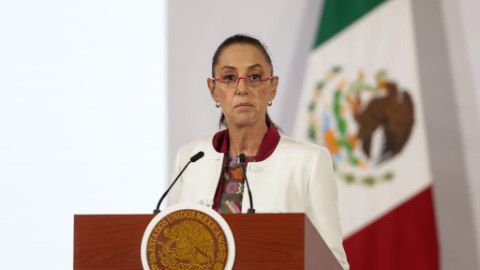
The controversy erupted on January 5, when Sheinbaum publicly addressed Trump's remarks, confirming that the U.S. leader had suggested deploying American troops to target cartel strongholds. Speaking to reporters, Sheinbaum emphasized Mexico's sovereignty, stating that such actions would be viewed as an unacceptable violation of national borders. According to Xinhua reporting, the Mexican president reiterated her administration's commitment to tackling organized crime internally, while dismissing foreign military involvement as counterproductive and inflammatory.
This exchange revives a long-simmering debate over U.S.-Mexico security cooperation, which has intensified under Trump's second term. Trump, who returned to the White House in January 2025, has repeatedly framed Mexican cartels as a national security threat to the United States, linking them directly to the influx of fentanyl and other synthetic opioids that have claimed over 100,000 American lives annually in recent years, per U.S. Centers for Disease Control and Prevention data.
Escalating Rhetoric and Historical Context
Trump's comments align with his longstanding "America First" approach to border security and drug trafficking. During his 2024 campaign and early second presidency, he designated major Mexican cartels—including the Sinaloa and Jalisco New Generation cartels—as foreign terrorist organizations, a move aimed at unlocking broader U.S. counterterrorism tools. In late 2025, Trump escalated rhetoric by floating military options, including drone strikes and special forces raids, echoing proposals from his first term when he reportedly considered invoking the Alien Enemies Act or even the Invading Armies Act against cartels.
Mexico's response has been consistent. Sheinbaum, who assumed office in October 2024 succeeding Andrés Manuel López Obrador, has pursued a "hugs, not bullets" strategy emphasizing social programs and intelligence-led policing over militarization. Her administration has deployed over 30,000 National Guard troops domestically to combat cartels, resulting in thousands of arrests but also criticism for human rights abuses and limited impact on violence levels, which exceeded 30,000 homicides in 2025 according to Mexico's Secretariat of Security and Citizen Protection.
The current spat stems from high-level talks initiated post-Trump's inauguration. U.S. officials have pressed Mexico for aggressive action amid record fentanyl seizures—over 27,000 pounds intercepted at the border in fiscal year 2025 by U.S. Customs and Border Protection. Trump has tied cooperation to trade concessions under the U.S.-Mexico-Canada Agreement (USMCA), threatening tariffs if Mexico does not curb flows. Sheinbaum's rejection, as reported by Xinhua on January 6, frames U.S. intervention as a "non-starter," potentially straining diplomatic ties further.
Broader Geopolitical Implications
This episode occurs against a backdrop of multifaceted U.S.-Mexico interdependence. Mexico is the U.S.'s top trading partner, with bilateral trade surpassing $800 billion in 2025, per U.S. Census Bureau figures. Yet, security challenges persist: Cartels control vast territories in states like Sinaloa, Michoacán, and Guerrero, fueling migration, extortion, and arms smuggling—much of which originates from unchecked U.S. gun sales, as noted in multiple Government Accountability Office reports.
Past precedents highlight risks. The 2019 "Culiacánazo" incident, where Mexican forces released a Sinaloa cartel leader's son after a deadly standoff, exposed government vulnerabilities and prompted U.S. calls for intervention. Bilateral efforts like the Mérida Initiative, launched in 2008 with over $3.5 billion in U.S. aid, have trained thousands of Mexican personnel but yielded mixed results amid corruption scandals.
Mexican officials argue that external military action would exacerbate violence, radicalize communities, and undermine sovereignty—a red line rooted in historical grievances, including the U.S.-Mexico War of 1846-1848, which ceded vast territories north of the Rio Grande.
Outlook for Bilateral Relations
As tensions mount, analysts anticipate intensified diplomatic maneuvering. The U.S. State Department has not commented directly on Trump's suggestion, but Secretary of State Marco Rubio indicated in December 2025 congressional testimony that "all options remain on the table" for addressing the opioid epidemic. Mexico, meanwhile, is bolstering its own operations, with Sheinbaum announcing plans to expand National Guard deployments to 50,000 by mid-2026.
The incident risks broader geopolitical ripple effects, including strained North American integration under USMCA reviews scheduled for 2026. Financial markets reacted mildly, with the Mexican peso dipping 0.5% against the dollar on January 6, per Bloomberg data.
Both nations face imperatives for collaboration: The U.S. needs reduced drug flows, while Mexico seeks economic stability and U.S. support against cartel incursions. Whether through joint task forces or extradition deals—as seen with the 2019 capture of Joaquín "El Chapo" Guzmán—pragmatic partnership may yet prevail over confrontation. For now, Sheinbaum's firm stance signals Mexico's resolve to chart its own path in the war on cartels.
(Word count: 712)