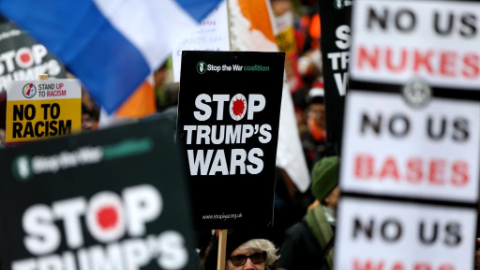

London Protest Erupts Against U.S. Military Action in Venezuela, Signaling International Dissent
London, United Kingdom – Demonstrators gathered in the British capital on Sunday, January 11, 2026, to voice strong opposition to a recent U.S. military attack on Venezuela, underscoring growing public unease with American foreign policy interventions in Latin America. The protest, captured in photographs circulated by global media, highlighted chants, banners, and placards decrying the U.S. actions as aggressive imperialism.
The event unfolded amid heightened geopolitical tensions, with participants assembling in a public space in London to condemn what they described as an unwarranted assault on Venezuelan sovereignty. According to visual documentation from Xinhua, the demonstration featured protesters holding signs and engaging in organized displays of solidarity with Venezuela, reflecting a segment of British civil society's dissent against U.S. military engagements abroad. The protest commenced around 02:39 GMT, classifying as a medium-severity civil unrest incident due to its peaceful nature but vocal anti-U.S. sentiment.
While specific crowd sizes and organizer statements were not detailed in initial reports, the imagery portrays a focused rally typical of London's vibrant protest culture. Participants appeared diverse, including activists, expatriates, and concerned citizens, waving flags and banners that explicitly referenced the U.S. attack. No reports of arrests, violence, or disruptions to public order emerged from the event, aligning with the United Kingdom's tradition of permitting peaceful assemblies under strict policing protocols.
Broader Context of U.S.-Venezuela Tensions
The London protest occurs against the backdrop of longstanding frictions between the United States and Venezuela, exacerbated by years of economic sanctions, diplomatic standoffs, and disputes over the legitimacy of Venezuelan President Nicolás Maduro's government. The U.S. has maintained a policy of "maximum pressure" since 2017, imposing sanctions on Venezuelan oil exports and officials in response to allegations of human rights abuses, electoral fraud, and corruption. Venezuela, in turn, has accused Washington of orchestrating coups and hybrid warfare.
The specific U.S. attack referenced in the protest—details of which remain centered on military strikes—represents a reported escalation. Historical precedents include U.S. support for opposition figures like Juan Guaidó in 2019, drone incidents near the Colombia-Venezuela border, and naval deployments in the region. Britain's own stance has mirrored aspects of U.S. policy; London recognized Guaidó as interim president in 2019 before reverting to engagement with Maduro's administration. Recent UK government statements have emphasized diplomatic solutions to Venezuela's humanitarian crisis, which has displaced over 7.7 million people since 2014, according to United Nations data.
London's role as a hub for international activism amplifies such events. The city has hosted numerous protests against U.S. foreign policy, from massive marches against the 2003 Iraq invasion—drawing up to 1.5 million people—to more recent demonstrations over Gaza and Ukraine. Venezuelan solidarity groups, including the Hands Off Venezuela campaign active since the early 2000s, have organized similar rallies in the UK, often aligning with left-wing networks critical of Western interventionism.
UK Public Sentiment and Civil Unrest Landscape
The demonstration fits into a pattern of medium-level civil unrest in the UK, where protests against global conflicts routinely draw hundreds to thousands without escalating to disorder. In 2025 alone, London saw sustained protests related to Middle East tensions, climate policy, and cost-of-living issues, managed by the Metropolitan Police under the Public Order Act 1986. Data from the UK Home Office indicates that while protest numbers rose 20% post-2024 elections, incidents of violence remained low at under 5% of events.
This Venezuela-focused protest underscores transatlantic divides. A 2023 YouGov poll showed 52% of Britons viewing U.S. foreign policy unfavorably, particularly on military interventions, a sentiment potentially deepened by economic ripple effects. Venezuela's oil sector disruptions from sanctions have indirectly impacted global energy prices, contributing to UK inflation pressures peaking at 11% in late 2022.
Organizers likely drew from networks like the Stop the War Coalition, which has campaigned against U.S.-led actions for two decades. Visuals from the scene depict standard protest iconography: anti-imperialist slogans, Venezuelan flags alongside Palestinian ones, and calls for sovereignty—echoing rhetoric from allied nations like China and Russia, whose state media, including Xinhua, amplified the coverage.
Implications for International Relations
As the first major public reaction in Europe to the U.S. attack, the London protest may signal broader ripple effects. European Union leaders, including UK Foreign Secretary David Lammy in a prior statement, have urged restraint in Latin American conflicts to avoid refugee surges. The event coincides with upcoming NATO summits and G7 meetings, where Venezuela could feature in discussions on hemispheric stability.
No immediate response from UK authorities or the U.S. Embassy in London was reported, but such protests typically prompt routine monitoring rather than policy shifts. With social media amplifying images rapidly—Xinhua's photos garnered thousands of views within hours—the rally contributes to a narrative of global pushback against unilateral U.S. actions.
In summary, the London protest represents a snapshot of civil dissent in a nation with deep U.S. ties, forged through the "special relationship" since World War II. As details of the Venezuela incident unfold, further demonstrations could emerge, testing the balance between free expression and diplomatic harmony. For now, it remains a peaceful medium-severity event in the UK's calendar of global solidarity actions.
(Word count: 728)






