
Jordan Detains Israelis Crossing Border Illegally Amid Ongoing Regional Tensions
Amman, Jordan – Jordanian military forces detained a group of Israelis who crossed the border illegally on January 4, 2026, before handing them over to Israeli Defense Forces (IDF) custody, highlighting persistent frictions along the shared frontier despite a long-standing peace treaty.
The incident, which occurred at an unspecified border point, underscores the volatile security dynamics between Jordan and Israel. According to reports, the individuals were apprehended by Jordanian troops shortly after 3:43 PM GMT on Sunday, January 4. They were held briefly by Jordanian authorities before being returned to IDF control, averting a potential escalation. No injuries or further details on the number of detainees or their motives were immediately disclosed, classifying the event as medium severity in regional security assessments.
This border episode comes against a backdrop of heightened geopolitical strains in the Middle East, particularly linked to the ongoing Gaza conflict. Jordan, which shares a 307-kilometer border with Israel and maintains the last Arab-Israeli peace treaty signed in 1994, has repeatedly voiced concerns over spillover effects from the Israel-Hamas war that began in October 2023. The kingdom hosts over 2 million Palestinian refugees and has positioned itself as a vocal advocate for Palestinian rights, including custodianship over Jerusalem's Al-Aqsa Mosque.
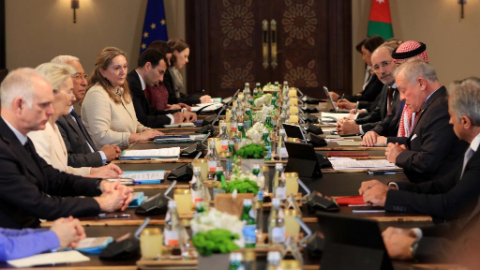
Just days after the border detention, on January 9, Jordan hosted a high-level summit with European Union leaders in Amman, where participants urged increased humanitarian aid to Gaza and renewed commitment to a two-state solution. The gathering, as reported by Xinhua, emphasized the need for immediate ceasefire efforts and sustainable peace mechanisms. Jordanian officials, led by King Abdullah II, have consistently warned of the risks posed by the Gaza crisis to regional stability, including potential unrest along Jordan's borders.
The Jordan-EU summit reflects Amman's broader diplomatic push to internationalize the Palestinian issue. European leaders echoed Jordan's calls for unhindered aid delivery to Gaza, where humanitarian conditions have deteriorated amid Israeli military operations. King Abdullah has previously hosted similar forums, such as the 2024 Washington summit on Gaza aid, reinforcing Jordan's role as a mediator in Arab-Israeli affairs.
Historical Context and Border Dynamics
Jordan and Israel's peace accord, formalized at Wadi Araba in 1994, ended decades of enmity following wars in 1948, 1967, and 1973. The treaty includes security cooperation, water-sharing agreements, and economic ties, with bilateral trade exceeding $1 billion annually in recent years. However, public sentiment in Jordan remains overwhelmingly pro-Palestinian, fueled by economic pressures and the kingdom's demographic makeup, where Palestinians form a significant portion of the population.
Border incidents are not unprecedented. In 2023 and 2024, similar crossings by Israeli activists protesting Gaza policies led to detentions and diplomatic protests. Jordanian authorities have bolstered border patrols, citing smuggling, terrorism risks, and unauthorized entries linked to the West Bank and Gaza tensions. The IDF, in turn, maintains that such events often involve civilians or activists rather than military personnel.
The January 4 detention occurred amid reports of increased Israeli military activity near the border, including exercises in the Negev Desert. Jordan has lodged formal complaints with Israel over airspace violations and water disputes, straining bilateral relations. In November 2023, Jordan intercepted a misfired Israeli missile, prompting airspace closures and mutual recriminations.
Broader Geopolitical Implications
The timing of the border event, just before the Jordan-EU summit, amplifies concerns over escalation. European diplomats at the Amman meeting reiterated support for Jordan's stability, with the EU providing over €200 million in aid to the kingdom since the Gaza war's onset for refugee support and economic buffers.
Analysts note that Jordan's monarchy navigates a delicate balance: cooperating with Israel on security while appeasing domestic calls for stronger action against perceived Israeli aggressions. King Abdullah II has called Gaza a "red line," warning in UN speeches that displacement of Palestinians into Jordan would be unacceptable.
No official statements from Jordanian or Israeli governments detailed the detainees' identities or intent as of January 10, 2026. The IDF confirmed receipt of the individuals without elaborating, while Jordan's military issued a terse statement on enhanced border vigilance.
Outlook
As the Middle East grapples with unresolved Gaza negotiations, incidents like the border detention serve as flashpoints testing the Jordan-Israel peace framework. The Jordan-EU summit's focus on aid and diplomacy signals multilateral efforts to de-escalate, but sustained border calm will depend on progress toward ceasefire and political horizons for Palestinians. Regional observers anticipate continued Jordanian advocacy for a two-state solution, rooted in its strategic position bridging Arab states, Israel, and Western allies.
(Word count: 612)






